
Unit 6: Work and Energy — Notes
6.1 Work
Long Questions
Q1. Define work. Derive its mathematical formula. When does a force do work? (Ex. 6.3, GRW 2017)
WORK
Definition:
“Work is done when force acting on a body displaces it in the direction of a force”.
Mathematically:
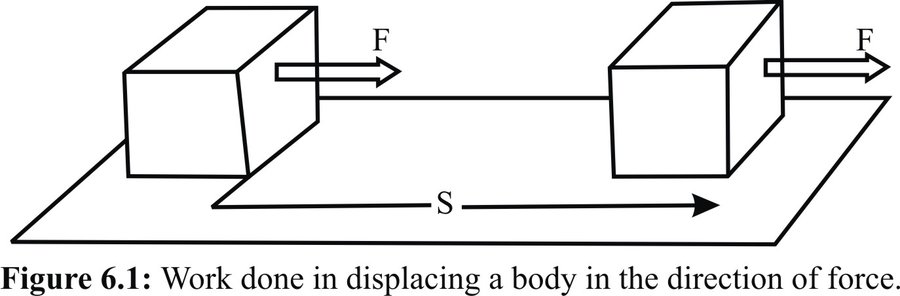
Work is equal to the product of force F and displacement S covered in the direction of force.
Work = Force x Displacement
W = FS
Explanation:
Suppose a force ‘F’ is acting on a body. It makes the body to move from point ‘A’ to ‘B’. If the distance between these two points is ‘S’ then we say that force has done some work as shown in the figure:
If ‘W’ stands for work, ‘F’ for force and ‘S’ for distance.
Then,
Work = Force x Displacement
W = FS
Unit of Work: (LHR 2017)
In System International, its unit is Nm that is also called as joule (J).
Joule:
“The amount of Work done is one joule if a force of one newton displaces a body through one meter in the direction of the force.”
Thus,
1J=1N×1m
Bigger Units:
Joule is a smaller unit of work. Commonly bigger units of work are also in use.
1 kilo joule (kJ) = 1000 J =103J
1 Mega Joule (MJ) =1000000J = 106J
Quantity:
Work is a scalar and derived quantity.
Conditions:
For work, the following two conditions must be fulfilled:
A force should act on a body.
The body should cover some distance under the action of this force.
Work Done on a Body When a Force Makes an Angle:
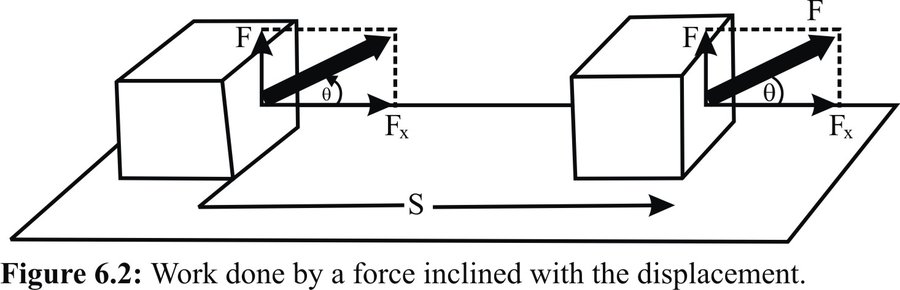
Sometimes force and displacement do not have same direction. Here the force F is making an angle θ with the surface on which the body is moved. Resolving F into its perpendicular components ‘Fx’ and ‘Fy’ as shown in the figure:
Fx = F cos θ
Fy = F Sin θ
In case when force and displacement are not parallel then x-component Fx parallel to the surface causes the body to move on the surface and not y-component Fy.
Hence W = Fx S
W = (Fcos θ) S
W = FS cos θ
Dependence:
Work depends upon following factors:
Force: Greater the force greater will be the work done.
Displacement of The Body: Greater the distance covered in the direction of the force greater will be the work done on the body.
Angle: Work done also depends upon angle between force and displacement covered by the body.
Short Questions
Q1. Write conditions for work to be done.
CONDITIONS FOR WORK
Following are the conditions for work to be done:
A force should act on a body.
The body should cover some distance under the action of this force.
Work also depends on angle between applied force and displacement covered by the body. For work to be done both applied force and displacement covered should not be perpendicular to each other.
Q2. How much work is done when a body moves with uniform velocity?
UNIFORM VELOCITY AND WORK DONE
When a body moves with uniform velocity means moving with zero acceleration then work done will be zero because according to Newton’s second law of motion if a = 0 then the net resultant force acting on the body is zero.
As we know that W = FS
If F = 0 then W = 0 x S = 0
Q3. Write some conditions for the work done will be zero
ZERO WORK DONE
We know,
W = FS
W = FS cos θ
These equations show that the work done on a body will be zero if:
No net force will act on the body
As
W = FS
W = (0) S = 0
Body will not cover any distance under the action of a force
As
W = FS
W= F (0) = 0
If applied force and distance covered by the body are perpendicular to each other
W = FS cos θ
If force and displacement are perpendicular then θ = 90° so
W= FScos900
cos900 =0
So, W= FS(0) = 0
Q4. Write some conditions for the work done to be maximum.
MAXIMUM WORK DONE
We know,
W = FS
W = FS cos θ
These equations show that the work done on a body will be maximum if:
The force acting on the body will be maximum
Body covers maximum displacement under the action of maximum applied force.
Applied force and displacement covered by the body are parallel to each other as:
W = FS cos θ
If force and displacement are parallel then θ = 0° so
W= FScos00
cos00 =1
So W= FS(1)
W = FS ——–( Indicates maximum work done)
Q5. Can a work done be negative?
NEGATIVE WORK
Yes work done on the body will be negative if applied force and displacement covered by the body are anti-parallel to each other as:
W = FS cos θ
If force and displacement are anti-parallel then θ =180° so
W= FScos00
cos1800 =-1
So
W= FS (-1)
W = -FS ——–( Indicates negative work done)
A crate is moved by pulling the rope attached to it. It moves 10m on a straight horizontal road by a force of 100 N. How much work will be done if:
(Mini Exercise Pg. # 120)
The rope is parallel to the road:
Ans. As we know that W = FS cos.
If the rope is parallel to the road then = 0.
So
W = 100 x 10 x cos0
= 100 x 10 x 1 (as cos0 = 1)
= 1000 J
The rope is making angle of 30o with road:
Ans. As we know that W = FS cos.
If the rope is parallel to the road then = 30o.
So
W = 100 x 10 x cos30o
= 100 x 10 x 0.866 (as cos0 = 0.866)
= 866 J
Result:
EXAMPLES 6.1
Q6. A girl carries a 10 kg bag upstairs to a height of 18 steps, each 20 cm high. Calculate the amount of work she has done to carry the bag. (Take g =10 ms-2).
Given Data:
Mass of the bag = m = 10 kg
No of steps = n = 18
Height of each step = h1= 20 cm = 0.2 m
To Find:
Work done by the girl to carry the bag = W =?
Calculations:
As we know
W = FS
First we find force F = weight = mg
F = (10)(10) = 100 N
Total distance covered by the girl = S = no of steps x height of each step
S= 18 x 0.2 = 3.6m
Now W = FS
Putting values
W = 100(3.6) = 360 J
Result:
6.2 Energy
6.3 Kinetic Energy
6.4 Potential Energy
Long Questions
Q1. Define kinetic energy and derive its relation. (Ex. 6.6, LHR 2011, 12, GRW 2011)
KINETIC ENERGY
Definition:
“The energy possessed by a body due to its motion is called kinetic energy”
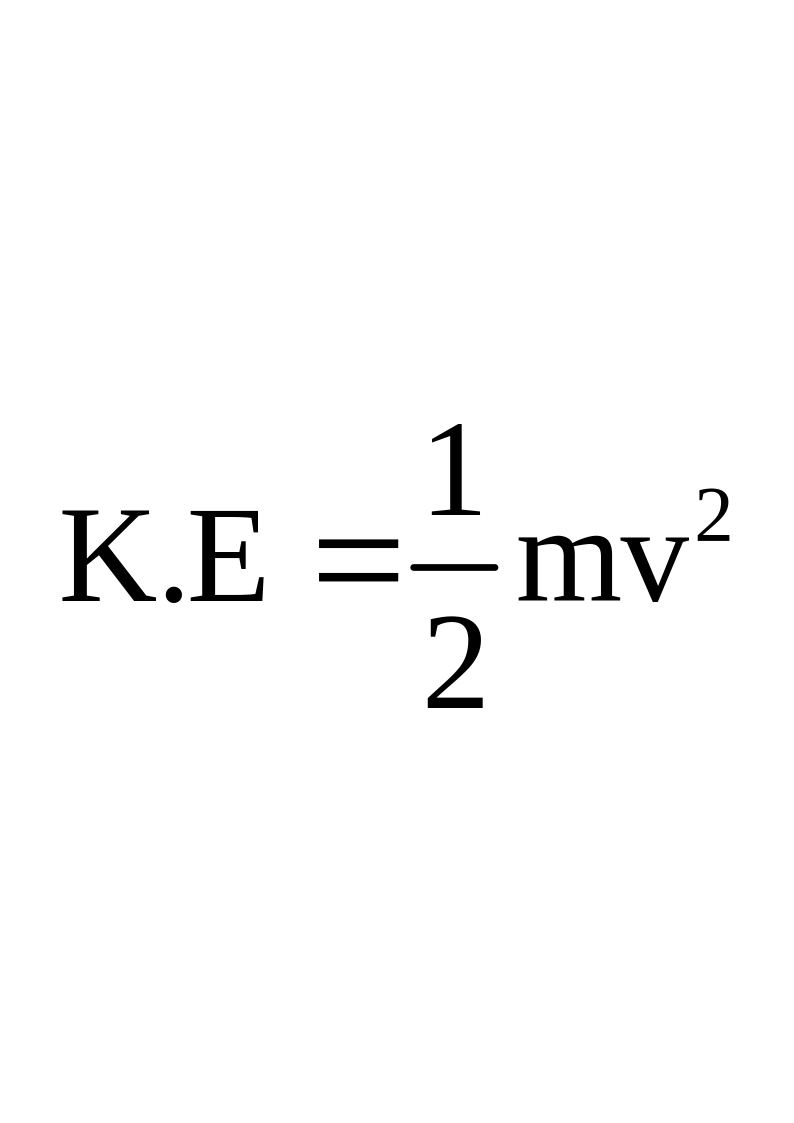
Formula:
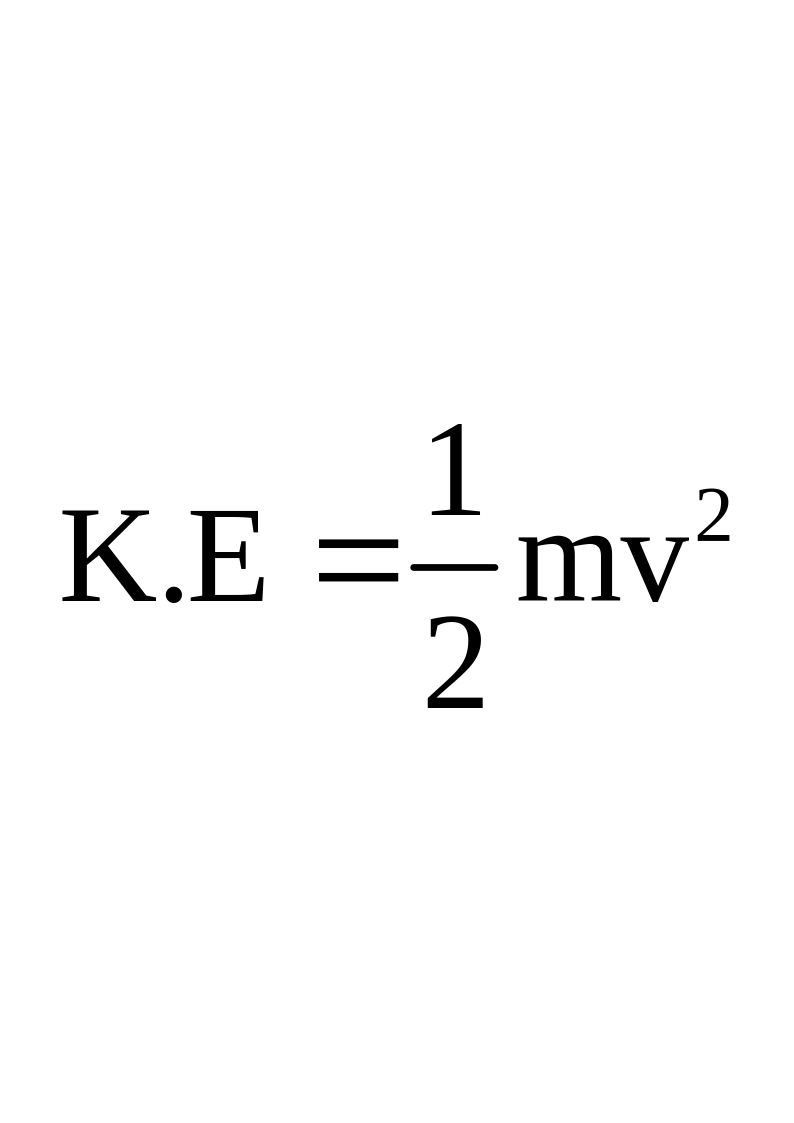
It is denoted by K.E. and its formula is given below:
Examples:
Following are important examples of Kinetic energy.
Moving air is called wind. Wind has kinetic energy. We can use wind energy for doing various things. It drives windmills and pushes sailing boats.
Moving water in a river has kinetic energy that can carry wooden logs through large distances and can also be used to drive turbines for generating electricity.
Mathematical Derivation:
Let a body of mass m is moving with velocity v. An opposing force F such as force of friction acting through a distance S brings it to rest. The body possesses kinetic energy and is capable to do work against opposing force F until all of its kinetic energy used up.
K.E of the body = Work done by it due to motion
K.E = FS
vi = v
vf = 0
As F = ma
a = – F/m
Since motion is opposed, hence, acceleration “a” is negative.
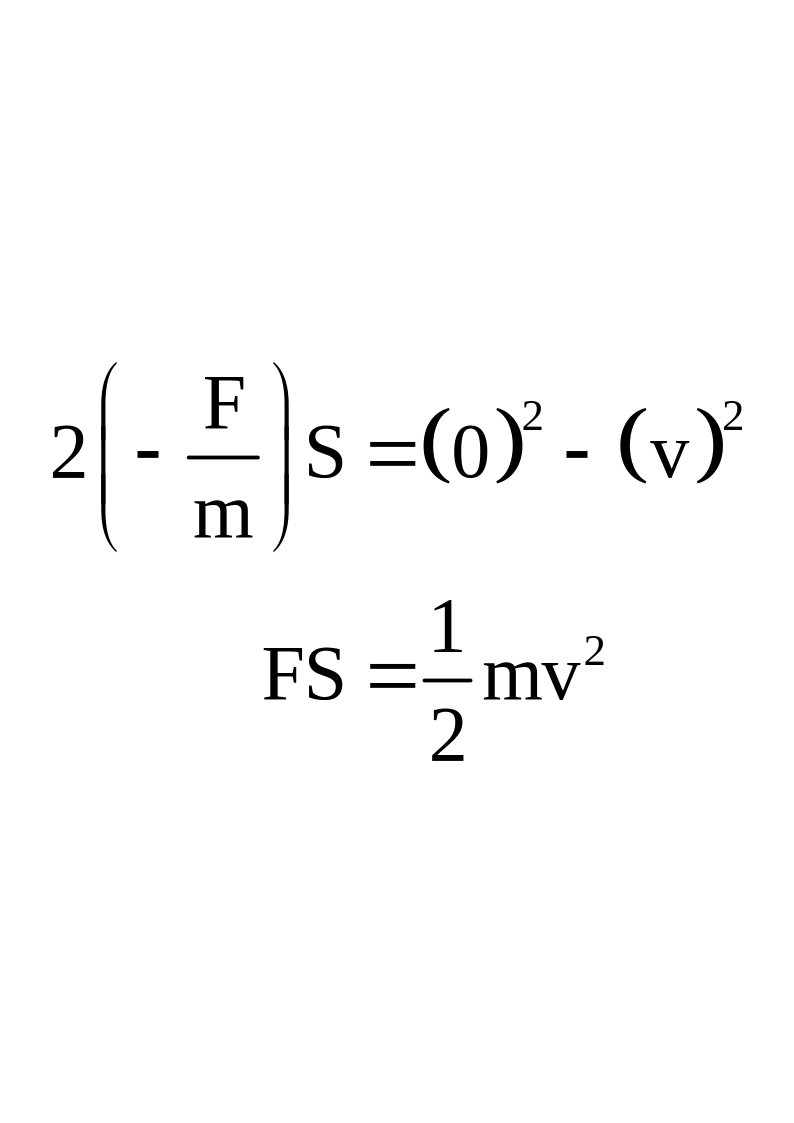
Using 3rd equation of motion:
2 a S = vf2 – vi2
As we know that K.E is equal to the work done,
So,
The above equation gives the K.E. possessed by a body of mass m moving with velocity v.
Conclusion:
Q2. Define Potential Energy and derive its relation. (Ex. 6.7)
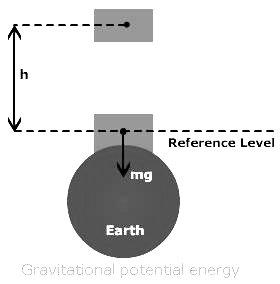
POTENTIAL ENERGY
Definition:
“The energy possessed by a body due to its position is known as potential energy.”
Formula:
Potential energy is denoted by P.E. and its formula is given below:
P.E. = m g h
Examples:
Following are important examples of Potential energy.
Energy stored in water in dam at certain height.
Energy possessed in raised hammer.
An apple on a tree is capable to do work as it falls thus it possess energy due to its position that is Potential energy.
Types of Potential Energy:
Elastic Potential Energy:
Potential energy due to elasticity of material is called elastic potential energy. Stretched bow and stretched catapult has elastic potential energy in it.
Gravitational Potential Energy:
The potential energy of a body due to its specific height from the surface of the earth is called its gravitational potential energy.
Mathematical Derivation:
Let a body of mass m be raised up through height h from the ground. The body will acquire potential energy equal to the work done in lifting it to height h as shown in the figure:
Thus, Potential Energy = F x h
= w x h
As we know that weight of the body = w = mg
So P.E. = w h = m g h
Conclusion:
Short Questions
Q1. Define Energy and write down its unit. (LHR 2012, GRW 2013)
ENERGY
Definition:
“A body possesses energy if it is capable to do work”.
OR
Ability of a body to do work is known as energy.
Quantity:
It is a scalar quantity
Unit:
Joule (Nm) is the unit of energy same as that of work.
Types of Energy:
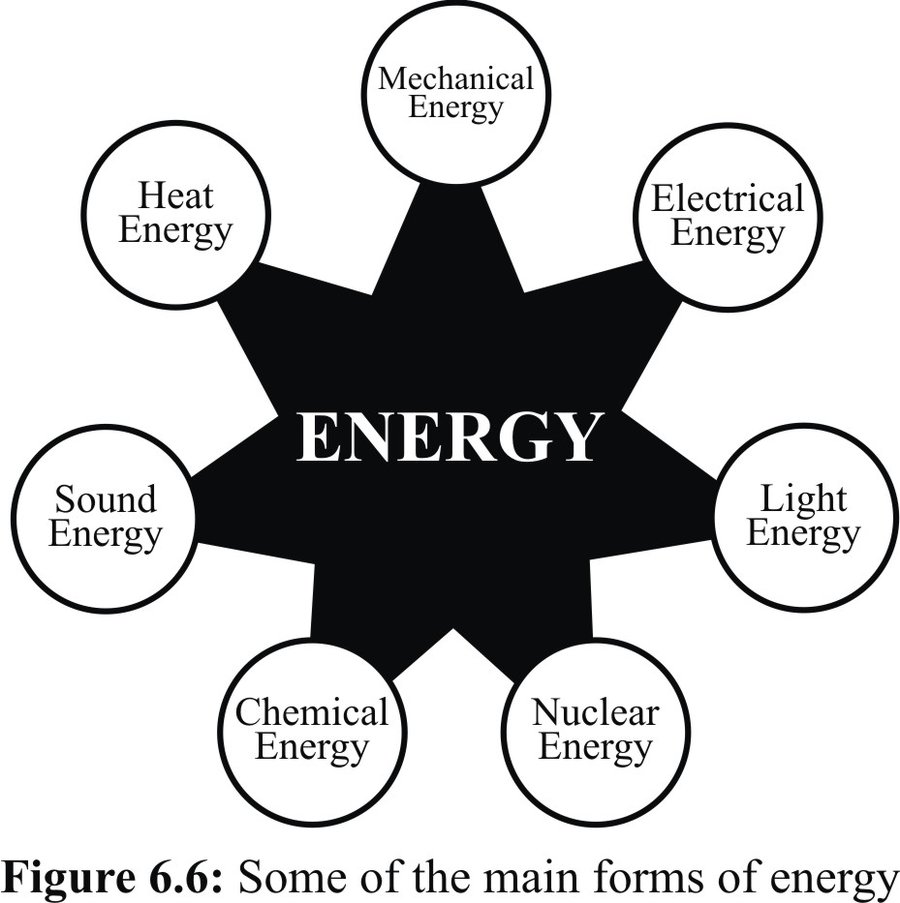
Energy exists in various forms such as mechanical energy, heat energy, light energy, sound energy, electrical energy, chemical energy and nuclear energy etc.
Example:
Water running down the stream has Kinetic energy in it.
Q2. Define Elastic Potential Energy.
ELASTIC POTENTIAL ENERGY
Definition:
“Potential energy of a body due to elasticity of material is called elastic potential energy”.
Examples:
Energy in stretched bow and stretched catapult is elastic potential energy.
Q3. Define Gravitational Potential Energy.
GRAVITATIONAL POTENTIAL ENERGY
Definition:
“The potential energy of a body due to its specific height from the surface of the earth is called its gravitational potential energy”.
Examples:
Energy in a ball placed at height “h” from the surface of the earth.
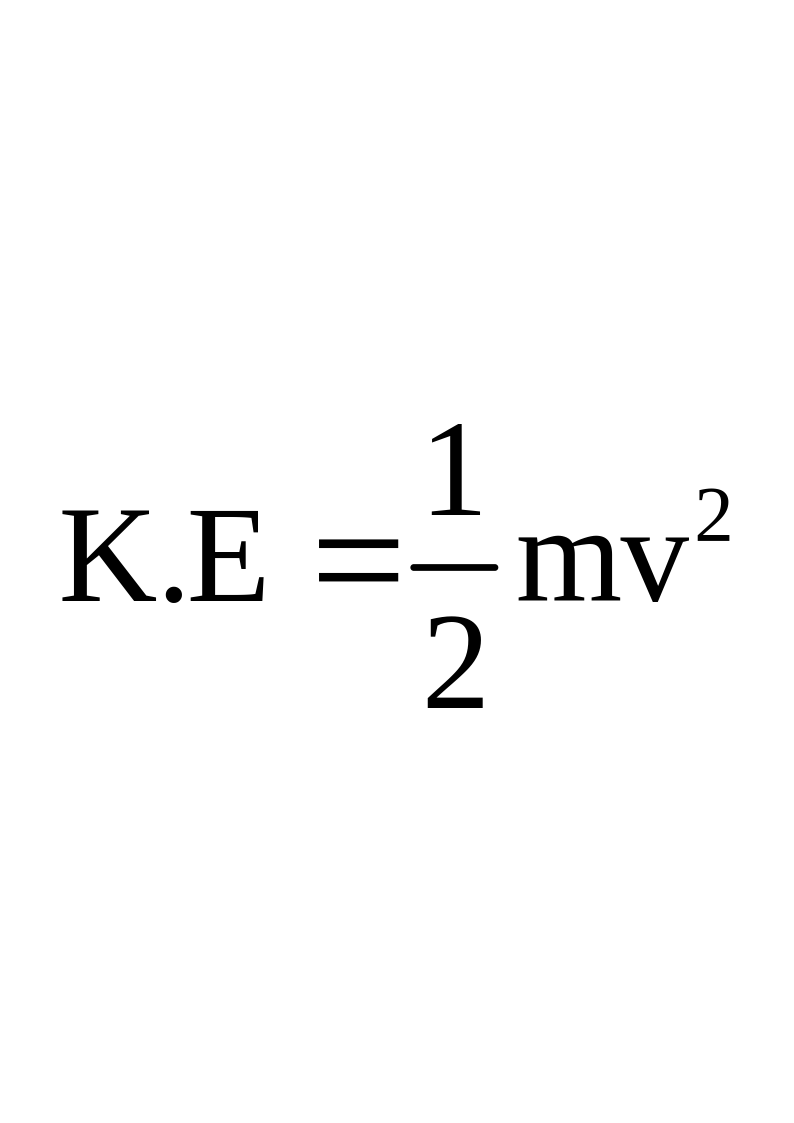
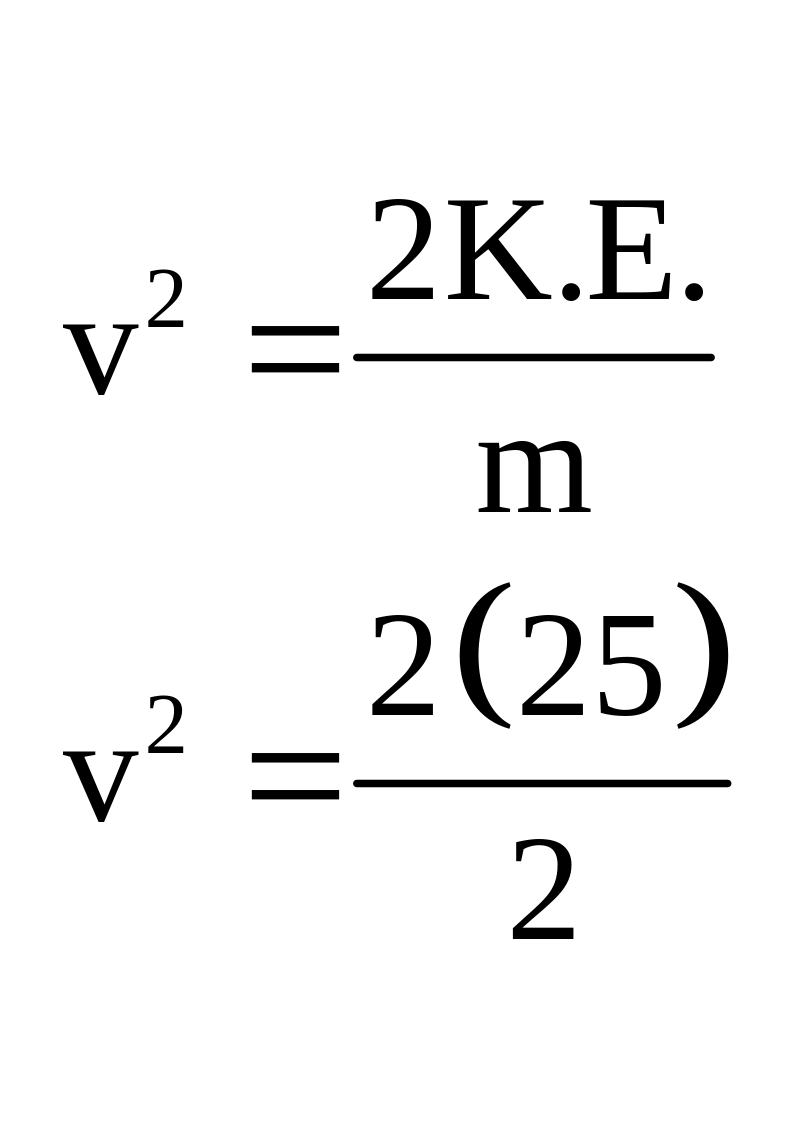
Q4. The kinetic energy of a body of mass 2 kg is 25 J. What will be its speed?
Given Data:
Kinetic energy of the body =K.E. = 25J
Mass of the body = m = 2kg
To Find:
Speed of the body= v =?
Calculations:
We know
and
2 K.E.= mv2
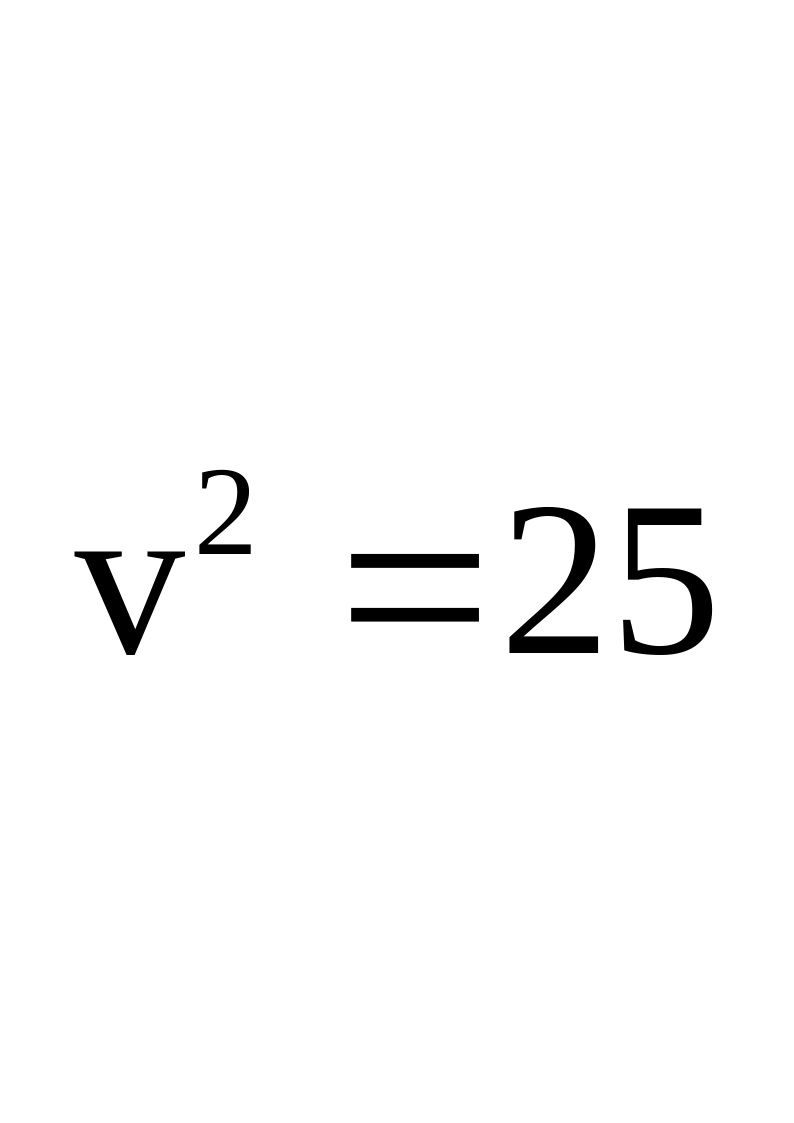
Taking square root on both sides we get
v = 5ms-1
Result:
EXAMPLE 6.2
Q5. A stone of mass 500 g strikes the ground with a velocity of 20ms-1. How much is the kinetic energy of the stone at the time it strikes the ground?
Given Data:
Mass of the stone = m = 500g = 0.5kg
Velocity with which the stone strikes with ground = v = 20ms-1
To Find:
Kinetic energy of the stone = K.E. = ?
Calculations:
We know,
Putting values,
K.E =½ (0.5) (20)2
K.E = 100J
Result:
EXAMPLE 6.3
Q6. A body of mass 50 kg is raised to a height of 3 m. What is its potential energy? (LHR 2017)
Given Data:
Mass of the body = m = 50 kg
Height of the body = h = 3m
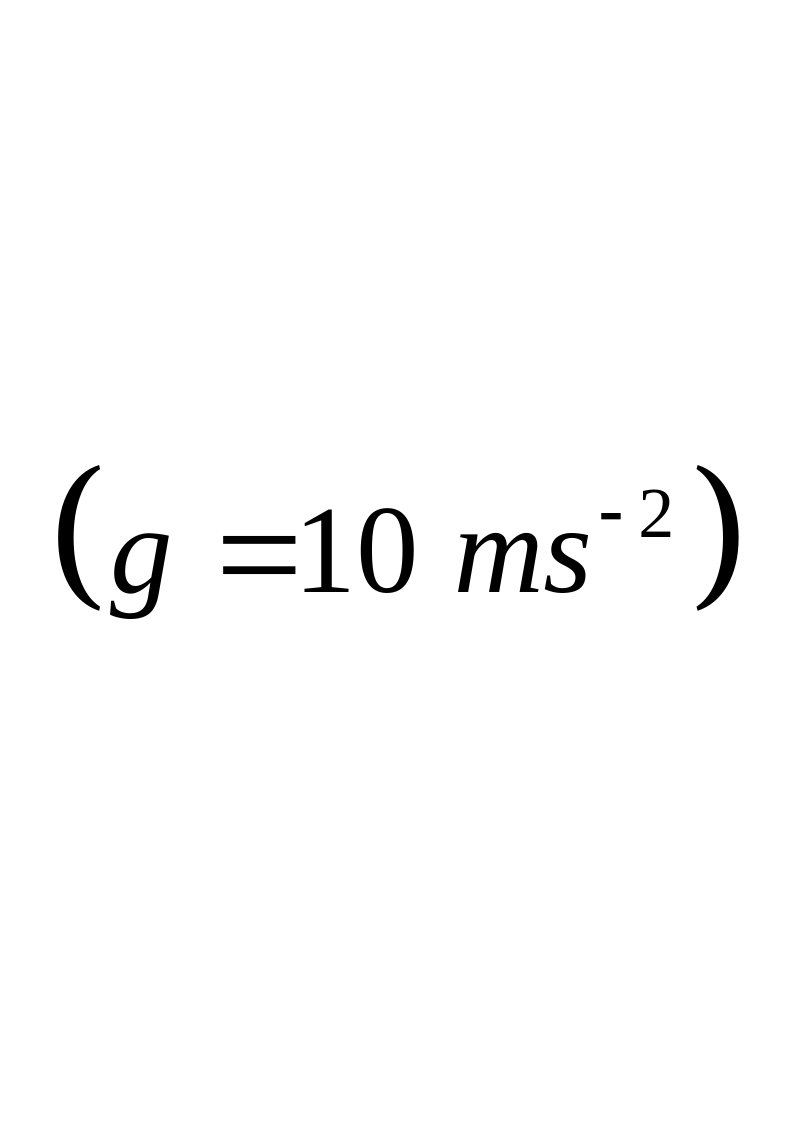
Gravitational acceleration = g = 10ms-2
To Find:
Potential energy of the body=P.E. = ?
Calculations:
We know
P.E. =mgh
Putting values
P.E.= (50)(10)(3)
P.E. = 1500 J
Result:
EXAMPLE 6.4
Q7. A force of 200 N acts on a body of mass 20 kg. The force accelerates the body from rest until it attains a velocity of 50 ms-1. Through what distance the force acts?
Given Data:
Force acting on the body = F= 200N
Mass of the body = m = 20kg
Velocity of the body = v = 50ms-1
To Find:
Distance through which the force acts = S=?
Calculations:
In this case the work done on the body will be equal to its K.E. as
Work done on the body = K.E. gained by the body
F.S = ½ m v2
Putting values
(200) S = ½ (20)(50)2
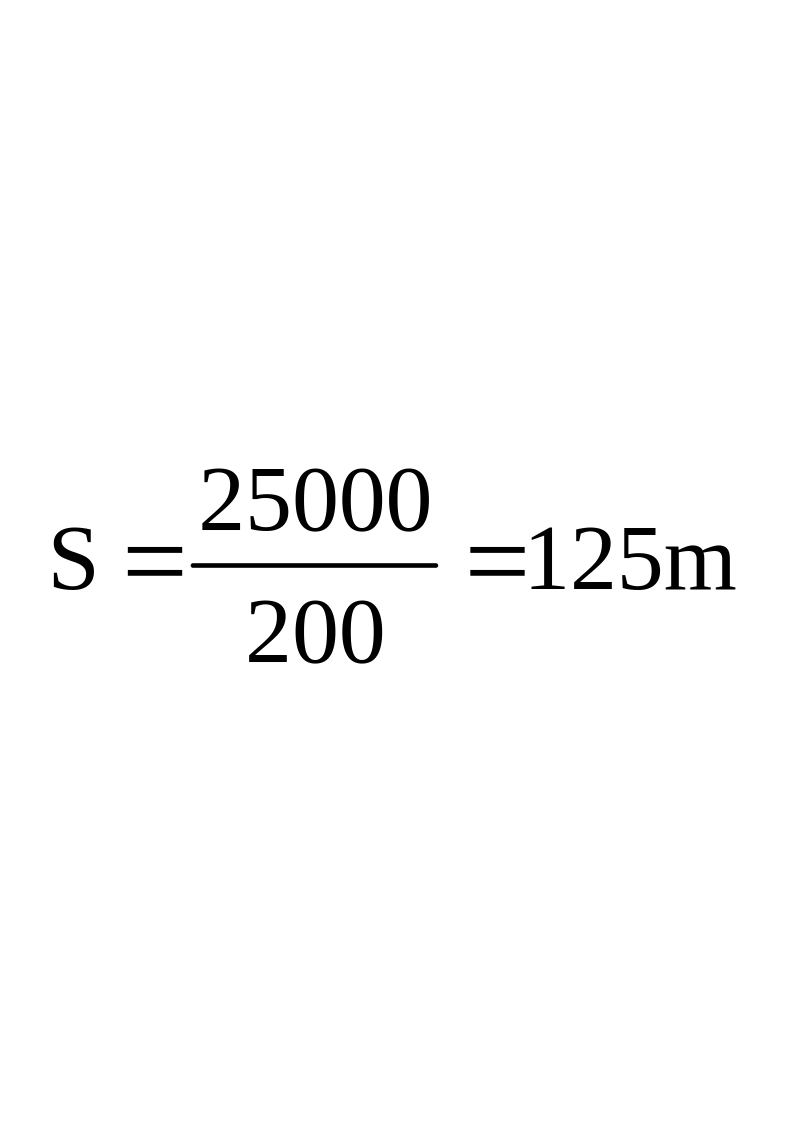
(200)S = 25000
Result:
6.5 Forms Of Energy
6.5.1 Interconversion Of Energy
Long Questions
Q1. Explain different Forms of Energy.
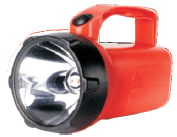

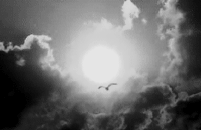

FORMS OF ENERGY
Energy exists in various forms. Some of the main forms of energy are explained below:
1) Mechanical Energy:
“The energy possessed by a body both due to its motion or position is called mechanical energy”.
Examples:
Following possess mechanical energy:
Water running down a stream
Wind
A moving car
A lifted hammer
A stretched bow
A catapult or a compressed spring
Types of Mechanical Energy:
Mechanical energy possessed by a body is of two types:
Kinetic Energy
Potential Energy
2) Heat Energy:
Heat is a form of energy given out by hot bodies. Large amount of heat is obtained by burning fuel. Heat is also produced when motion is opposed by frictional forces. The foods we take provide us heat energy. The Sun is the main source of heat energy.
3) Electrical Energy: (GRW 2015)
Electricity is one of the widely used forms of energy. Electrical energy can be supplied easily to any desired place through wires.
Sources:
We get electrical energy from batteries and electrical generators. These electric generators are run by hydro power, thermal or nuclear power.
4) Sound Energy: (GRW 2015)
Sound is a form of energy. It is produced when a body vibrates.
Examples:
Sound is produced by:
By knocking at the door
By vibrating diaphragm of a drum
By vibrating strings of a sitar
By vibrating air column of wind instruments as flute pipe
5) Light Energy:
Light is an important form of energy. Plants produce food in the presence of light. We also need light to see things.
Sources:
We get light from candles, electric bulbs, and fluorescent tubes and also by burning fuel. However, most of the light comes from the Sun.
6) Chemical Energy:
Chemical energy is present in food, fuels and in other substances. We get other forms energy these substances during chemical reactions.
Examples:
The burning of food, coal or natural gas in air is a chemical reaction which releases energy as heat and light.
Electric energy is obtained from electric cells and batteries as a result of chemical substances present in them.
Animals get heat and muscular energy from the food they eat.
7) Nuclear Energy:
Nuclear energy is the energy released in the form of nuclear radiations in addition to heat and light during nuclear reactions such as fission and fusion reactions. Heat energy released in nuclear reactors is converted into electrical energy. A nuclear power plant uses the energy released in nuclear reactor such as Fission to generate electric power.
Usually we carried fission and fusion reactions in nuclear reactors.
In fission reaction a heavy nuclei splits into smaller nuclei with the emission of large amount of nuclear energy
In fusion reaction small nuclei combine to form a heavy nucleus with the emission of tremendous amount of nuclear energy. This reaction is taking place in the Sun.
Biggest Source of Energy:
The energy coming from the Sun for the last billions of years is the result of nuclear reactions taking place on the Sun. Sun is the biggest source of energy.
Q2. Explain inter conversion of Energy. OR Explain inter-conversion of energy
INTER CONSERSION OF ENERGY
Introduction:
In order to explain conversion of energy from one form to another form a law has been presented that is called law of conservation of energy.
According to law of conservation of energy:
“During the inter conversion of energy from one form to other forms, the total energy at any time remains constant.”
Energy cannot be destroyed however it can be converted into some other forms.
Example:
Rub your hands together quickly. You will feel them warm. You have used your muscular energy in rubbing hands as a result heat is produced. In the process of rubbing hands, mechanical energy is converted into heat energy.
Explanation:
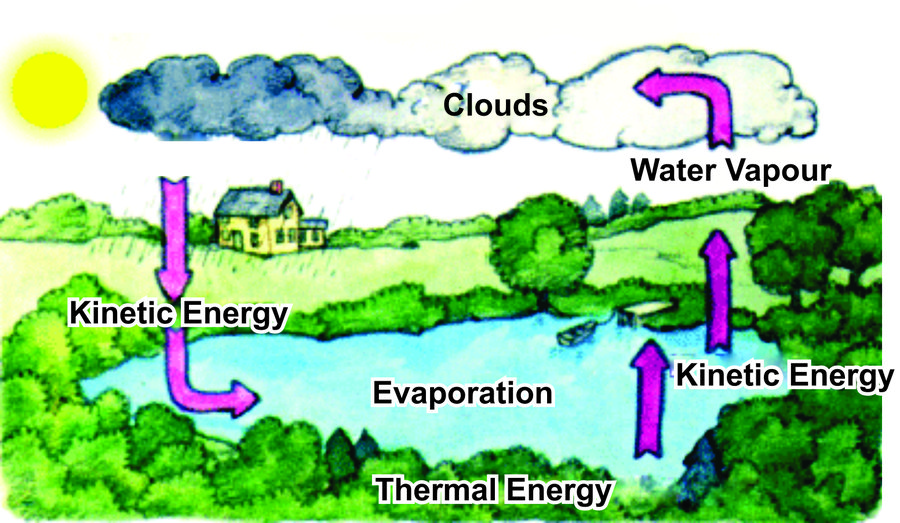
Processes in nature are the results of energy changes. For example, some of the heat energy form the Sun is taken up by water in the oceans. This increases the thermal energy. Thermal energy causes water to evaporate from the surface to form water vapors. These vapors rise and form clouds. As they cool down, they form water drops and fall down as rain. Potential energy changes to kinetic energy as the rain falls. This rain water may reach a lake or a dam. As the rain water flows down, its kinetic energy changes into thermal energy while parts of the kinetic energy flowing water is used to wash away soil particles of rocks known as soil erosion.
Conclusion:
Short Questions
Q1. Define Mechanical Energy, Write its types. (LHR 2017)
MECHANICAL ENERGY
Definition:
“The energy possessed by a body due to its motion or position is called mechanical energy”.
Examples:
Water running down a stream
A moving car
A lifted hammer
A stretched bow
A catapult or a compressed spring
Types of Mechanical Energy:
Mechanical energy possessed by a body is of two types:
Kinetic Energy:
“The energy possessed by a body due to its motion is called kinetic energy”.
Formula:
It is denoted by K.E. and its formula is given below:
K.E. = ½ m v2
Potential Energy:
“The energy possessed by a body due to its position is known as potential energy”.
Formula:
Potential energy is denoted by P.E. and its formula is given below:
P.E. = m g h
Q2. Give some examples of energies used in our body?
ENERGIES USED IN DAILY LIFE
There are many kinds of energies are used in our body. Some of them are given below:
Mechanical Energy:
For the moving of our body.
Chemical Energy:
For making body molecules.
Electrical Energy:
For the propagation of electrical signals in the body.
Heat Energy:
For maintaining the body temperature
Q3. State law of conservation of energy.
LAW OF CONSERVATION OF ENERGY
Statement:
According to law of conservation of energy:
“During the inter conversion of energy from one form to other forms, the total energy at any time remains constant.”
Example:
Rub your hands together quickly. You will feel them warm. You have used your muscular energy in rubbing hands as a result heat is produced. In the process of rubbing hands, mechanical energy is converted into heat energy.
Q4. Write about chemical energy and its sources.
CHEMICAL ENERGY
Chemical energy is present in food, fuels and in other substances. We get other forms energy these substances during chemical reactions.
Sources:
The sources of chemical energy are as follows:
The burning of food, coal or natural gas in air is a chemical reaction which releases energy as heat and light.
Electric energy is obtained from electric cells and batteries as a result of chemical substances present in them.
Animals get heat and muscular energy from the food they eat.
Q5. With the help of a figure just show inter-conversion of Kinetic and Potential energy.
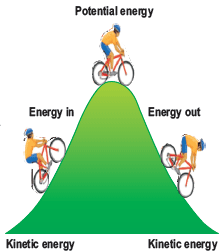
INTERCONVERSION OF ENERGY
Inter-conversion of Kinetic energy and Potential energy is shown below:
6.7 Major Sources Of Energy
Long Questions
Q1. Explain some non-renewable sources of Energy.
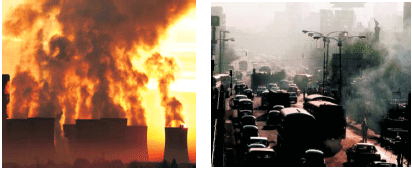
NONRENEWABLE SOURCES OF ENERGY
Definition:
“The sources of energy that take billions of years to reproduce and have chances to run-out in future are called non-renewable energy sources”.
Some nonrenewable sources of energy are given below:
1) Fossil Fuels:
We use fossil fuels such as coal, oil and gas to heat our houses and run industry and transport. They are usually hydrocarbons (compounds of carbon and hydrogen).
Chemical Reaction:
When they are burnt, they combine with oxygen from air. The carbon becomes carbon dioxide; hydrogen becomes hydrogen oxide called water; while energy is released as heat. In case of coal;
Carbon + Oxygen carbon dioxide + heat energy
Hydrocarbon + Oxygen carbon dioxide + water + heat energy
Fossil Fuels are Non-renewable:
The fossil fuels took millions of years for their formation. They are known as non-renewable resources. We are using fossil fuels at a very fast rate. Their use is increasing day by day to meet our energy needs. If we continue to use them at present rate, they will soon be exhausted. Once their supply is exhausted, the world would face serious energy crises.
Future Crises of Energy:
Thus, fossil fuels would not be able to meet our future energy needs. This would cause serious social and economical problems for countries like us. Therefore, we must use them wisely and at the same time, develop new energy sources for our future survival.
Harmful Effects Produced By Burning Fossil Fuels: (LHR 2017)
Moreover, fossil fuels release harmful waste products. These wastes include carbon mono-oxide and other harmful gases, which pollute environment. This causes serious health problems such as headache, tension, nausea, allergic reactions, and irritation of eyes, nose and throat. Long exposure of these harmful gases may cause asthma, lungs cancer, heart diseases and even damage to brain, nerves and other organs of our body.
2) Nuclear Fuels:
In nuclear power plants, we get energy as a result of fission reactions. During fission reaction, heavy atoms, such as uranium atoms, split up into smaller parts releasing a large amount of energy. Nuclear power plants give out a lot of nuclear radiations and vast amount of heat. A part of this heat is used to run power plants while lot of heat goes waste into the environment.
Q2. Explain some renewable sources of energy.
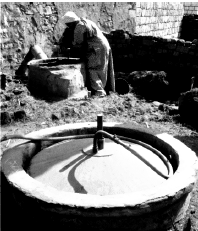
RENEWABLE SOURCES OF ENERGY
Definition:
“The sources of energy that reproduce quickly and do not have chances to run-out in future are called renewable energy sources.”
Example:
Sun light and water power are the renewable sources of energy. The will not run out like coal, oil and gas.
Sources of Renewable Energy:
Some renewable sources of energy are given below:
Energy Form Water:
Energy from water power is very cheap. Dams are being constructed at suitable locations in different parts of the world. Dams serve many purposes. They help to control floods by storing water. The water stored in dams is used for irrigation and also to generate electric energy without creating much environmental problems. Energy stored in the water of dams is used to run power plants.
2) Energy From Sun:
Solar energy is the energy coming from the sun and is used directly and indirectly. Sunlight does not pollute the environment in any way. The sunrays are the ultimate source of life on the Earth. We are dependent on the Sun for all our food and fuels. If we find a suitable method to use a fraction of the solar energy reaching the Earth, then it would be enough to fulfill our energy requirements.
Solar energy is most preferred form of energy due to following reasons:
It is easily available and it is the most cheapest form of energy
It can easily be converted into other forms of energy
It is pollution free form of energy.
Wind Energy:
Wind has been used as a source of energy for centuries. It has powered sailing ships across the oceans. It has been used by wind mills to grind grain and pump water.
Wind Turbines:
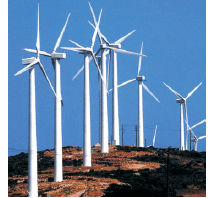
More recently, wind power is used to turn wind turbines. When many wind machines are grouped together on wind farms, they can generate enough power to operate a power plant. In the United States, some wind farms generate more than 1300 MW of electricity a day. In Europe, many wind farms routinely generate hundred megawatts or more electricity a day.
Geothermal Energy: (GRW 2017)
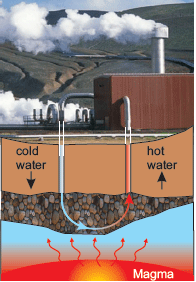
In some parts of the world, the earth provides us hot water from geysers and hot springs. There is hot molten part, deep in the Earth called magma. Water reaching close to the magma changes to steam due to high temperature of magma. This energy is called geothermal energy.
Electricity From Geothermal Energy:
Geothermal well can be built by drilling deep near hot rocks at places, where magma is not very deep. Water is then pushed down into the well. The rocks quickly heat the water and change it into steam. It expands and moves up to the surface. The steam can be pipes directly into houses and offices for heating purposes or it can be used to generate electricity.
5) Energy From Biomass: (GRW 2015, 2017)
Biomass is plant or wastes that can be burnt as fuel. Other forms of biomass are garbage, farm wastes, sugarcane and other plants. These wastes are used to run power plants. Many industries that use of forest products get half of their electricity by burning bark and other wood wastes. Biomass can serve as another energy source, but problems are there in its use.
Electricity From Biomass:
When animal dung, dead plants are dead animals decompose, they give off a mixture of methane and carbon dioxide. Electricity can be generated by burning methane.
Q3. What is solar house heating system? Write its construction and working. (LHR 2014)
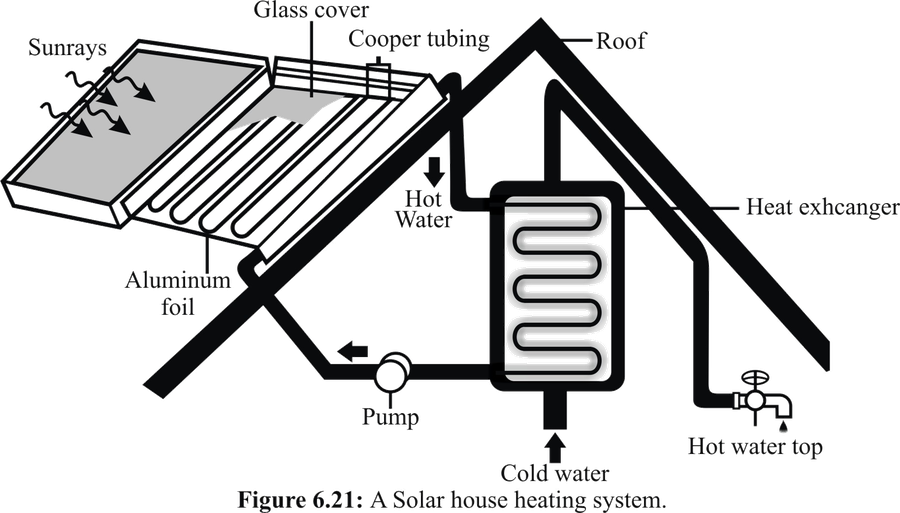
SOLAR HOUSE HEATING SYSTEM
Introduction:
The use of solar energy is not new. However, it’s use in houses and offices as well as for commercial industrial purposes is quite recent. Complete solar house heating system are successfully used in area with a minimum amount of sunshine in winter.
Construction:
A house heating system consists of:
A collector
A storage device
A distribution system
Working:
The above figure shows a solar collector made of glass panels over blank metal plates. The plates absorb the sun energy which heats a liquid flowing in the pipes at the back of the collector. The hot water can be used for cooking, washing and heating the buildings.
Solar energy collected through this system is used in solar cookers, solar distillation plants, and solar power plants.
Q4. What are solar cells and solar panels? Write their use.
SOLAR CELLS AND SOLAR PANELS
Solar Cell:
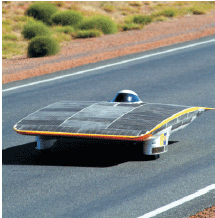
Solar energy can also be converted directly into electricity by solar cells. A solar cell also called photo cell is made from silicon wafer. When sunlight falls on the solar cell, it converts the light directly into electrical energy.
Use:
Solar cells are used in calculators, watches and toys.
Solar Panels:
Large number of solar cells are wired together to form a solar panel.
Uses:
Solar panels can provide power to telephone booths, light houses and scientific research centers.
Solar panels are also used to power satellites.
Several other methods to trap sunrays are under way. If scientists could find an efficient and inexpensive method to use solar energy, then the people would get clean, limitless energy as long as the Sun continues to shine.
Q5. Explain Mass – Energy Equation. (GRW 2015)
MASS ENERGY EQUATION
Einstein predicted the Inter-conversion of matter and energy. According to him, a loss in the mass of a body provides us a lot of energy. This happens in nuclear reactions.
Equation:
The relation between mass m and energy E is given by Einstein mass – energy equation.
E = m c2
Here c is the speed of light (3 x 10⁸ ms-1). The above equation shows that tremendous amount of energy can be obtained from small quantity of matter. It appears that matter is highly concentrated form of energy.
Energy on Sun and Stars:
This process of getting energy from our nuclear power plants is based on the above equation. This process is taking place on the sun and stars for the last millions of years. Only a very small fraction of the sun energy reaches the earth. This very small fraction of the sun energy is responsible for life on the earth.
Q6. Explain the electricity from fossil fuels with block diagram.
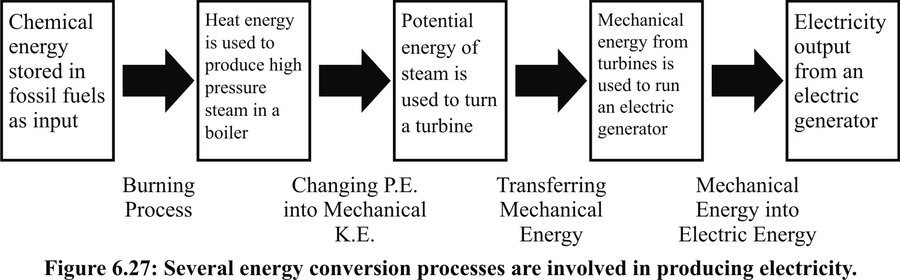
ELECTRICITY FROM FOSSIL FUELS
We are using electricity in houses, offices, schools, business centers, factories and in farms. We have different ways of generating electricity. Most of the electricity is obtained using fossil fuels such as oil, gas and coal. Fossil fuels are burnt in thermal power stations to produce electricity. Various energy conversion process involved in producing electricity from coal are described in Block diagram.
Q7. Explain the effect of consumption of Energy on Environment.
ENERGY AND ENVIRONMENT
Environmental problems such as pollution that consists of noise, air pollution and water pollution may arise by using different sources of energy such as fossil fuels and nuclear energy.
Pollution:
“Pollution is the change in the quality of environment that can be harmful and unpleasant for living things.”
Pollutants:
All things, chemicals or substances that cause pollution in our environment are called Pollutants e.g. Co2 and So2 are air pollutants.
Thermal Pollution:
A temperature rise in the environment that disturbs life is called thermal pollution. Thermal pollution upsets the balance of life and endangers the survival of many species.
Air Pollution:
Air pollutants are unwanted and harmful. Natural processes such as volcanic eruptions, forest fires and dust storms add pollutant to the air. These pollutant, rarely build up to harmful levels. On the other hand, the burning of fuel and solid wastes in homes automobiles, and factories releases harmful amount of air pollutants.
Nuclear Pollution:
All power plants produce waste heat, but fission plants produce the most. The heat released into a lake, a river or an ocean upsets the balance of life in them. Unlike other power plants, nuclear power plants do not produce carbon dioxide. But they produce dangerous radioactive waste.
Q8. How can we control environmental pollution?
CONTROLLING POLLUTION
It is not easy to control environmental pollution; however mutual efforts can reduce its rate as:
Government Laws:
In many countries, governments have passes laws to control air pollution. Some of these laws limit the amount of pollution level that, power plants, factories and automobiles are allowed to give off. To meet these conditions for automobiles, new cars have catalytic converters these devices convert some polluting gases. The use of lead free petrol has greatly reduced the amount of lead in air. Engineers are working to improve new kinds of cars that use electricity or energy sources other than petrol and diesel.
Individual Efforts:
Many individual communities have laws which protect their areas from pollution. Individuals can help to control air pollutions simply by reducing the use of cars and other machines that burnt fuel. Sharing rides and using public transportation are the ways to reduce the number of automobiles in use.
Short Questions
Q1. Differentiate renewable and nonrenewable sources of energy.
DIFFERENTIATION
Renewable and nonrenewable energy sources can be differentiated as:
| RENEWABLE SOURCES | NON-RENEWABLE SOURCES |
| Definition | Definition |
| The sources of energy that reproduce quickly and do not have chances to run-out in future are called renewable energy sources.” | The sources of energy that do not reproduce quickly and have chances to run-out in future are called nonrenewable energy sources”. |
| Natural Recycling | Natural Recycling |
| They have natural recycling cycle | They do not have natural recycling cycle. |
| Examples | Examples |
| Water Sun light Wind energy |
Coal Gas Oil |
Q2. Write some functions of dams.
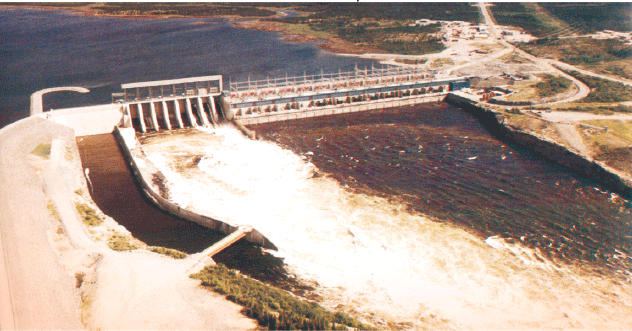
FUNCTIONS OF TIMES
Dams serve many purposes.
They help to control floods by storing water.
The water stored in dams is used for irrigation and also to generate electric energy without creating much environmental problems.
Energy stored in the water of dams is used to run power plants.
Q3. How can we produce electricity from geothermal energy?
PRODUCTION OF ELECTRICITY
Geothermal well can be built by drilling deep near hot rocks at places, where magma is not very deep. Water is then pushed into the well. The rocks quickly heat the water and change it into steam. It expands and moves up to the surface. The steam can be pipes directly into houses and offices for heating purposes or it can be used to generate electricity.
Q4. How does a pole vaulter attain the height? (Do you know Pg. # 128)

POLE VAULTER
A pole vaulter uses a flexible vaulting pole made of special material. It is capable to store all the vaulter’s kinetic energy while bending in the form of potential energy. The vaulter runs as fast as possible to gain speed. The kinetic energy gained by the pole vaulter due to speed helps him/her to rise up as the vaulter straightens. Thus he attains height as the pole returns the potential energy stored by the vaulter in the pole.
Q5. Draw the Flow Diagram Of An Energy Converter. (GRW 2015)
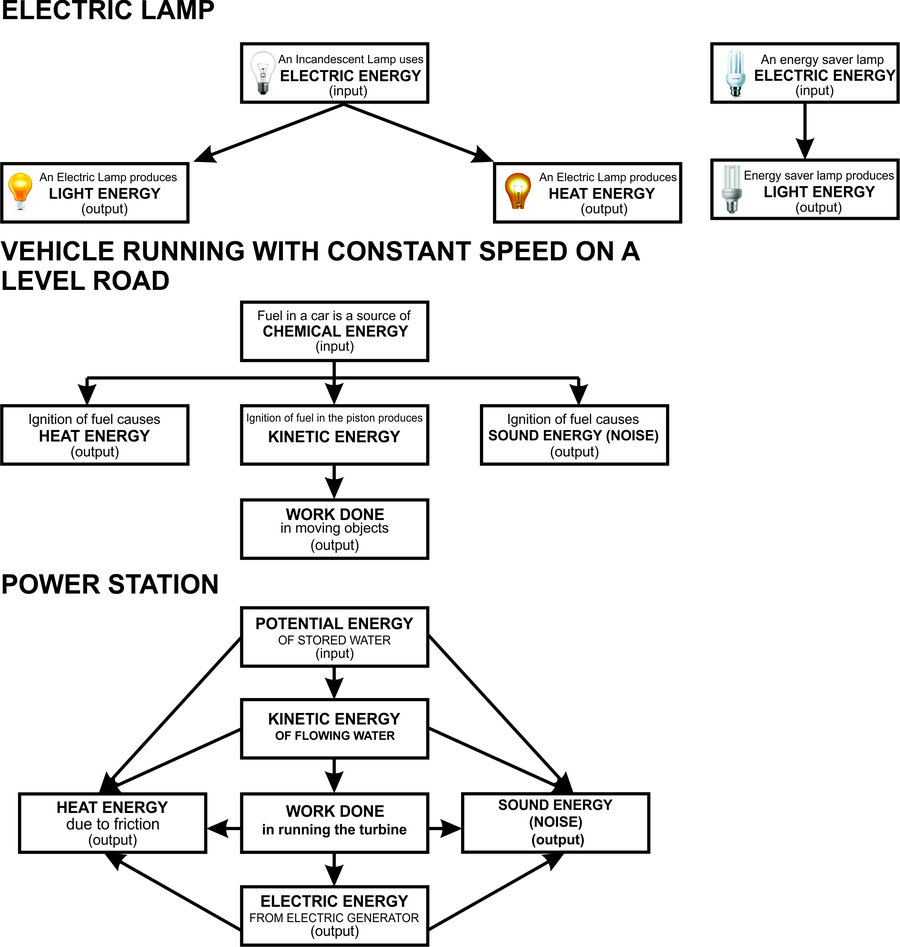
FLOW DIAGRAMS
In an energy converter, a part of energy taken (used up) by the system is converted into useful work. Remaining part of the energy is dissipated as heat energy, sound energy (noise) into the environment. Energy flow diagram given below shows the energy taken up by an energy converter to transform it into other forms of energy.
Some flow diagrams of energy converters are given below:
6.8 Efficiency
6.9 Power
Short Questions
Q1. What is Efficiency? Write its formula and unit (if any)
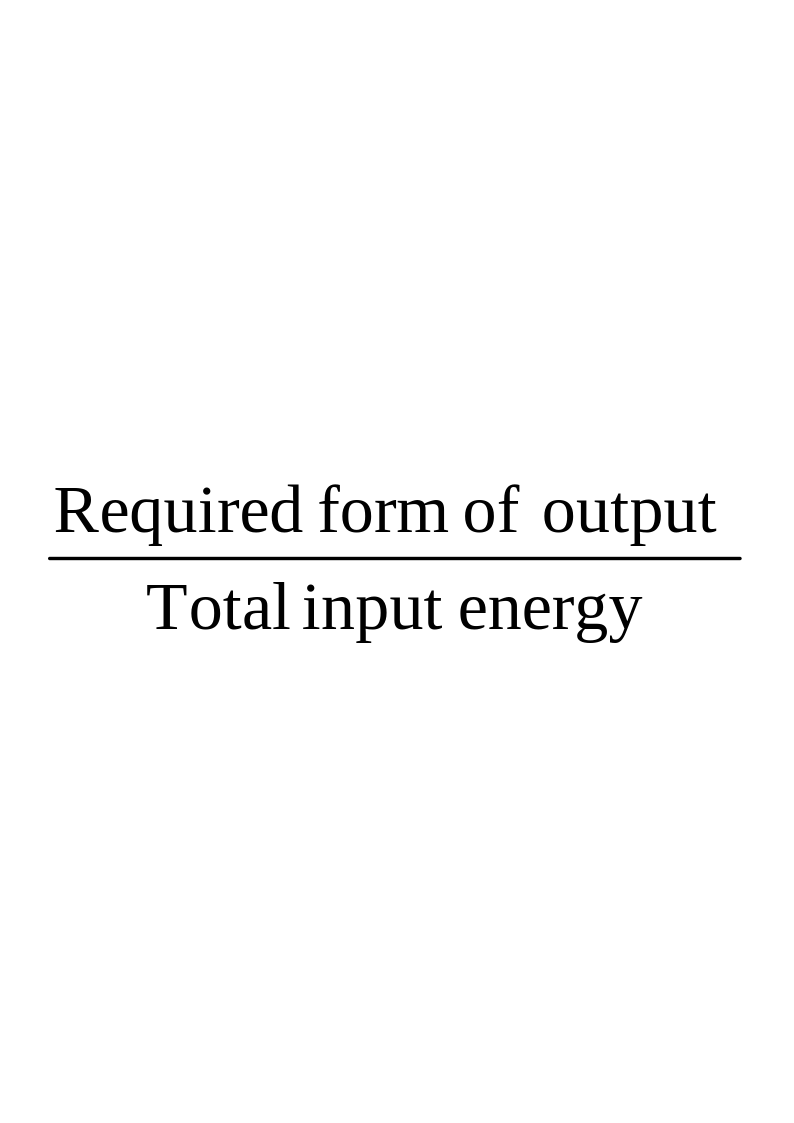
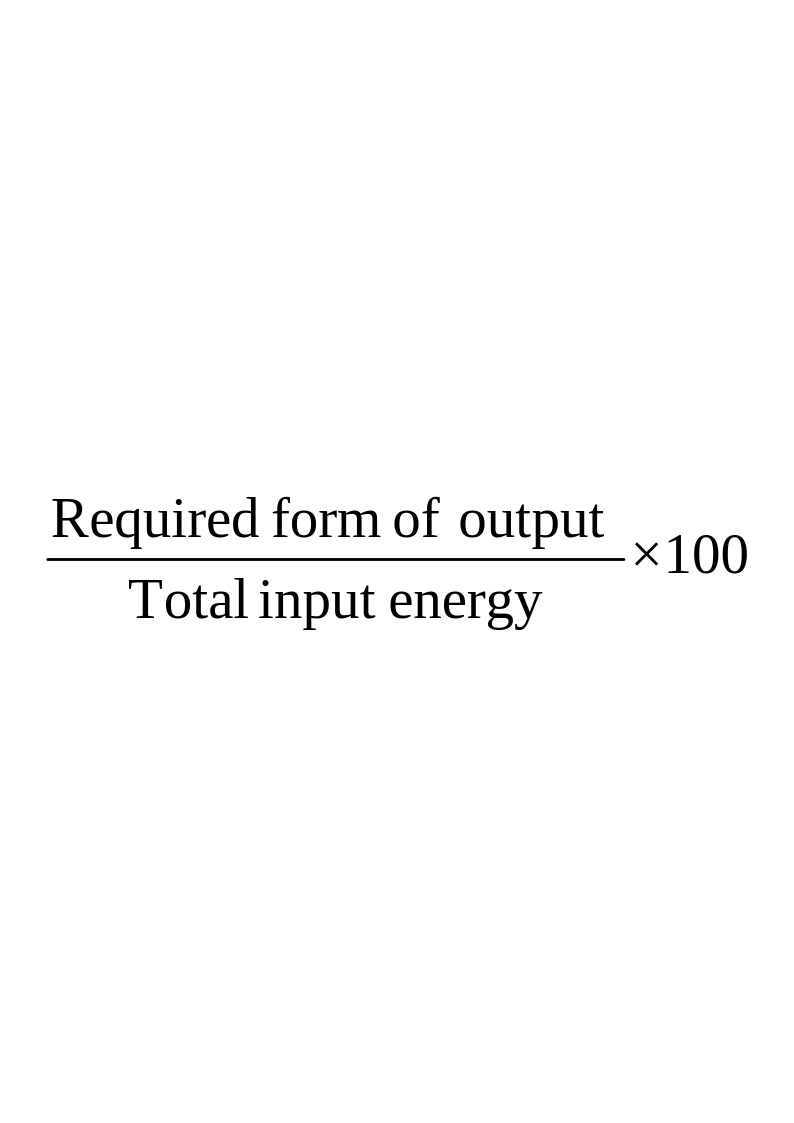
EFFICIENCY
Definition:
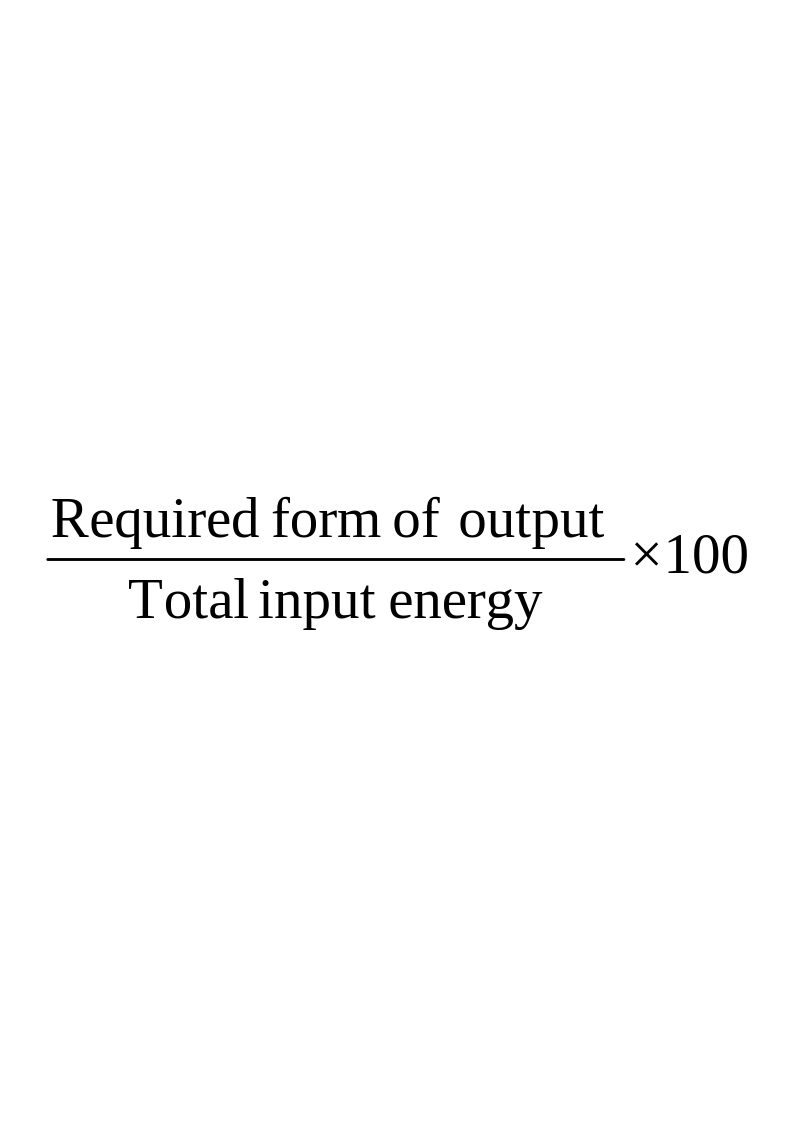
“Efficiency of a system is the ratio of required form of energy obtained from a system as output to the total energy given to it as input”.
Example:
Electric motors may be used to pump water, to blow air, to wash clothes, to drill holes, etc. for that they use electric energy. How good a machine is, depends how much output we obtain from it by giving certain input. The ratio of useful output to input energy is very important to judge the working of machine.
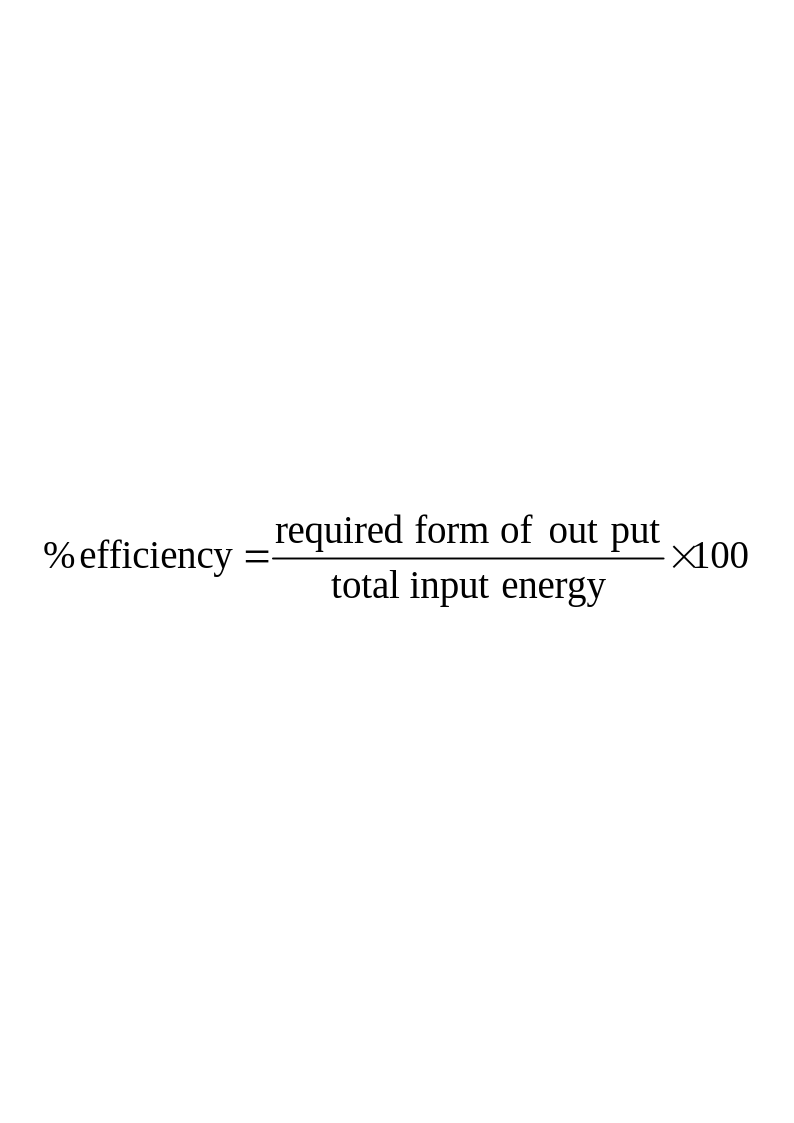
Mathematical Form:
Efficiency =
Or % Efficiency =
Unit:
Efficiency is a ratio between two similar quantities so it has no unit. It is measured in percentage.
Q2. Define the ideal system. Why is it not possible to construct 100% efficient system?
IDEAL SYATEM
Definition:
An ideal system is that which gives an output equal to the total energy used by it. In other words, its efficiency is 100 %. People have tried to design a working system that would be 100 % efficient. But practically such system does not exist.
Reason For Not Existing 100% Efficient System:
Every system meets energy losses due to friction that causes heat, noise etc. These are not the useful forms of energy and go waste. This means we cannot utilize all the energy given to working system. The energy in the required form obtained from working system always less than the energy given to it as input.
Q3. What is Power? Write down its unit and define it. (LHR 2017, GRW 2017)
POWER
Definition:
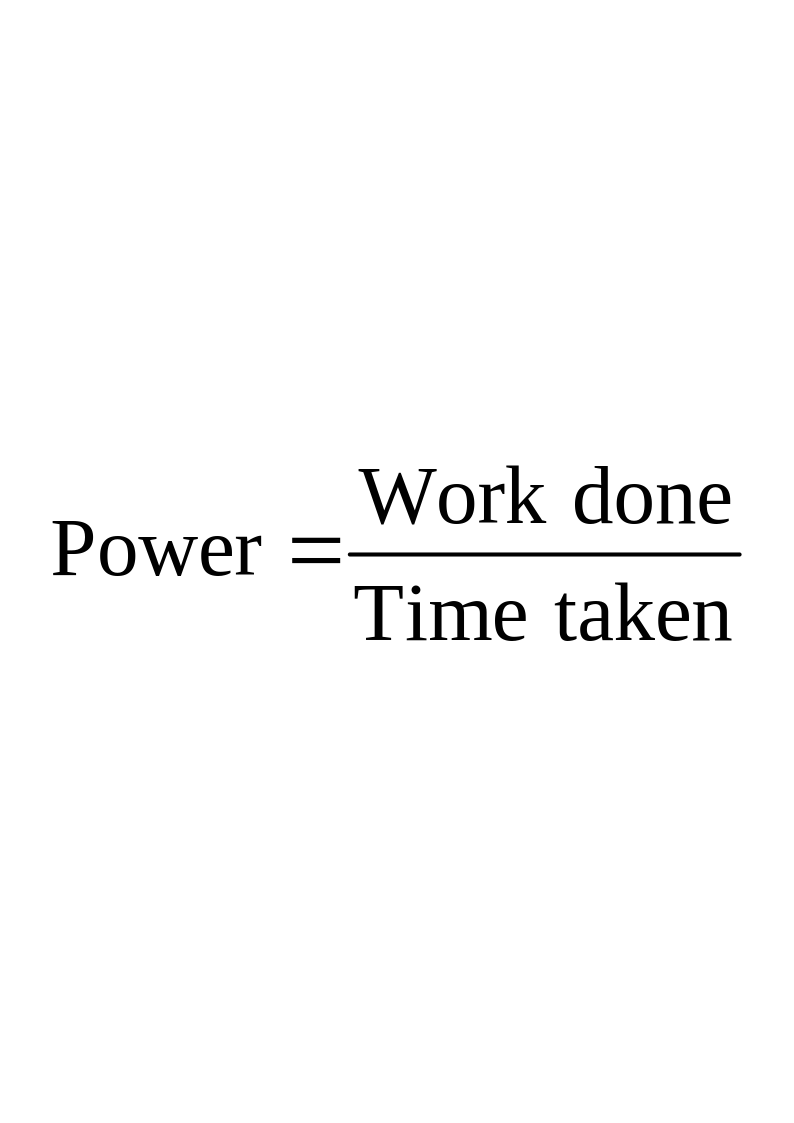
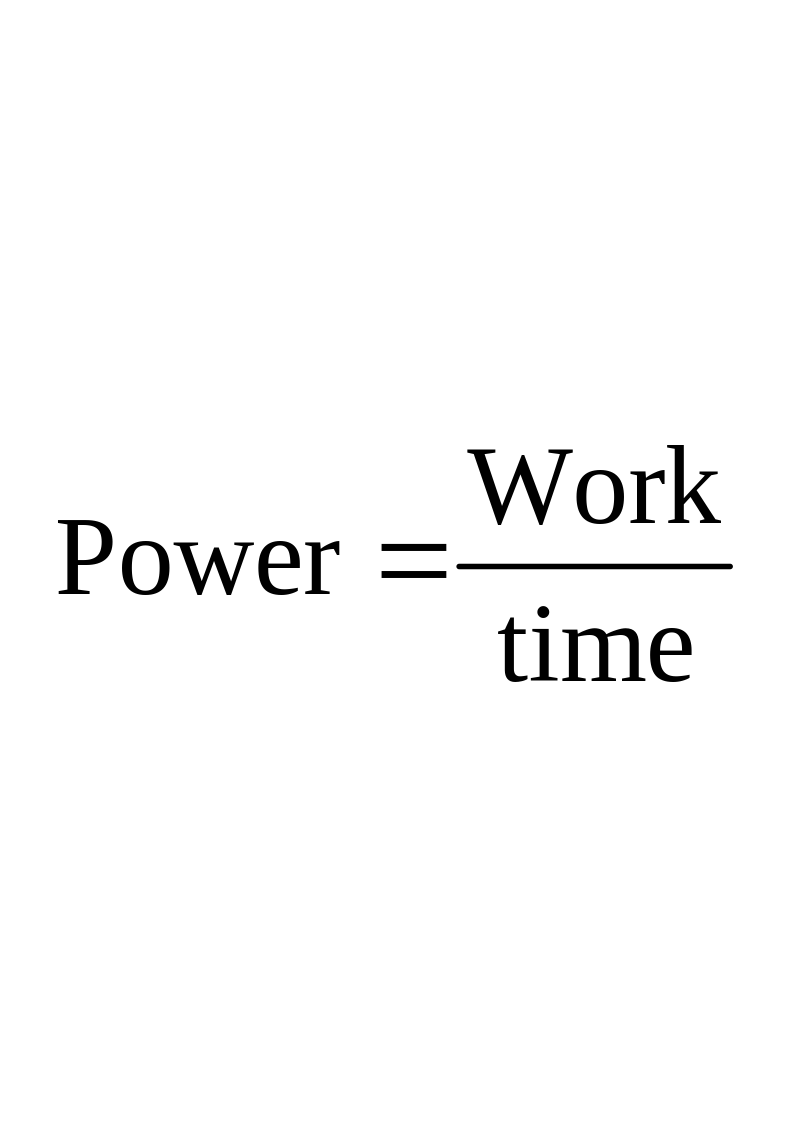
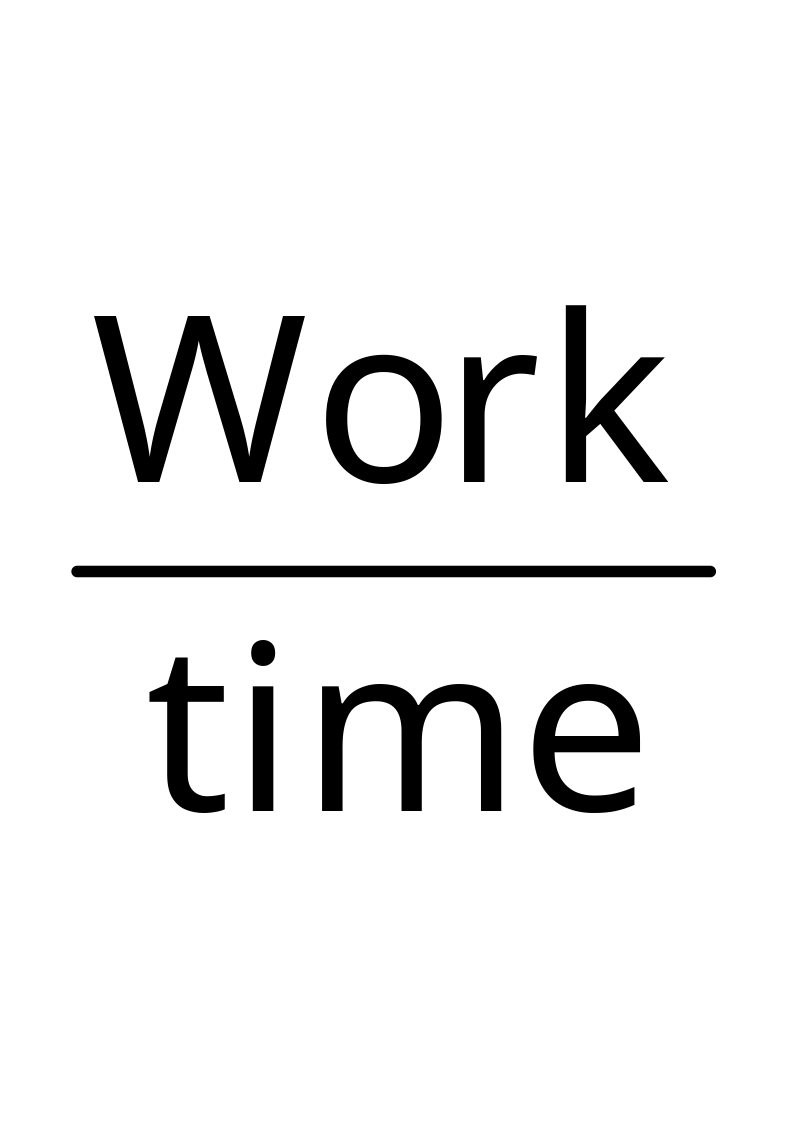
“Rate of doing work with respect to time is called the power.”
Formula:
Formula for power is given below:
Thus,
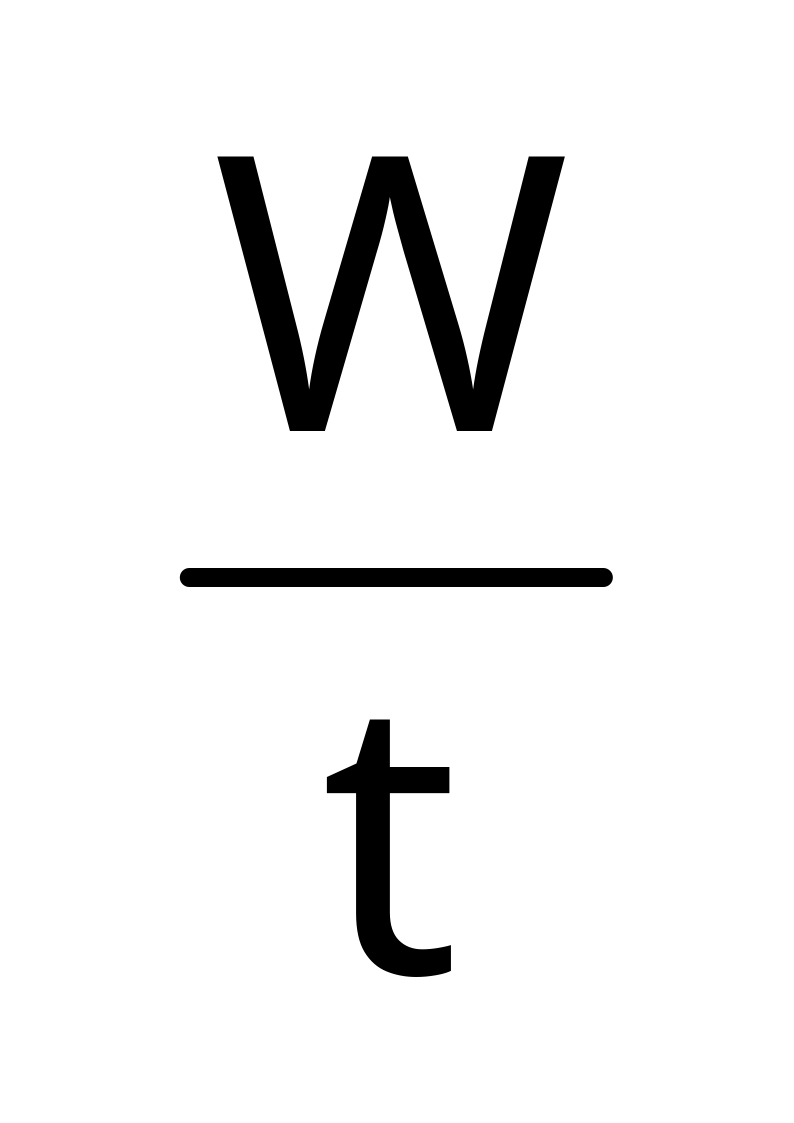
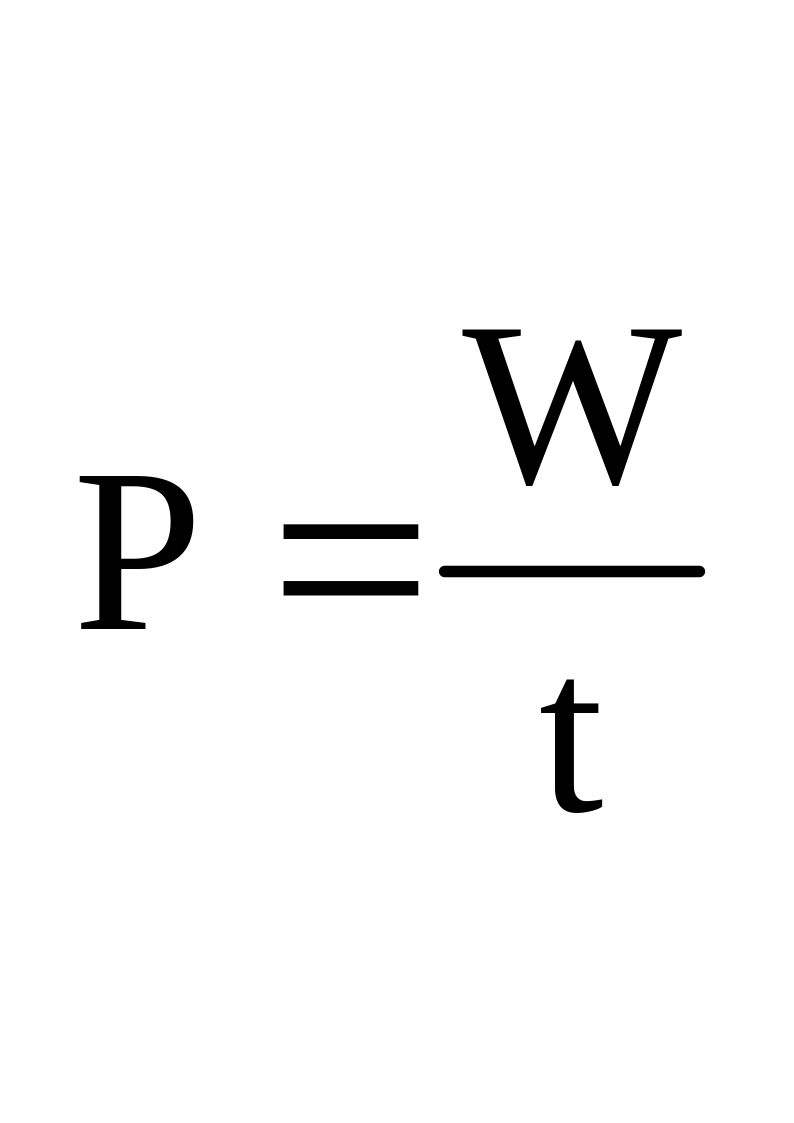
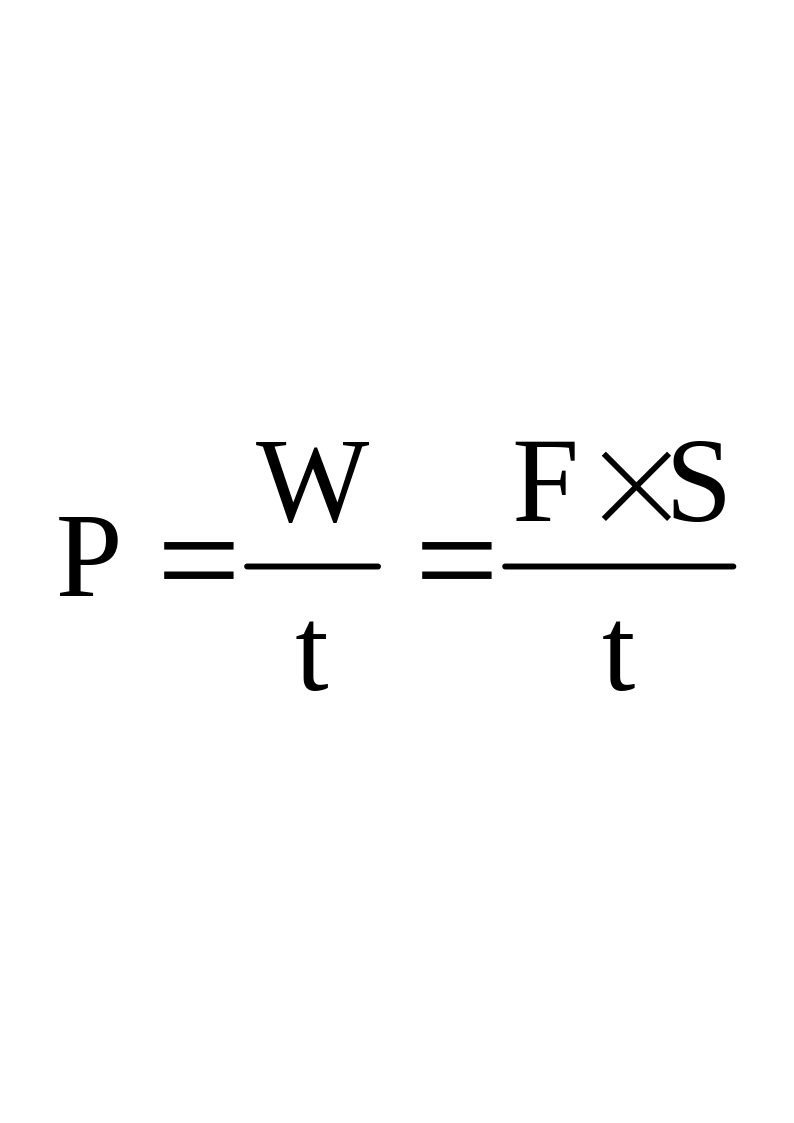
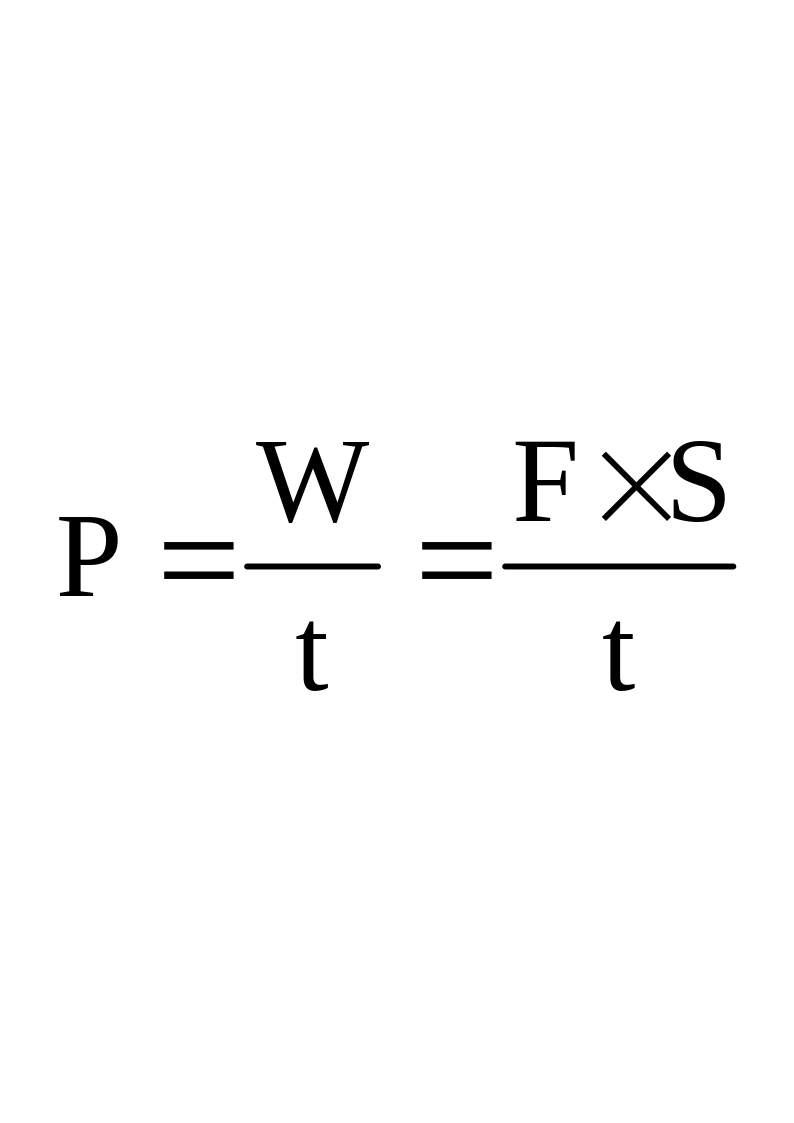
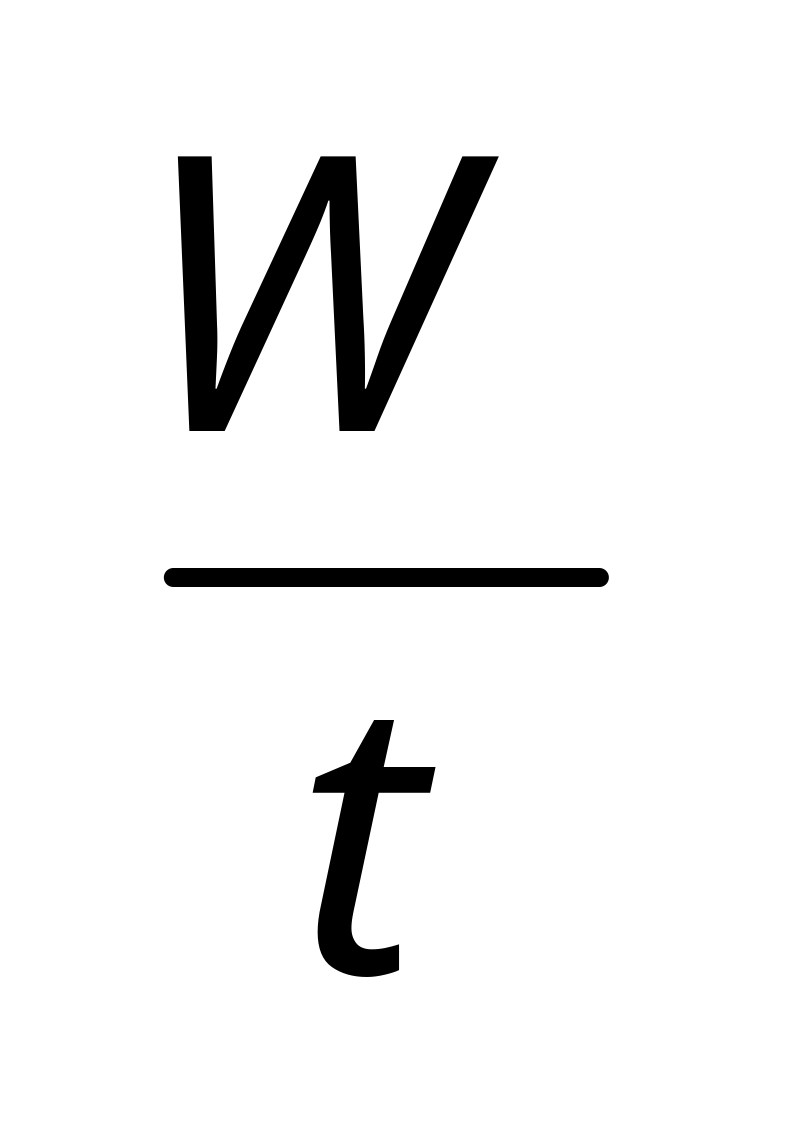
If we represent power by ‘P’, work by ‘W’ and time by ‘t’, then
P =
Quantity:
Since work is scalar quantity so power is also a scalar quantity.
Unit of Power:
In System International, the unit of power is watt (W).
Watt:
“The power of a body is one watt if it does work at the rate of 1 joule per second (1Js-1)”.
Bigger Units:
Bigger units of power are kilowatt (kW), megawatt (MW) etc.
1 KW = 1000W = 103 W
1 MW = 1000000 = 106 W
1 horsepower = 1hp = 746 W
Q4. How much power is used by a 40 kg athlete by climbing 10m high ladder in 10s?
Given Data:
Mass of athlete = m = 40 kg
Time taken by athlete to climb= t = 10 s
Height of ladder = h = S = 10 m
To Find:
Power of athlete used for climbing = P = ?
Calculations:
As we know that Force = weight = w = mg = 40 x 10 = 400N
Work = W = FS = 400 x 10 = 4000 J
As we know that Power = P = W/t
So, Power = P = 4000/10 = 400 W
Result:
EXAMPLE 6.5
Q5. A cyclist does 12 joules of useful work while pedaling his bike from every 100 joules of food energy which he takes. What is his efficiency?
Given Data:
Useful work done by the cyclist = Output = 12J
Energy used by the cyclist = Input = 100J
To Find:
Efficiency of cyclist = ?
Calculations:
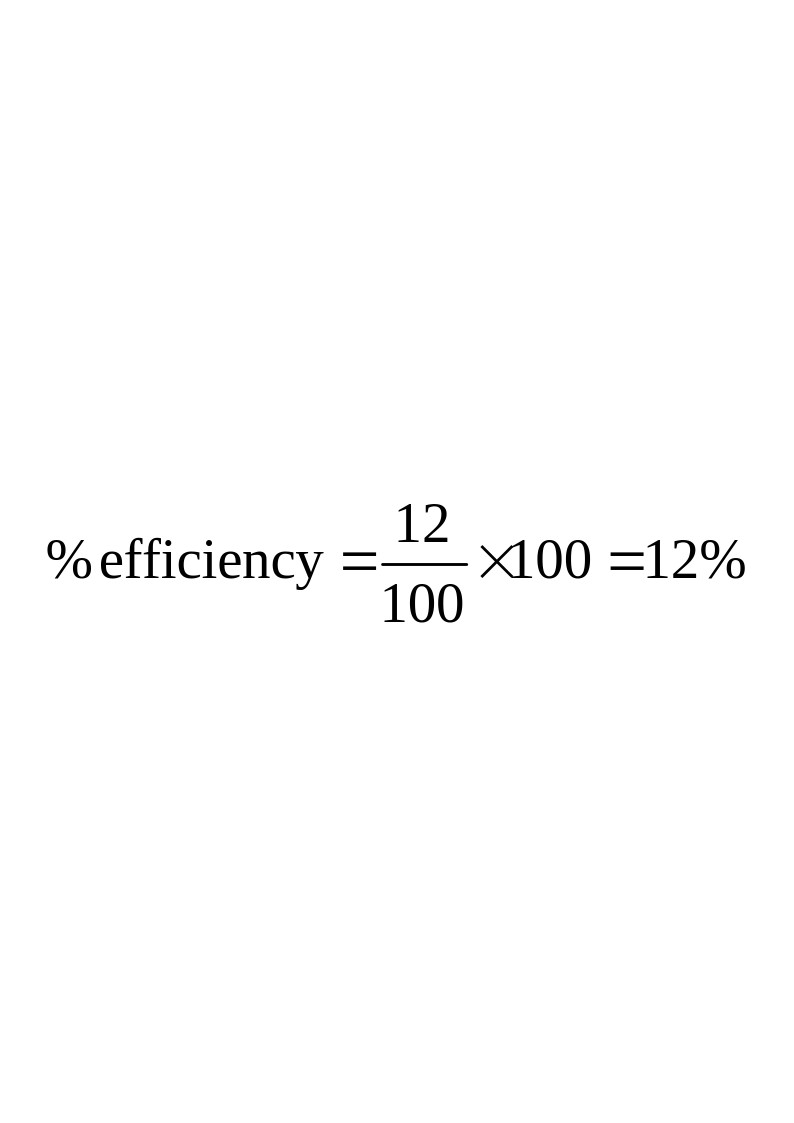
We know efficiency is measured in percentage as:
Putting the values,
Result:
EXAMPLE 6.6
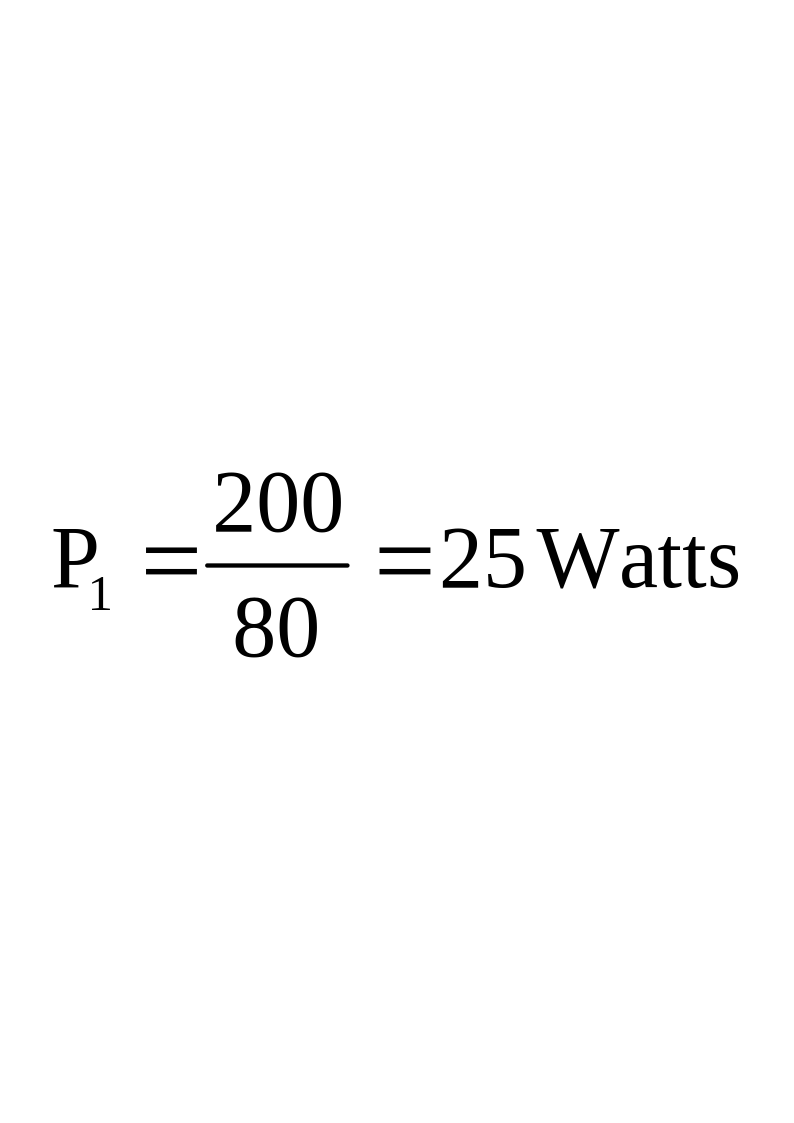
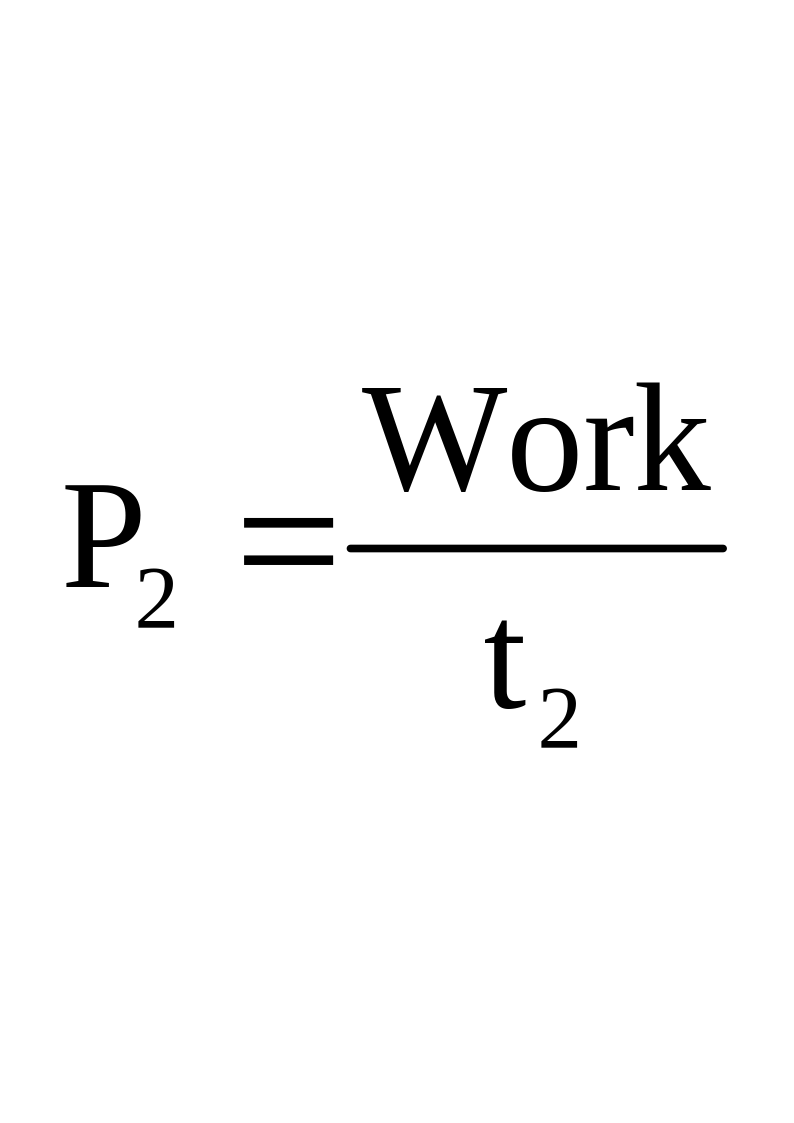
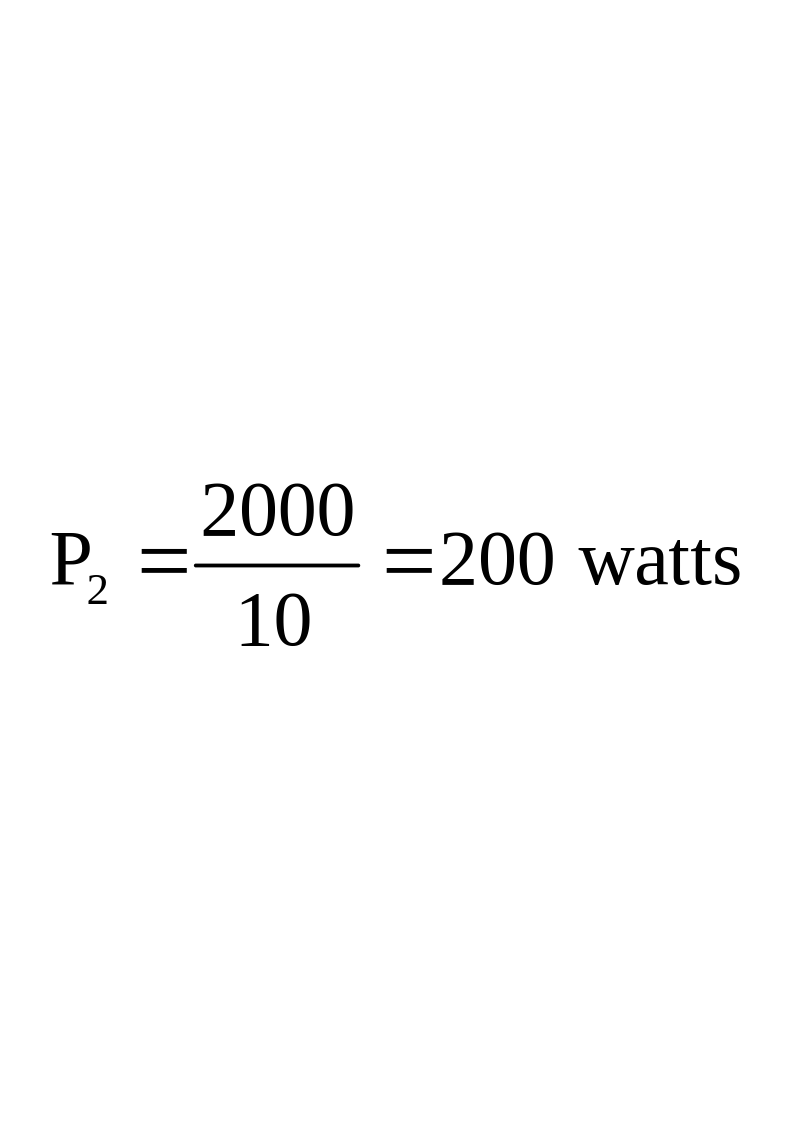
Q6. A man M1 takes 80 s in lifting a load of 200 N through a height of 10 m. While another man M2 takes 10 s in doing the same job. Find the power of each.
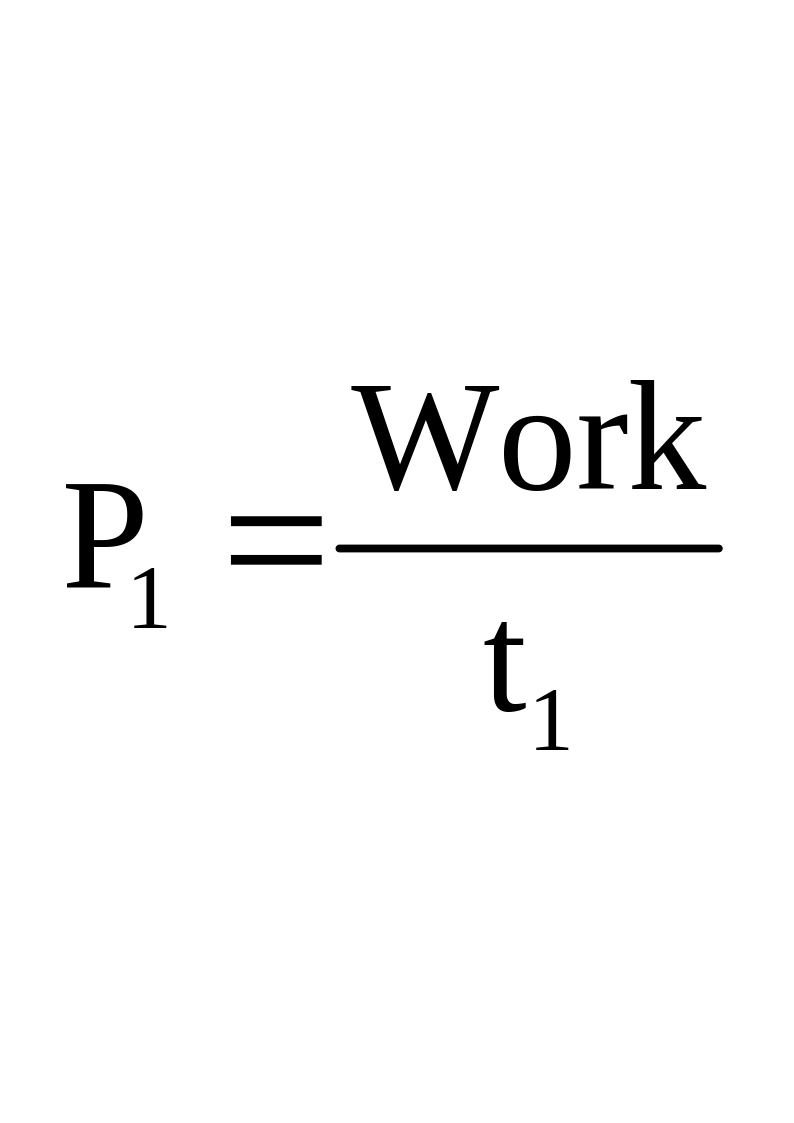
Given Data:
Force used in lifting the load = F =200N
Time taken by M1 to do the job = t1 = 80 s
Distance covered by the body = S = 10m
Time taken by M2 to do the job = t2 = 10 s
To Find:
Power of M1 = P1 = ?
Power of M2 = P2 = ?
Calculations:
As the work done by both men is same i.e.
W = FS
Putting values
W= (200)(10)
W= 2000J
Now we find power of M1 as
Putting the values
Now we find power of M2 as
Putting the values
Result:
EXAMPLE 6.7
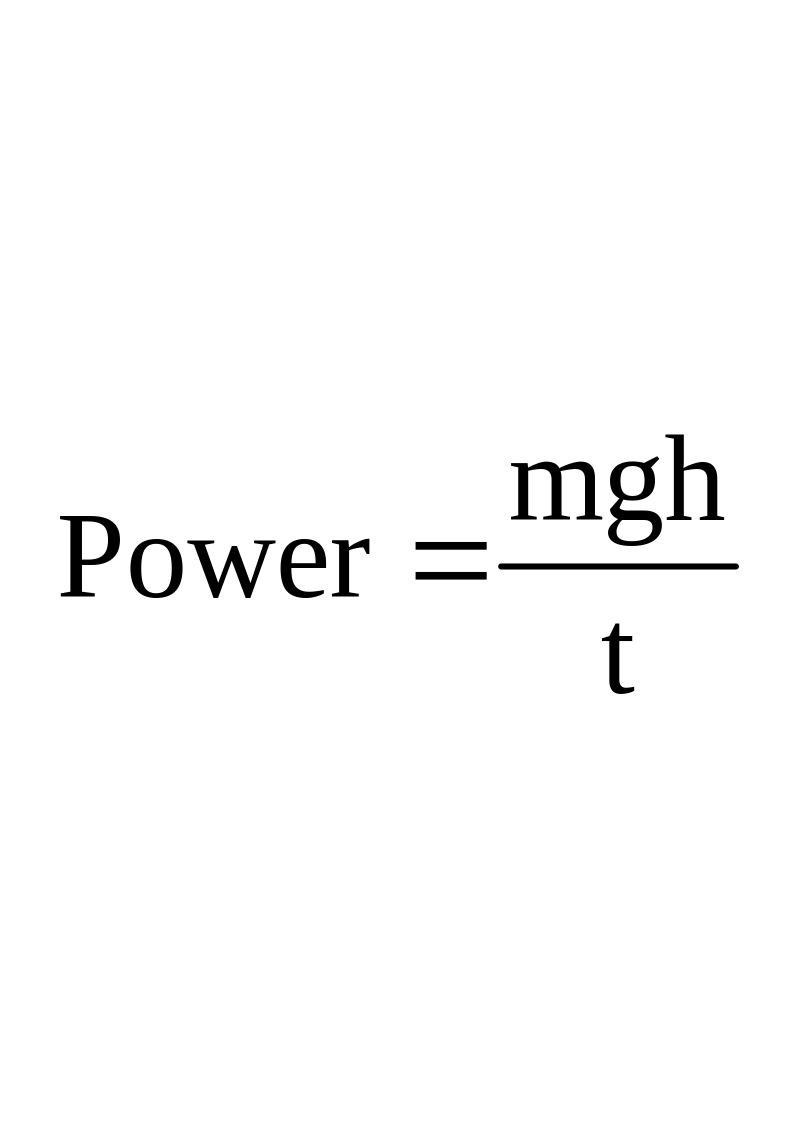
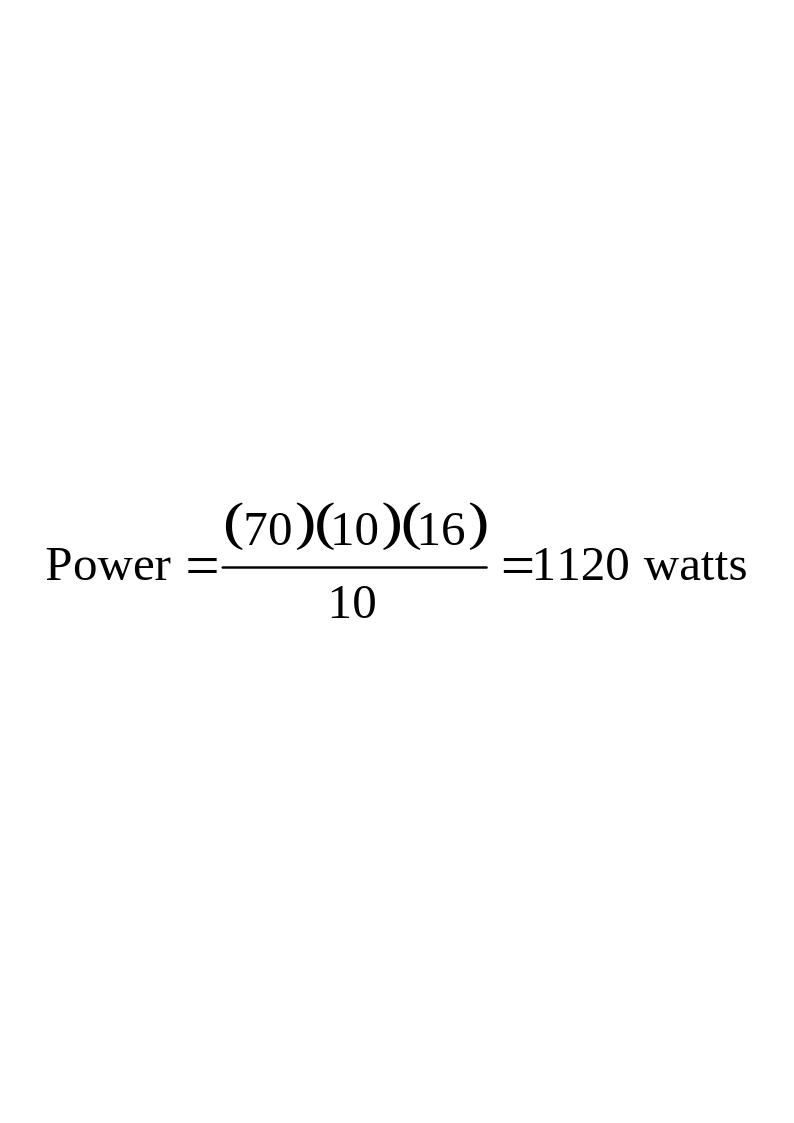
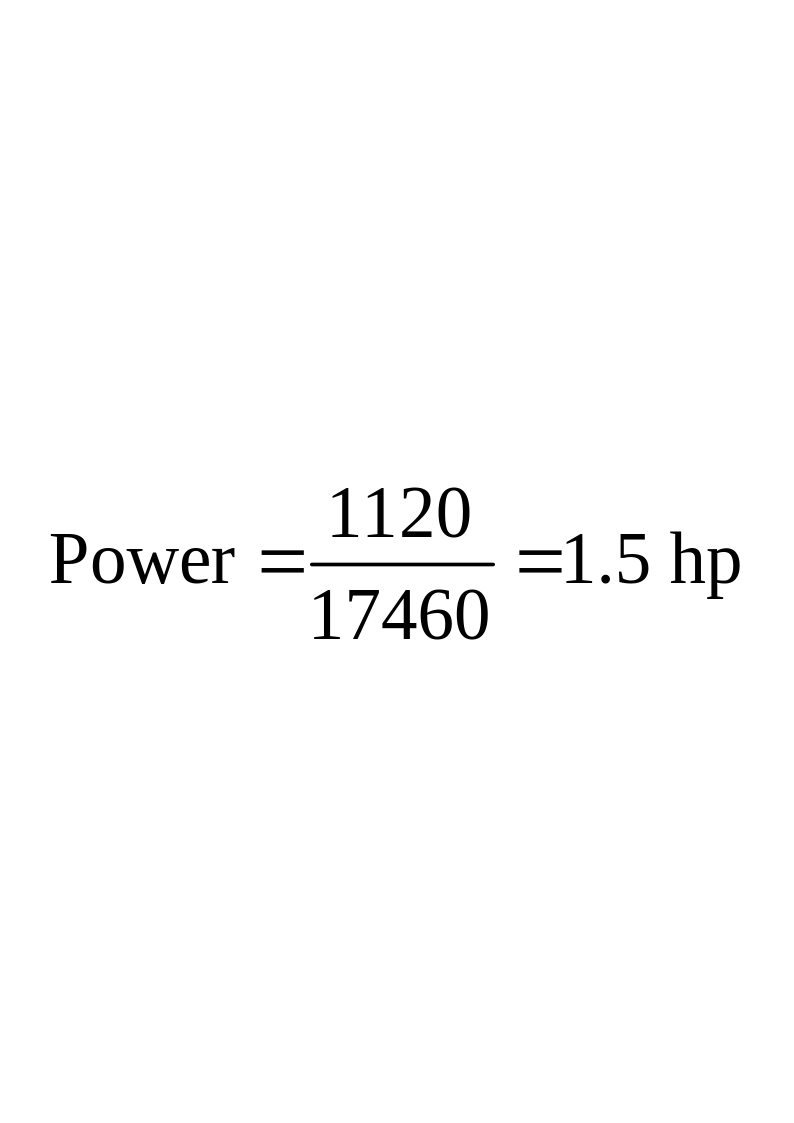
Q7. Calculate the power of a pump which can lift 70 kg of water through a vertical height of 16 metres in 10 seconds. Also find the power in horse power
Given Data:
Mass of water = m = 70 kg
Height at which the water has been lifted = h =16 m
Time taken in lifting the water = t = 10 s
To Find:
Power of the pump (hp) = ?
Calculations:
We know,
In this case work done will be converted into P.E. of the body so
Putting the values
Conversion in hp:
We know
1hp = 746 watts
Result:
TB Text Book Exercise
Long Questions
Q1. Define work. What is its SI unit? (LHR 2014)
WORK
Definition:
Work is done when a force acting on a body displaces it in the direction of a force.
Mathematically:
Work is equal to the product of force and distance covered in the direction of force.
Work = Force x Displacement
W = FS
Unit of Work:
In System International, its unit is Nm that is also called as joule (J).
Joule:
“The amount of Work done will be one joule if a force of one Newton displaces a body through a distance of one meter in the direction of the force.”
Bigger Units:
Joule is a smaller unit of work. Commonly bigger units of work are also in use.
1 kilo joule ( kJ) = 1000 J =103J
1 Mega Joule (MJ) =1000000J = 106J
Quantity:
Work is a scalar and derived quantity.
Q2. Define energy; give two types of mechanical energy.
ENERGY
Definition:
A body possesses energy if it is capable to do work.
OR
Ability of a body to do work is known as energy.
Quantity:
It is a scalar quantity
Unit:
Joule (Nm) is the unit of energy same as that of work.
Types of Energy:
Energy exists in various forms such as mechanical energy, heat energy, light energy, sound energy, electrical energy, chemical energy and nuclear energy etc.
MECHANICAL ENERGY
Definition:
The energy possessed by a body due to its motion or position is called mechanical energy.
Examples:
Water running down a stream
A moving car
A lifted hammer
A stretched bow
A catapult or a compressed spring
Types of Mechanical Energy:
Mechanical energy possessed by a body is of two types:
Kinetic Energy:
“The energy possessed by a body due to its motion is called kinetic energy”
Formula:
It is denoted by K.E. and its formula is given below:
K.E. = ½ m v2
Potential Energy:
“The energy possessed by a body due to its position is known as potential energy.”
Formula:
Potential energy is denoted by P.E. and its formula is given below:
P.E. = m g h
Q3. Define K.E. and derive its relation.
See Q. no.1 Long Question TOPIC 6.2
Q4. Define potential energy and drive its relation. (LHR 2013)
See Q. no.2 Long Question TOPIC 6.3
Q5. How is energy converted from one form to another? Explain.
See Q. no.2 Long Question TOPIC 6.6
Q6. Name the five devices that convert electrical energy into mechanical energy.
DEVICES NAMES
Following devices convert electrical energy into mechanical energy:
Electric Motor
Electric Fan
Elevator
Drill machine
Grinder
Electric sewing machine
Q7. What is meant by efficiency of a system?
EFFICIENCY
Definition:
“Efficiency of a system is the ratio of required form of energy obtained from a system as output to the total energy given to it as input.”
Example:
Electric motors may be used to pump water, to blow air, to wash clothes, to drill holes, etc. for that they use electric energy. How good a machine is, depends how much output we obtain from it by giving certain input. The ratio of useful output to input energy is very important to judge the working of machine.
Mathematical Form:
Efficiency =
Or % Efficiency =
Unit:
Efficiency is a ratio between two similar quantities so it has no unit. It is measured in percentage.
Q8. Or % Efficiency = What is meant by the term power? (GRW 2013, LHR 2012, 2016)
POWER
Definition:
“Rate of doing work with respect to time is called the power.”
Formula:
Formula for power is given below:
Thus Power =
If we represent power by ‘P’, work by ‘W’ and time by ‘t’, then
P =
Quantity:
Since work is scalar quantity so power is also a scalar quantity.
Unit of Power:
In System International, the unit of power is watt (W).
Q9. Define watt. (LHR 2011, 2014, 2016, 17)
UNIT OF POWER
In System International, the unit of power is watt (W).
Watt:
If a body does a work of one joule in one second then its power will be one watt.
1 W = 1 Js-1
Bigger Units:
1 KW = 103 W
1 MW = 106 W
Short Questions
Q1. When does a force do work? Explain.
Long question #1 topic 1
Q2. Why do we need energy?
NEED OF ENERGY
We need energy to do different types of work in our daily life. When we say that body has energy, we mean that it has the ability to do work.
Examples:
Energy is required to move.
Energy is required to stop the moving objects.
Q3. Why fossils fuels are called non – renewable form energy? (LHR 2013)
NONRENEWABLE ENERGY SOURCE
The fossil fuels took millions of years for their formation. They are known as non-renewable resources. We are using fossil fuels at a very fast rate. Their use is increasing day by day to meet them at present rate, they will soon be exhausted. Once their supply is exhausted, the world would face serious energy crises.
Q4. 6.9 Which form of energy is most preferred and why?
MOST PREFERRED FORM OF ENERGY
Solar energy is most preferred form of energy due to following reasons:
It is easily available and it is the most cheapest form of energy
It can easily be converted into other forms of energy
It is comparatively pollution free form of energy.
Q5. 6.12 Name device that converts mechanical energy into electrical energy. (LHR 2016)
DEVICE NAME
Electric Generator is a device which is used to convert mechanical energy into electrical energy.
Q6. How can you find the efficiency of a system?
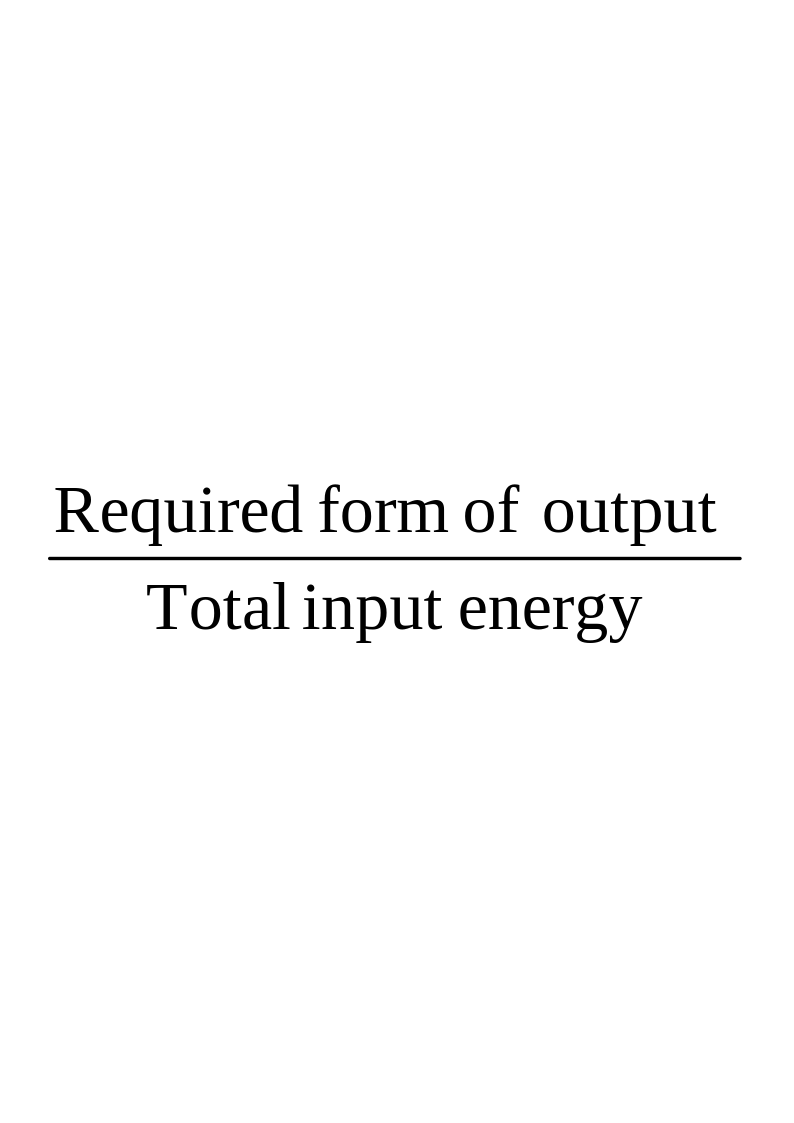
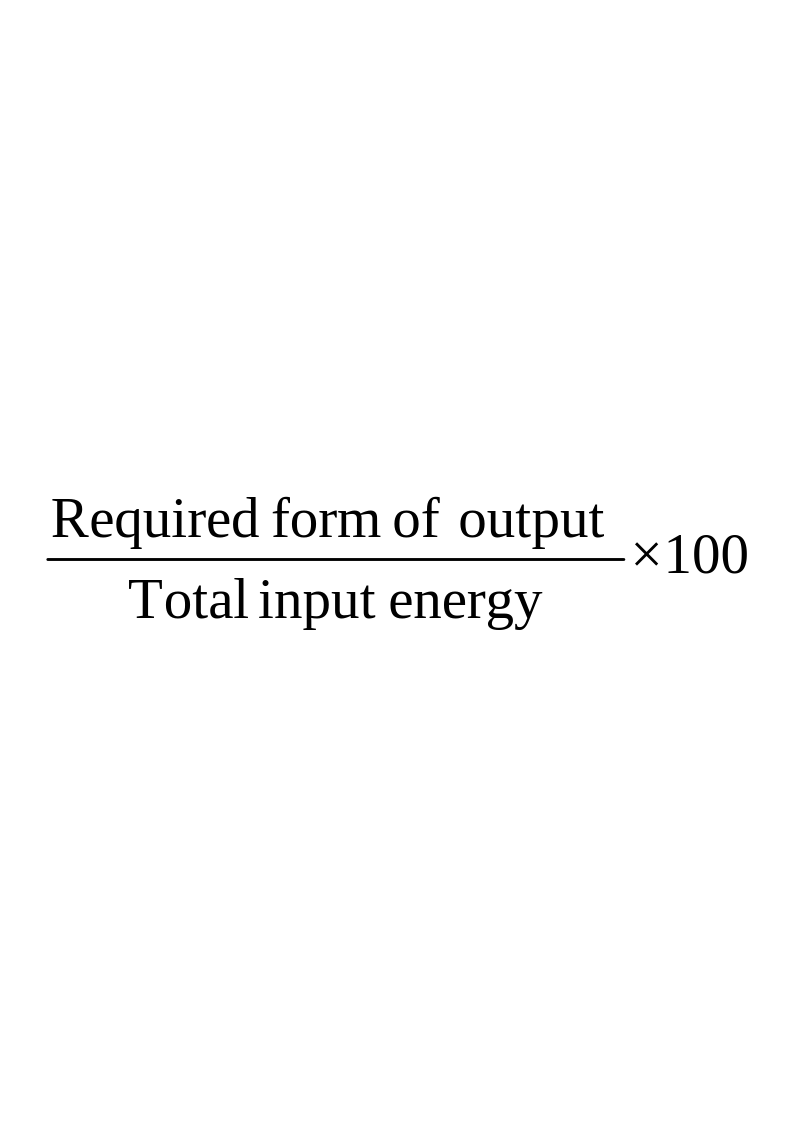
FINDING EFFICIENCY OF A SYSTEM
Efficiency of a system is the ratio of required form of energy obtained from a system as output to the total energy given to it as input.
Mathematically, it can be calculated as:
Efficiency =
Numerical Problems
Numerical 1. A man has pulled a cart through 35 m applying a force of 300 N. Find the work done by the man. (GRW 2013, 2017)
Given Data:
Force applied = F = 300 N
Distance moved by cart = S = 35 m
To Find:
Work done by the man = W =?
Calculations:
As we know that,
W = F x S
By putting the values, we have
W = 300 x 35
W = 10500 J
Result:
Numerical 2. A block weighing 20 N is lifted 6 m vertically upward. Calculate the potential energy stored in it.
Given Data:
Weight of the block = W = 20 N
Distance moved vertically upward = h = 6 m
To Find:
Potential energy of the block = P.E = ?
Calculations:
As we know that
W = F x S
By putting the values, we have
W = 20 x 6
W = 120 J
Result:
Numerical 3. A car weighing 12 kN has speed of 20 ms-1. Find its kinetic energy stored in it. (LHR 2015)
Given Data
Weight of car = w = 12 kN
Speed of car = v = 20 ms-1
To Find:
Kinetic energy stored in car = K.E = ?
Calculations:
As we know that
K.E = ½ mv2
By putting the values, we have
K.E. = ½ x 1200 x (20)2
K.E. = ½ x 1200 x 400
K.E. = 240000 J
K.E. = 240 Kj
Result:
Numerical 4. A 500 g stone is thrown up with a velocity of 15 ms-1. Find its i) P.E. at its maximum height ii) K.E. when it hits the ground
Given Data:
Mass of the stone = m = 500 g = 0.5 kg
Velocity of the stone = v = 15 ms-1
To Find:
P.E. at its maximum height = P.E. = ?
K.E. when it hits the ground = K.E. = ?
Calculations:
As we know that
Potential energy at maximum height = kinetic energy while throwing
Potential energy at maximum height = ½ mv2
By putting the values, we have
Potential energy at maximum height = ½ x 0.5 x (15)2
Potential energy at maximum height = ½ x 0.5 x 225
Potential energy at maximum height = 56.25 J
Also we know that
Kinetic energy while hitting the ground = Potential energy at maximum height
As Potential energy at maximum height = 56.25 J
So Kinetic energy while hitting the ground = 56.25 J
Result:
Numerical 5. On reaching the top of a slope 6 m high from its bottom, a cyclist has a speed of 1.5 ms-1. Find the kinetic energy and the potential energy of the cyclist. The mass of the cyclist and his bicycle is 40 kg.
Given Data:
Speed of the cyclist = v = 1.5 ms-1
Height of slope = h = 6 m
Mass of cyclist and bicycle = m = 40 kg
To Find:
Kinetic energy of the cyclist = K.E. = ?
Potential energy of the cyclist = P.E = ?
Calculations:
As we know that
P.E. = mgh
By putting the values, we have
P.E. = 40 x 10 x 6
P.E. = 2400 J
Also we know that
K.E. = ½ mv2
By putting the values, we have
K.E. = ½ x 40 x (1.5)2
K.E = ½ x 40 x 2.25
K.E. = 45 J
Result:
Numerical 6. A motor boat moves at a steady speed of 4 ms-1. Water resistance acting on it is 4000 N. Calculate the power of its engine. (LHR 2017)
Given Data:
Speed of the motor boat = v = 4 ms-1
Water resistance acting on boat = 4000 N
To Find:
Power of the engine of motor boat = P = ?
Calculations:
As we know that
P = F x v
By putting the values, we have
P = 4000 x 4
P = 16000 W ( 1000 = 1 kilo)
P = 16 KW
Result:
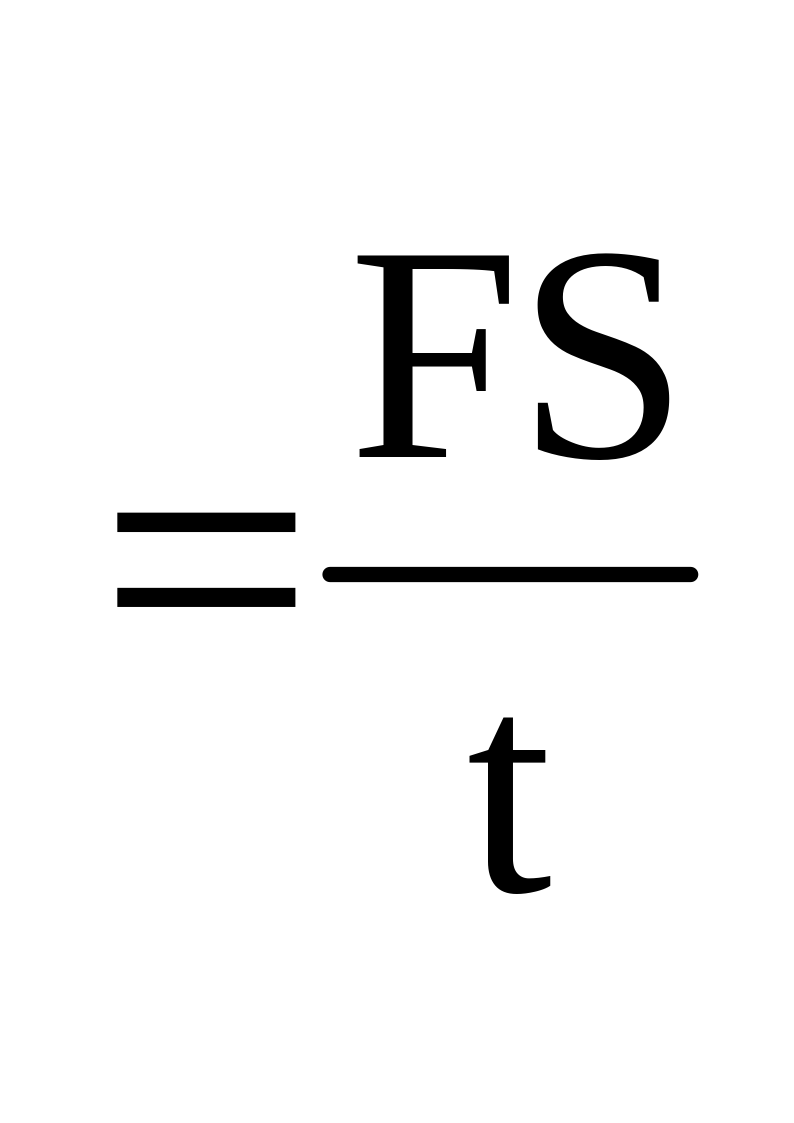
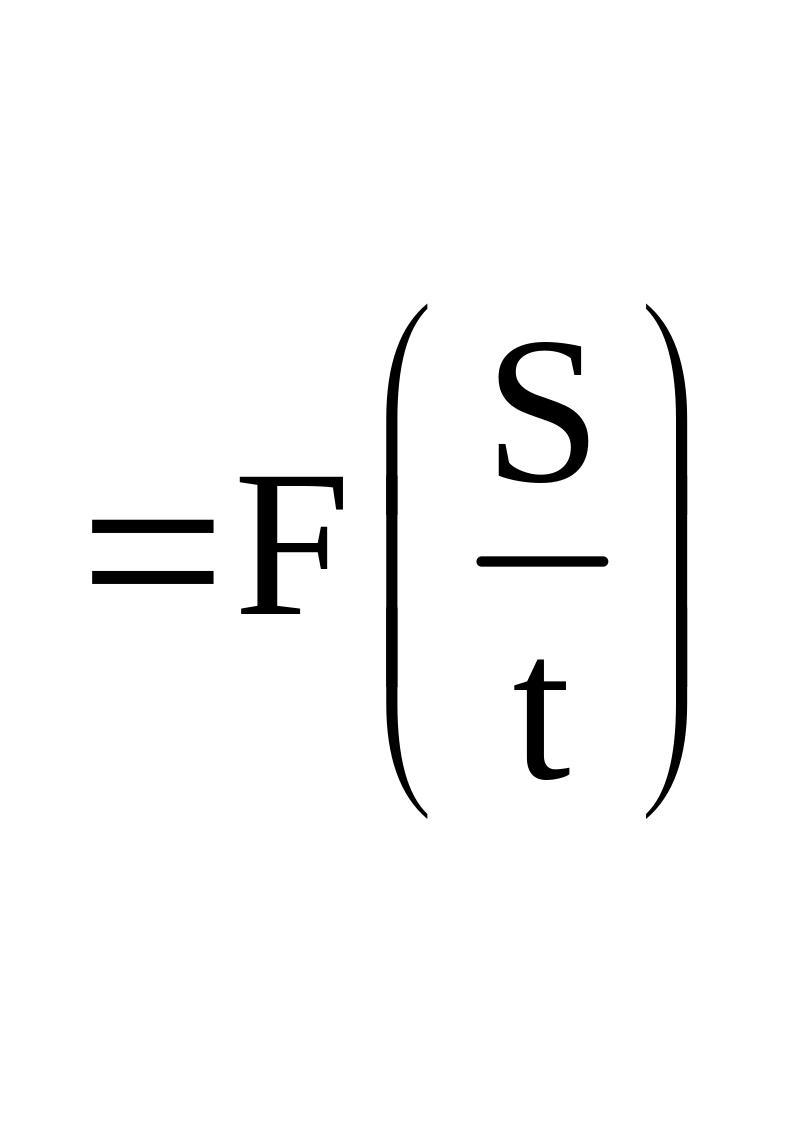
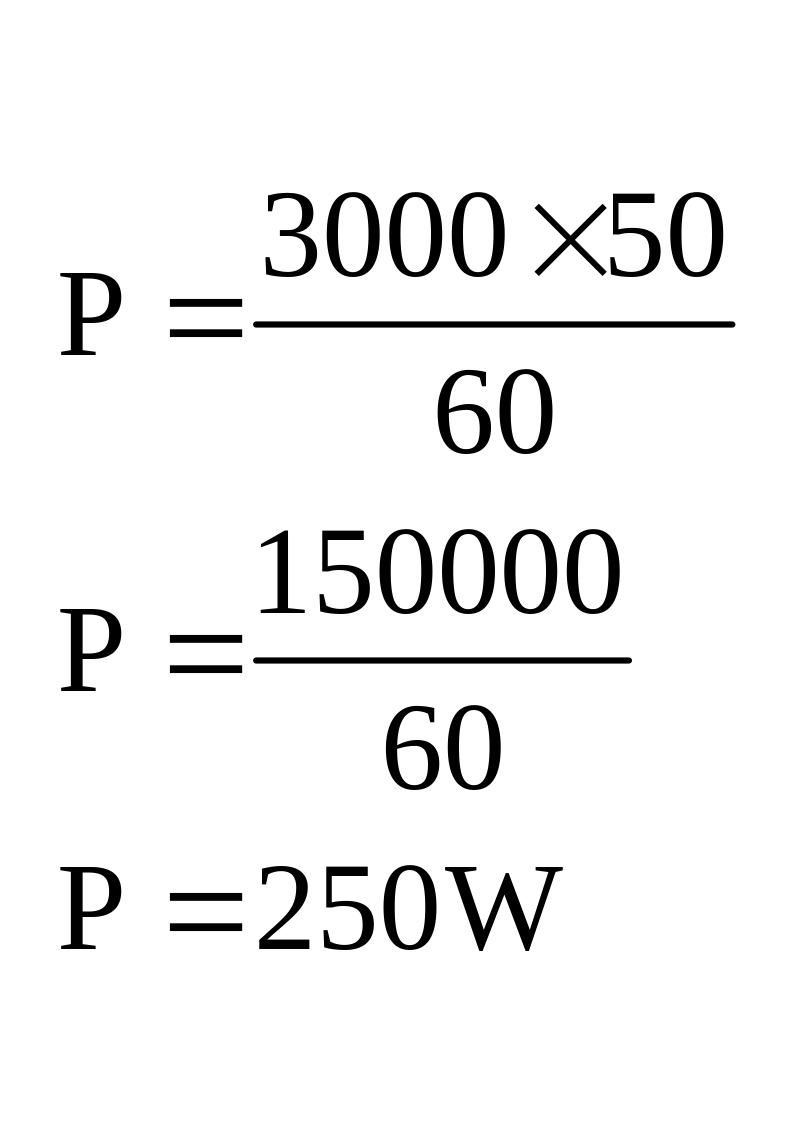
Numerical 7. A man pulls a block with a force of 300 N through 50 m in 60 s. Find the power used by him to pull the block. (LHR 2015)
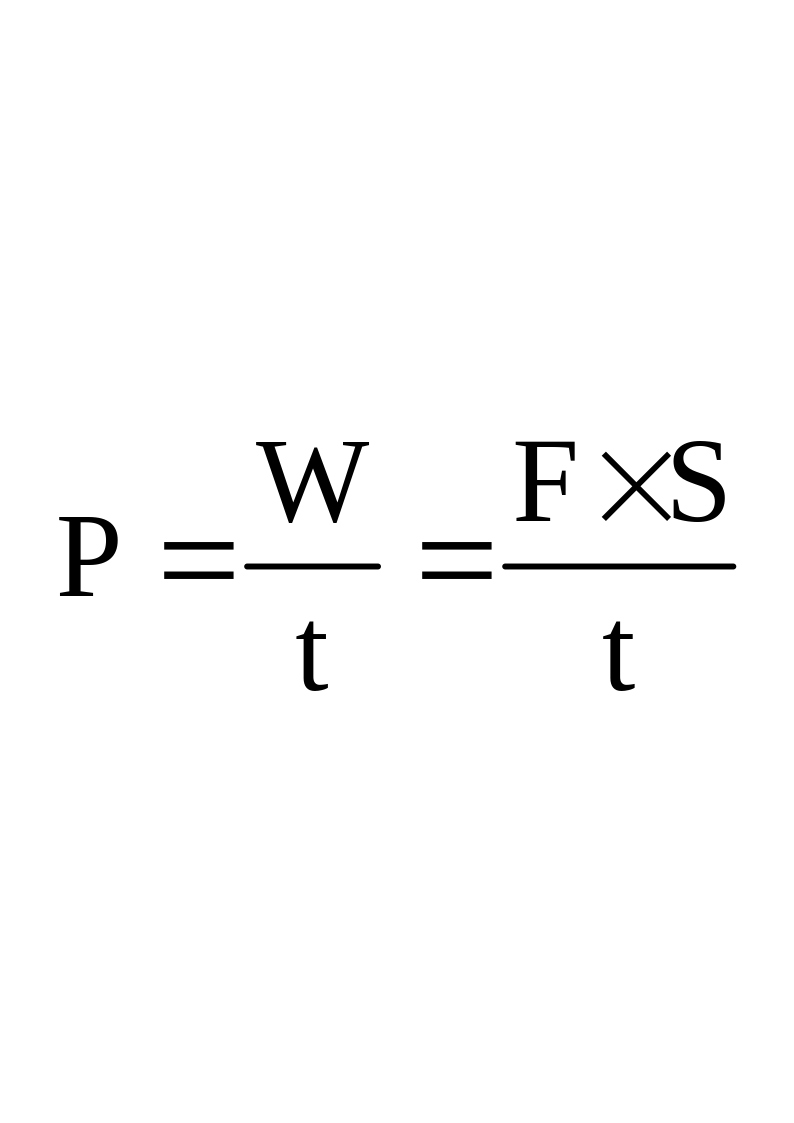
Given Data:
Force applied on block = F = 300 N
Distance covered by the block = S = 50 m
Time taken = t = 60 s
To Find:
Power used to pull the block = P = ?
Calculations:
As we know that
By putting the values, we have
Result:
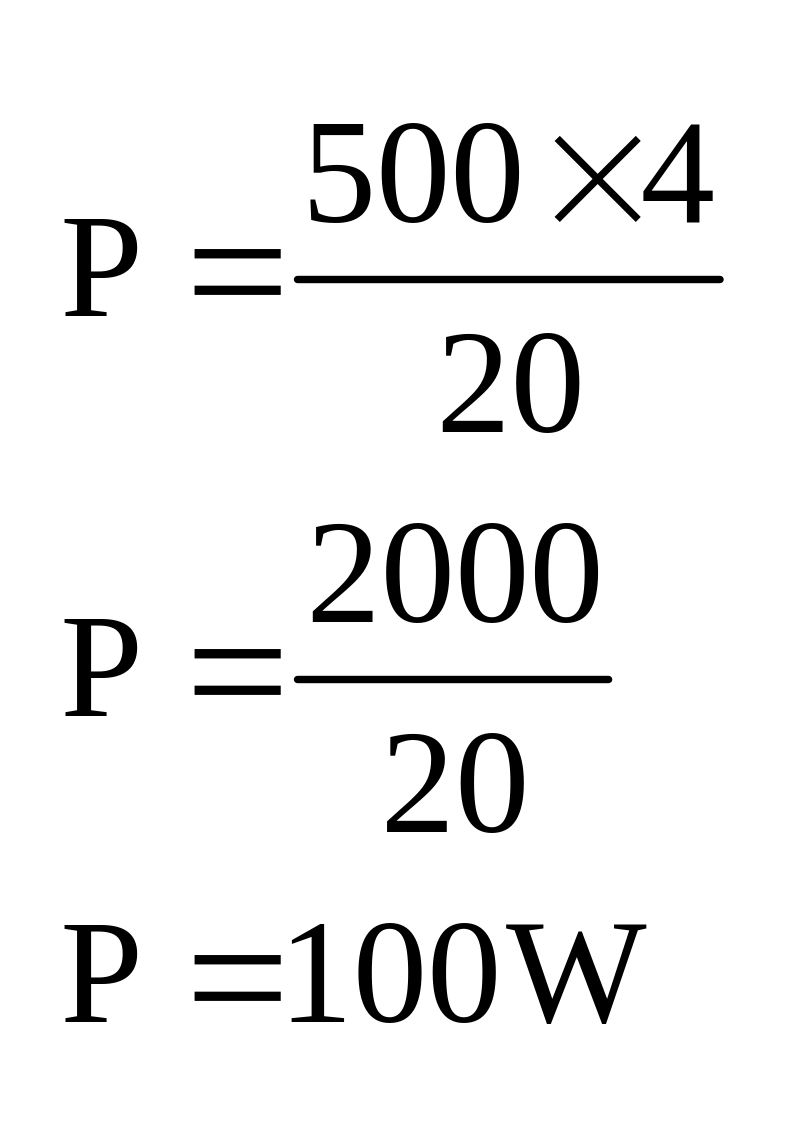
Numerical 8. A 50 kg man moved 25 steps up in 20 seconds. Find his power, if each step is 16 cm high. (GRW 2014)
Given Data:
Mass of man = m = 50 kg
Height of each step = h = 16 cm = 0.16 m
Number of steps = n = 25
Time taken = t = 20 s
To Find:
Power of the man = P = ?
Calculations:
Since
F = w
= mg
= (50) (10)
= 500 N
Height reached by man = h = 0.16 × 25
= 4 m
As we know that
By putting the values, we have
Result:
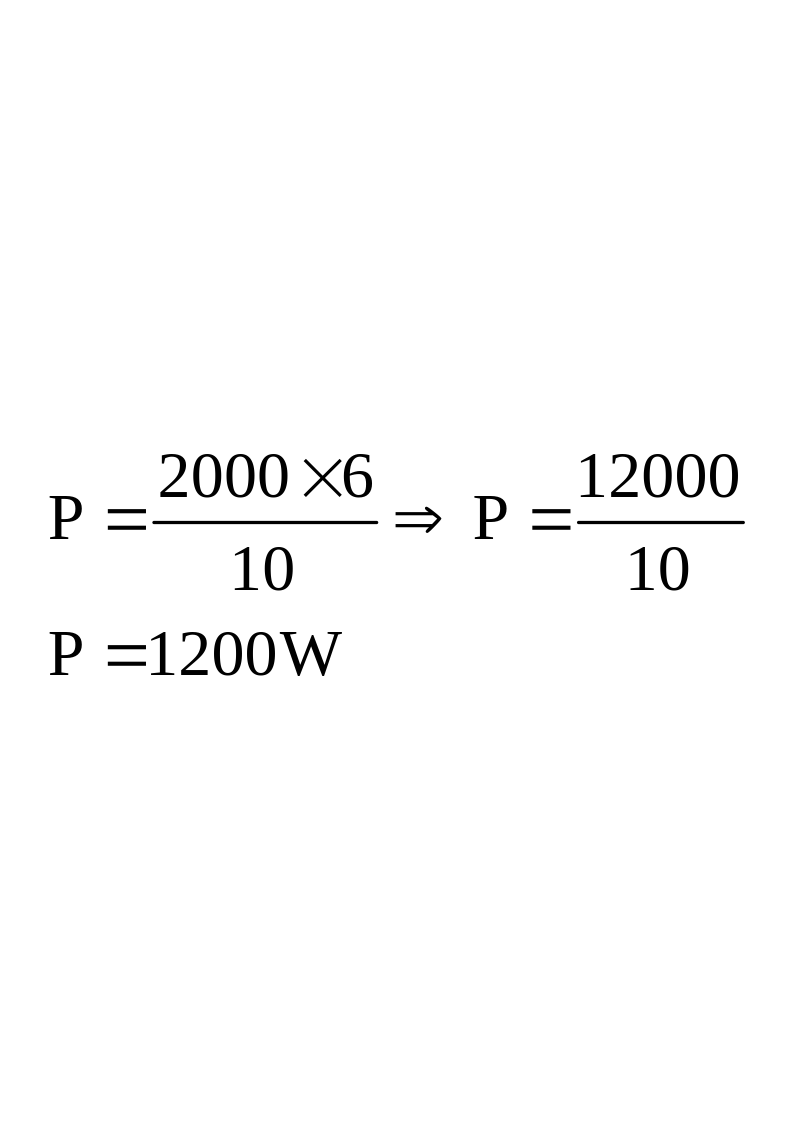
Numerical 9. Calculate the power of a pump which can lift 200 kg of water through a height of 6 m in 10 seconds. (LHR 2013, 2017, GRW 2013, 2014)
Given Data:
Mass of the water = m = 200 kg
Height attained = h = 6 m
Time taken = t = 10 s
To Find:
Power of the pump = P = ?
Calculations:
Since
F = w
= mg
= 200 × 10
= 2000 N
Numerical 10. As we know that By putting the values, we have Result: An electric motor of 1 hp is used to run water pump. The water pump takes 10 minutes to fill an overhead tank. The tank has a capacity of 800 liters and height of 15 m. find the actual work done by the electric motor to fill the tank. Also find the efficiency of the system. (Density of water = 1000 kgm-3)(Mass of 1 litre of water = 1kg)
Given Data:
Power of the motor = P = 1 hp
Time taken by pump = t = 10 mins = 600 s
Capacity of the tank = v = 800 liters
Height of the tank = h = 15 m
To Find:
Work done by the motor = W = ?
Efficiency of the system = ?
Calculations:
As we know that
P = So W = P x t
By putting the values, we have
W = 1 hp x 600s
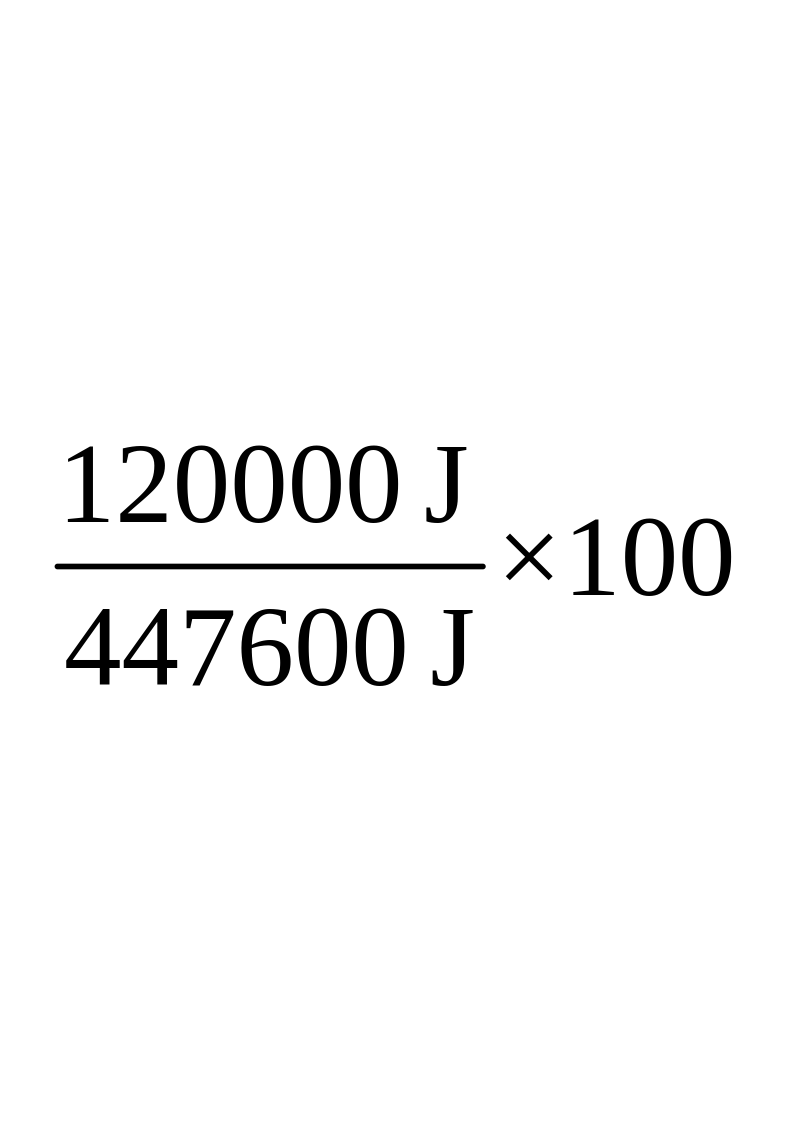
Or W = 746 w x 600s = 447600 J
Now Output = W = mgh
By putting the values, we have
Output = 800 x 10 x 15
Output = 120000 J
We also know that
% Efficiency =
By putting the values, we have
% Efficiency =
% Efficiency = 0.268 x 100
So, % Efficiency = 26.8%
Result:
TB.ST Self Test
Long Questions
Q1. What is an ideal system? Why is it not possible construct and ideal system practically?
Q2. Calculate the power of a pump which can lift 200 kg of water through a height of 6 m in 10 seconds.
Q3. Note:
Q4. Parents or guardians can conduct this test in their supervision in order to check the skill of students.
Short Questions
Q1. Why LED light is preferred to traditional electric bulb?
Q2. How much energy can be produced by 4 kg of matter?
Q3. Write three conditions for work to be zero.
Q4. What will be the effect on kinetic energy of a body if its speed is doubled?
Q5. Why fossil fuels are called non-renewable energy sources?