
Unit 4: Turning Effect of Forces — Notes
4.1 Like And Unlike Parallel Forces
4.2 Addition Of Forces
Long Questions
Q1. Which method is used for addition of forces? Explain with example.
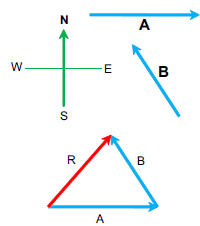
ADDITION OF FORCES
Force is a vector quantity. It has magnitude as well direction; therefore forces are not added by ordinary arithmetical rules. They are added by a method known as head to tail rule. By head to tail rule we get resultant force.
Resultant Force:
A resultant force is a single force that has same effect as the combined effect of all the forces to be added.
HEAD TO TAIL RULE
Definition:
“Graphical method of addition of vectors in which the representative lines of all the vector to be added are drawn in such a way that head of first vector coincides with the tail of second vector, and the head of second vector coincides with the tail of third vector and so on…the line obtained by joining the tail of first vector with the head of last vector represents resultant vector is called Head to Tail Rule.
Method:
Head to tail rule can be used to add any number of forces. The method of addition of two vectors is given below:
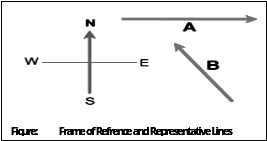
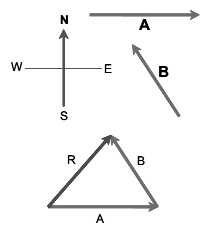
Select the frame of reference and suitable scale and draw the representative lines of all the vectors according to the scale; such as vector A and B.
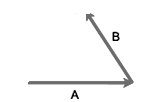
Take any one of the vectors as first vector e.g. vector A. then draw next vector B such that its tail coincides with the head of the first vector A. Similarly draw the next vector for the third force (if any) with its tail coinciding with the head of the previous vector and so on.
Now draw a vector R such that its tail is at the tail of vector A, the first vector, while its head is at the head of vector B
Vector R represents the resultant force completely in magnitude and direction. The length of the line according to scale represents the magnitude of the resultant vector. The direction of the resultant vector is from the tail of the first vector towards the head of the second.
Short Questions
Q1. What is meant by parallel forces?
PARALLEL FORCES
Definition:
“In a plane, if number of forces act on a body such that their points of action are different but their lines of action are parallel to each other, then these forces are called parallel forces.”
Types of Parallel Forces:
There are two types of parallel forces:
Like parallel forces
Unlike parallel forces
Example:
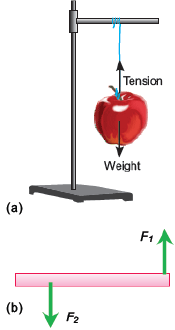
Suppose an apple is suspended by a string. The string is stretched due to weight of the apple. The forces acting on it are; weight of the apple acting vertically downward and tension in the string pulling it vertically upward. The two forces are parallel but opposite to each other. These forces are called unlike parallel forces as shown in the figure below:
Q2. What is meant by like and unlike parallel forces? Also give examples to differentiate them.
LIKE PARALLEL FORCES
Definition:
“Like parallel forces are the forces that are parallel to each other and have the same direction”.
Example:
Consider a bag with apples in it. The weight of the bag is due to the weight of all the apples in it. Since the weight of every apple in the bag is the force of gravity acting on it vertically downwards, therefore, weights of apples are the parallel forces. All these forces are acting in the same direction. Such forces are called like parallel forces.
UNLIKE PARALLEL FORCES
Definition:
“Unlike parallel forces are the forces that are parallel but have direction opposite to each other”
Example:
Suppose an apple is suspended by a string. The string is stretched due to weight of the apple. The forces acting on it are; weight of the apple acting vertically downward and tension in the string pulling it vertically upward. The two forces are parallel but opposite to each other. These forces are called unlike parallel forces.
Example To Differentiate Parallel Forces:
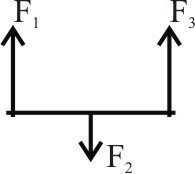
In the second figure below, the direction of the parallel forces F1 and F3 is the same, so these are like parallel forces. While the parallel forces F1, F2 and F2, F3 are acting in opposite direction, so these are unlike parallel forces.
Q3. Define Resultant Force
RESULTANT FORCE
Definition:
A resultant force can be defined as:
“A resultant force is a single force that has the same effect as the combined effect of all
the forces to be added”.
EXAMPLE 4.1
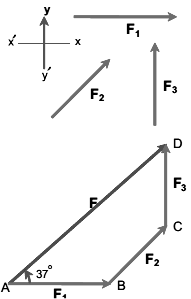
Q4. Find the resultant of three forces 12 N along x-axis, 8 N making an angle of 45° with x- axis and 8 N along y-axis.
Given Data:
First Force = F1 = 12 N along x-axis
Second Force =F2 = 8 N along 45° with x-axis
Third Force = F3 = 8 N along y-axis
Scale: 1 cm = 2 N
Graphical Representation:
Represent the forces by vectors F1, F2 and F3 according to the scale in the given direction.
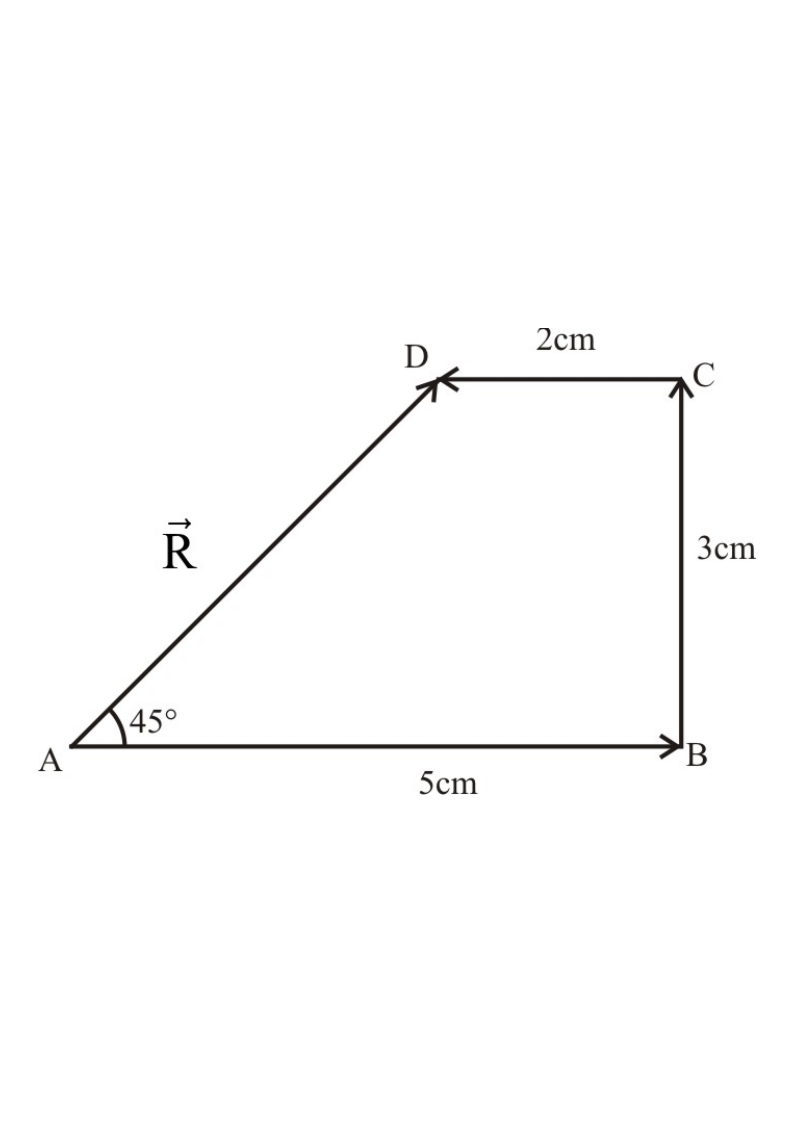
Arrange these forces F1, F 2 and F3 such that the tail of force F2 coincides with the head of force F1 at point B. Similarly, the tail of force F3 coincides with the head of force F2 at point C.
Join point A the tail of the force F1 and point D the head of force F3. Let AD represents force F. According to head to tail rule, force F represents the resultant force as shown in the figure:
Measure AD and multiply it by 2 cm the scale to find the magnitude of the resultant force F in (N).
Measure the angle <DAB using a protractor which the force F makes with x-axis. This gives the direction of the resultant force.
Result:
4.3 Resolution Of Forces
Long Questions
Q1. Define and Explain Resolution of Forces
RESOLUTION OF FORCES
Introduction:
The process of splitting up vectors (forces) into their component forces is called Resolution of forces. If a force is formed from two mutually perpendicular components then such components are called perpendicular components. They are also called Rectangular components.
Definition:
“Splitting up of a force into two mutually perpendicular components is called the resolution of that force.”
Explanation:
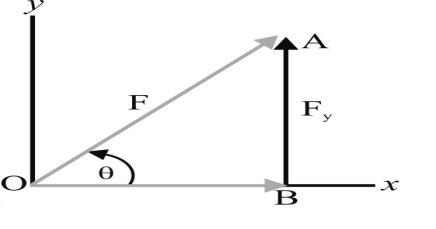
Consider a vector F acts on a body by making an angle θ with the x-axis which is represented by the vector OA as shown in the figure. Draw perpendicular from A on x-axis as AB as shown in the figure:
Draw a perpendicular AB on x-axis from A. According to head to tail rule, OA is the resultant of vectors represented by OB and BA.
According to head to tail rule, OA is the resultant vector of vectors represented by OB and BA.
So, OA = OB + BA ……….…… (1)
Since the angle between BA and OB is 900, hence these are called the perpendicular components of the vector OA representing force F.
Horizontal or x-component:
The component OB along x-axis is represented by Fx and is called the X-component or horizontal component of the vector F.
Vertical or y-component:
The component BA is represented by Fy and is called the y-component or vertical component of the vector F.
So equation (1) can be represented by:
F = Fx + Fy
Magnitudes of Rectangular Components:
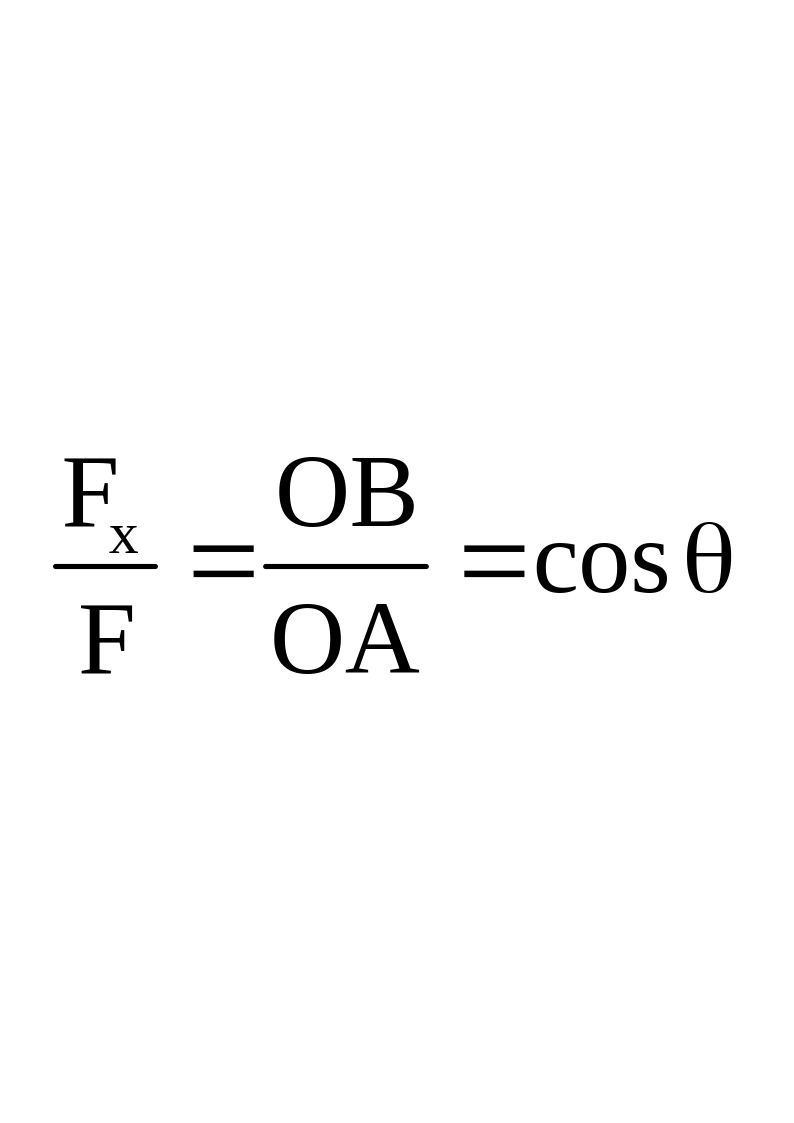
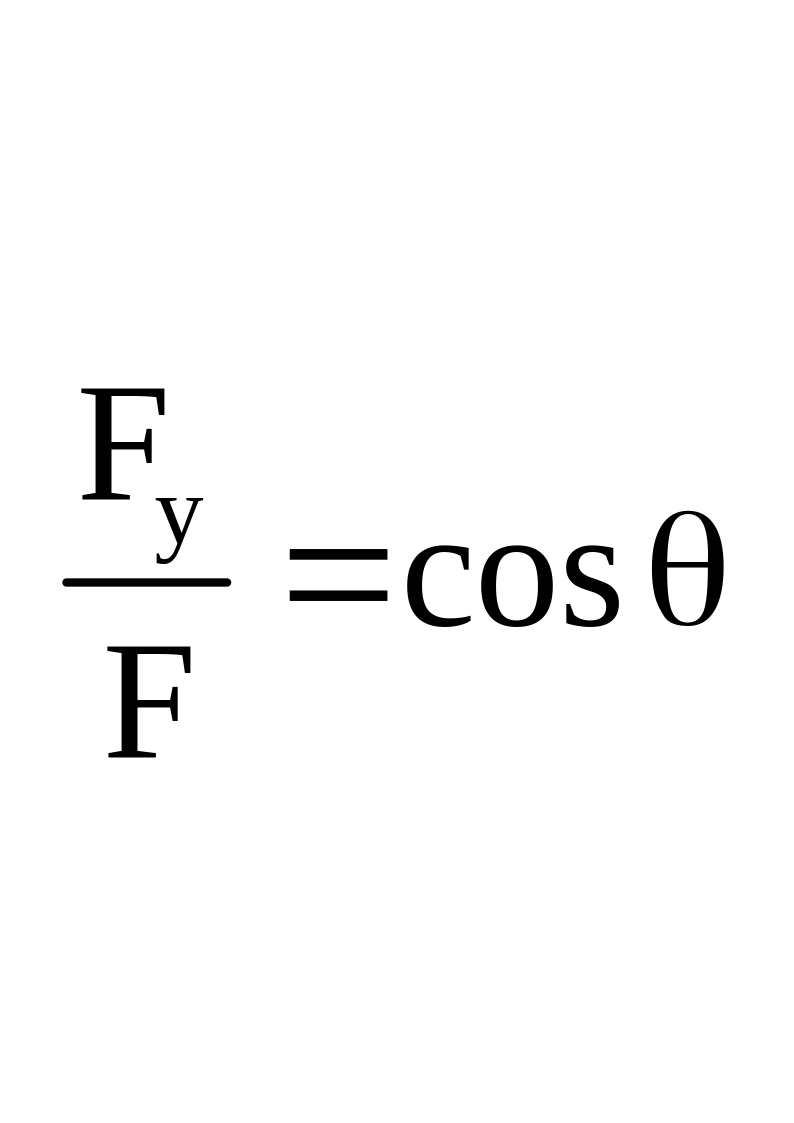
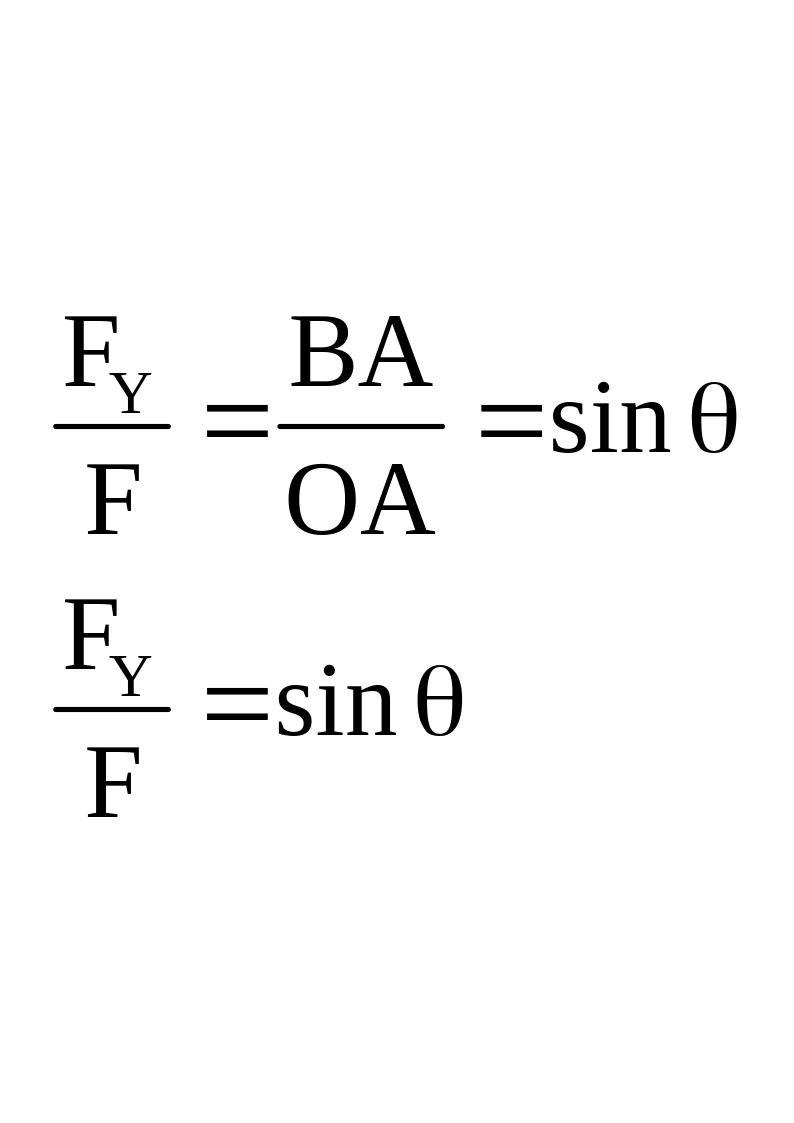
The magnitude of the perpendicular components Fx and Fy of forces can be found
by using the trigonometric ratios. In right angled triangle OAB,
Hence
Similarly,
Therefore,
Conclusion:
Q2. Find the magnitude and direction of a vector whose rectangular components are given.
DETERMINATION OF A FORCE FROM PERPENDICULAR COMPONENTS
Introduction:
Since a force can be resolved into two perpendicular components. Its reverse is to determine the force knowing its perpendicular components.
Explanation:
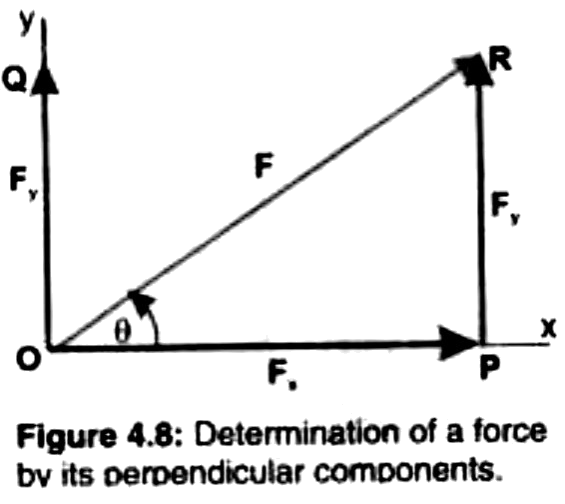
Consider Fx and Fy as the perpendicular components of a force F. These perpendicular components Fx and Fy are represented by lines OP and PR respectively as shown in figure:
According to head to tail rule:
OR = OP + PR
Thus OR will completely represent the force F where x and y-components are Fx and Fy respectively.
F = Fx+ Fy
Magnitude of the Force:
The magnitude of the force F can be determined using the right angled triangle OPR as,
According to Pythagoras Theorem
(Hypotenuse)2 = (Base)2 + (Perpendicular)2
(OR)2 = (OP)2 + (PR)2
F2 = Fx2 + Fy2
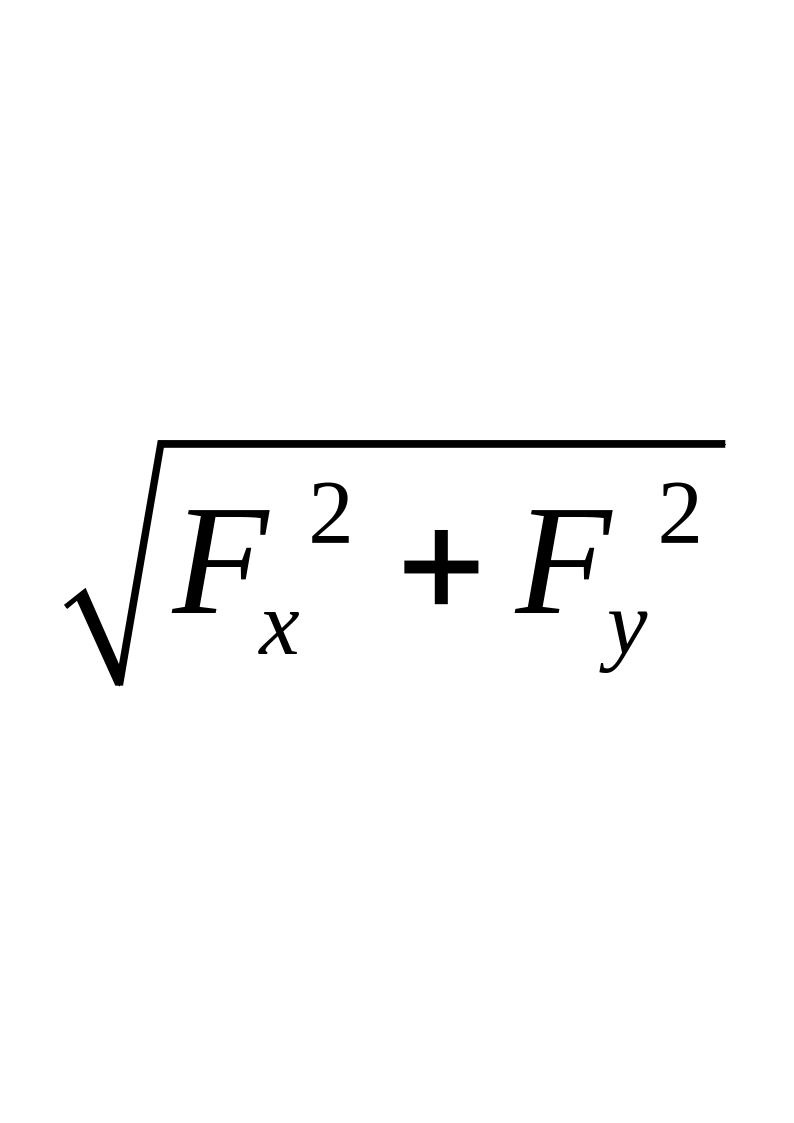
Hence F =
Direction of the Force:
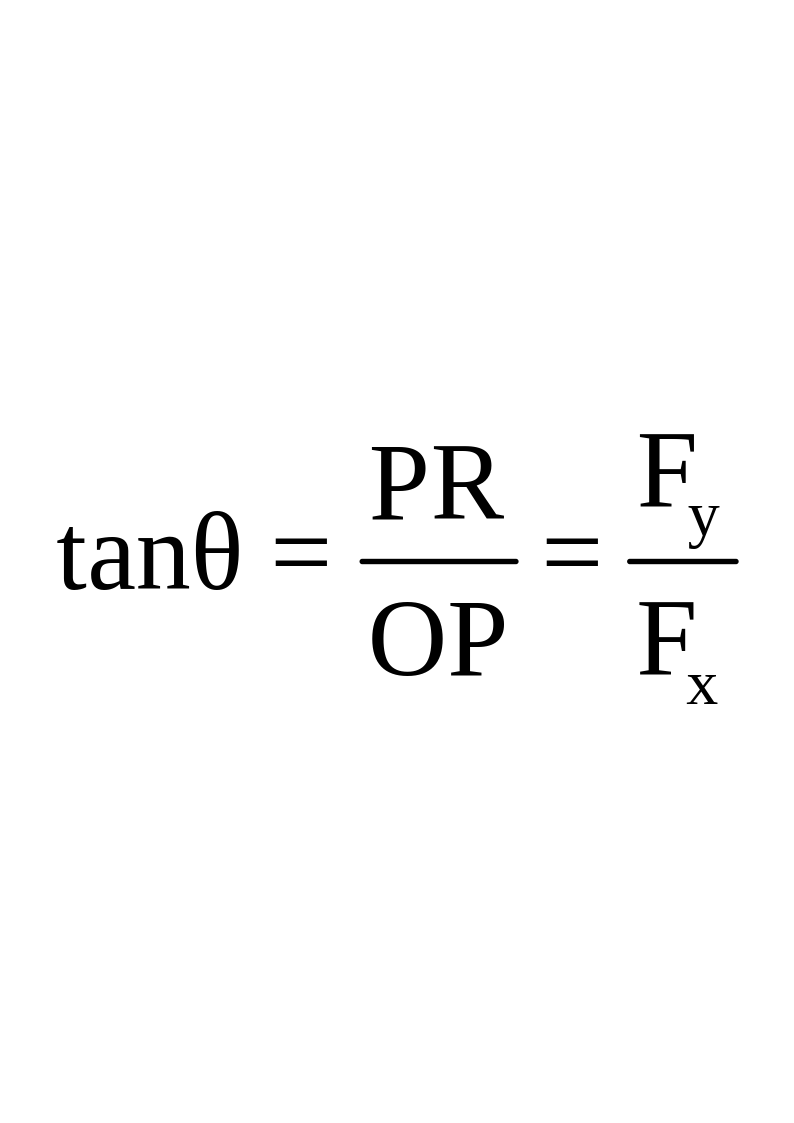
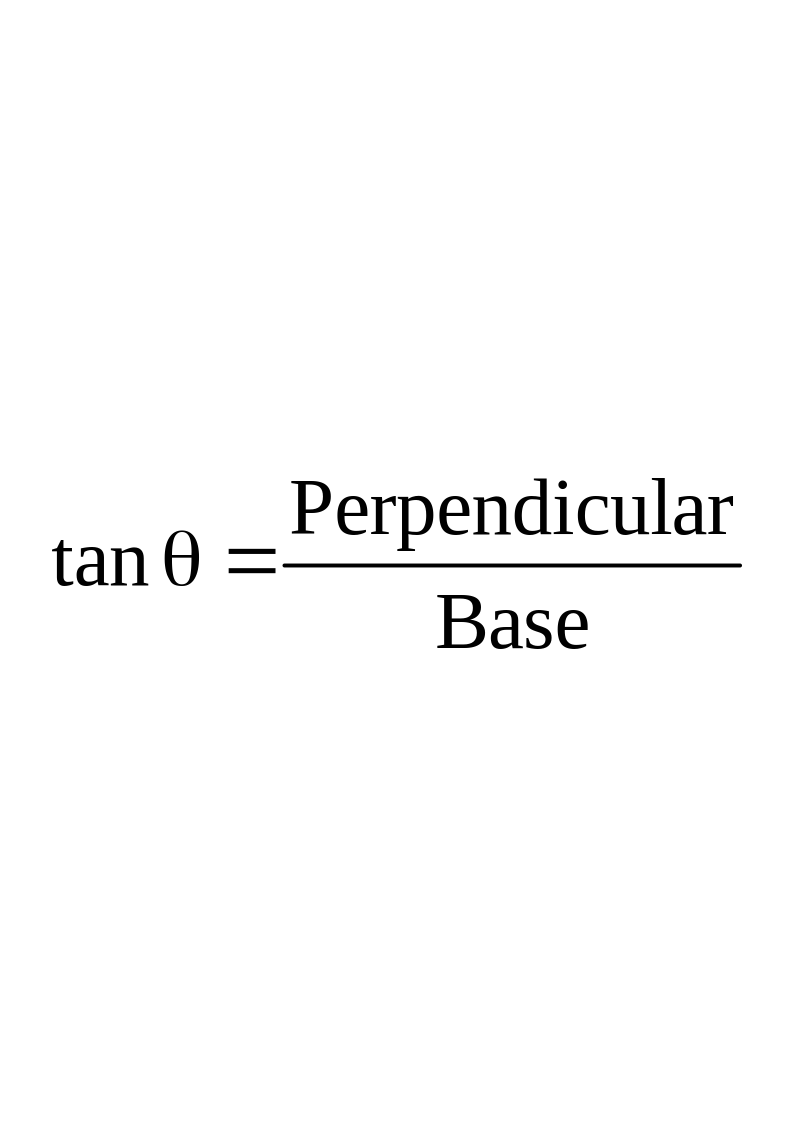
Direction of the force F with x-axis is given by,
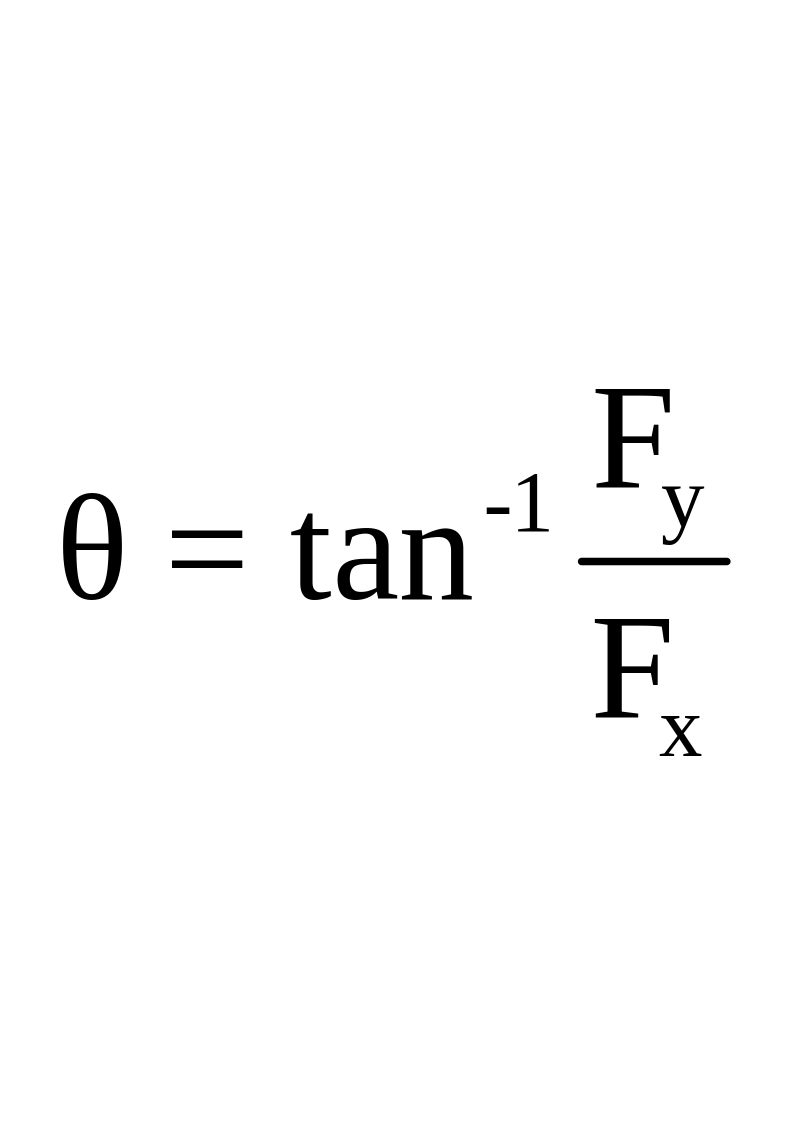
So,
The value of the angle can be determined by using trigonometric tables or calculator.
Conclusion:
Short Questions
Q1. Define Resolution of Forces. (LHR 2017)
RESOLUTION OF FORCES
Definition:
“Splitting up of a force into two mutually perpendicular components is called the resolution of that force.”
A force can be resolved into many components usually we resolve it into its Perpendicular components. They are also called Rectangular components like Fx and Fy.
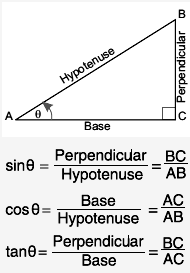
Q2. Define Trigonometric Ratios. Give Examples
TRIGONOMETRIC RATIOS
Definition:
“The ratios between any of the two sides of a right angle triangle are called trigonometric ratios”
Examples:
Consider a right angled triangle ABC having angle θ at A as shown in the figure:
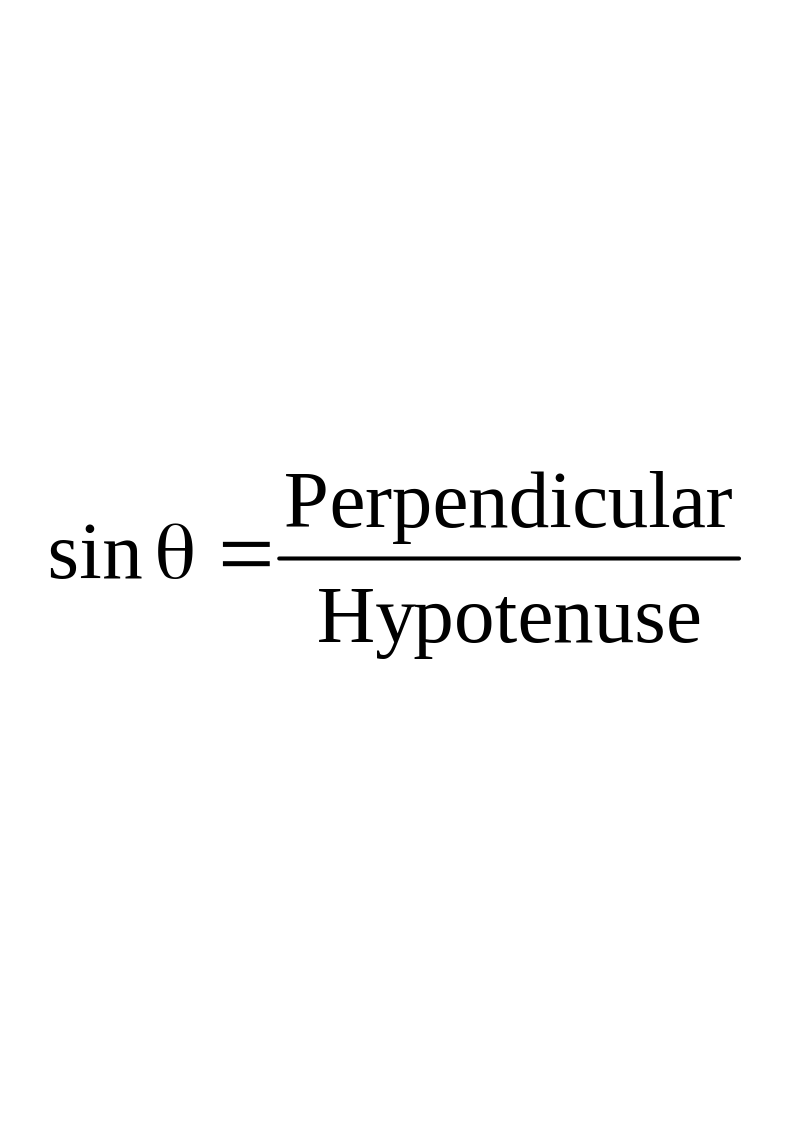
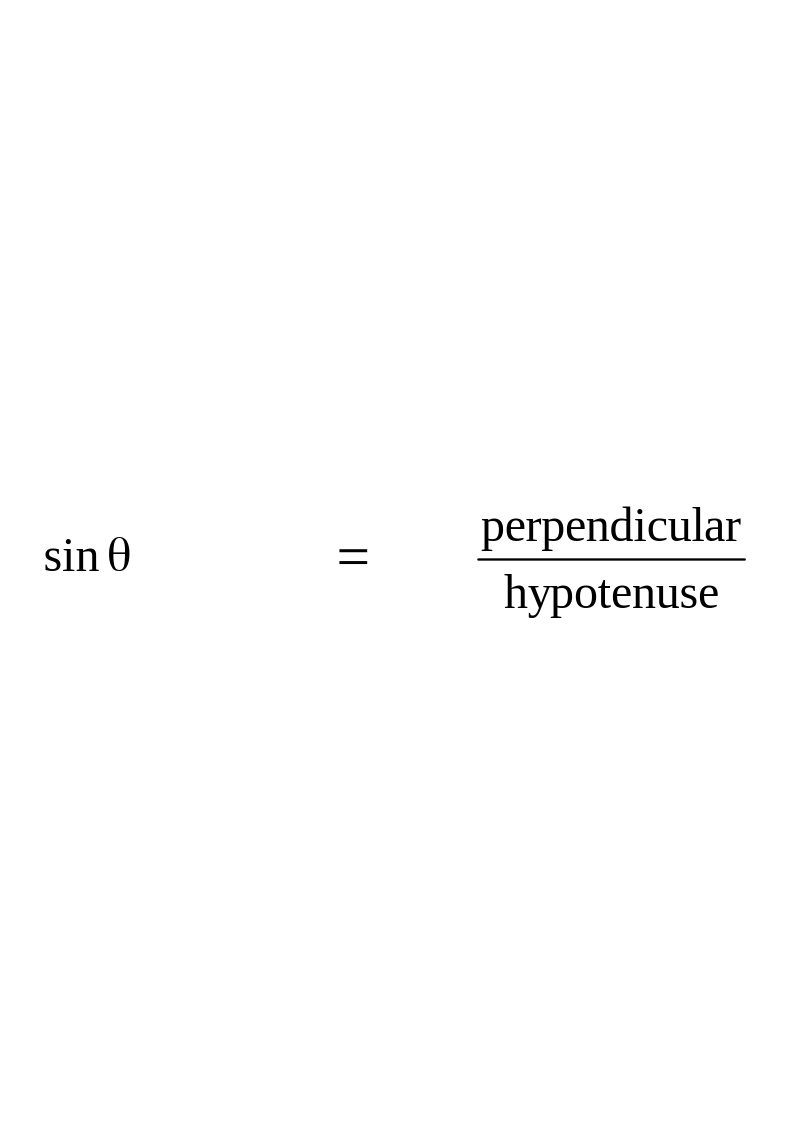
Q3. Define sin θ?
SIN θ
Definition:
“For a right angled triangle the ratio between Perpendicular and Hypotenuse is called sin θ”
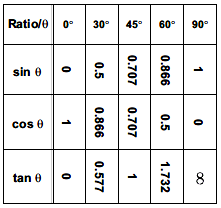
Q4. Sketch values of Trigonometric values at different angles.
VALUES OF TRIGONOMETRIC RATIOS
Some values of Trigonometric Ratios are given below:
In a right angled triangle length of base is 4 cm and its perpendicular is 3 m.
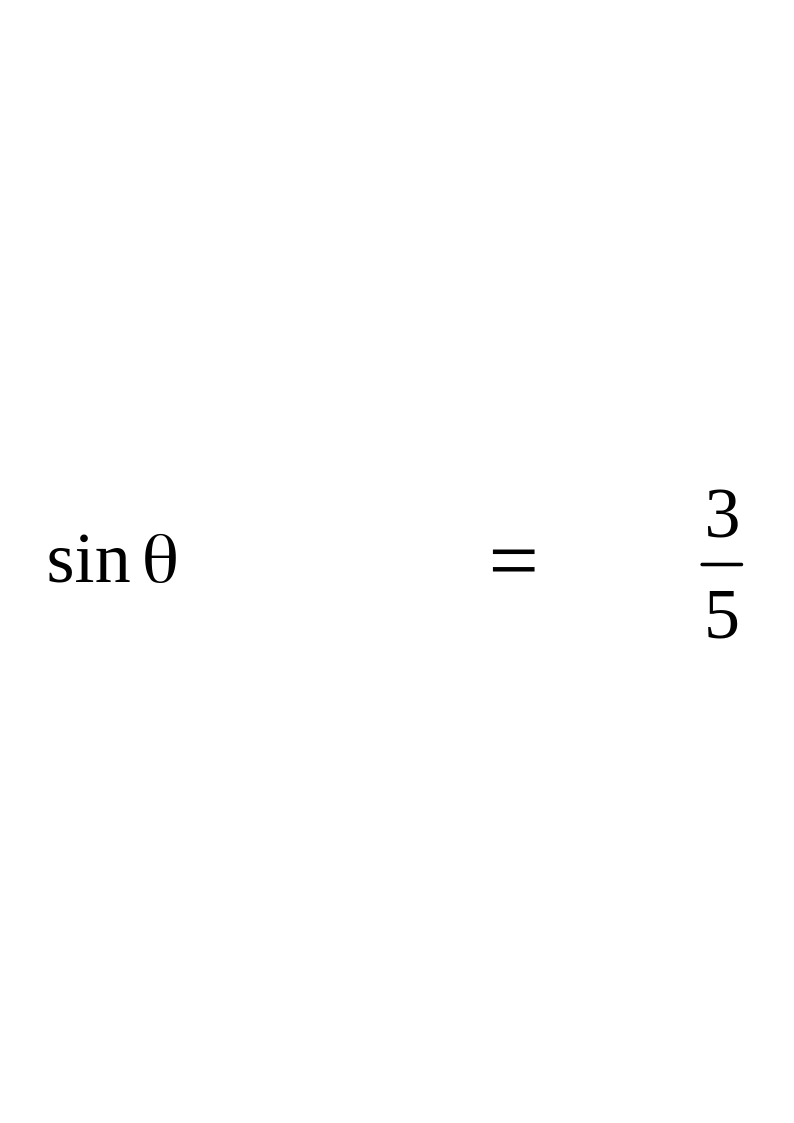
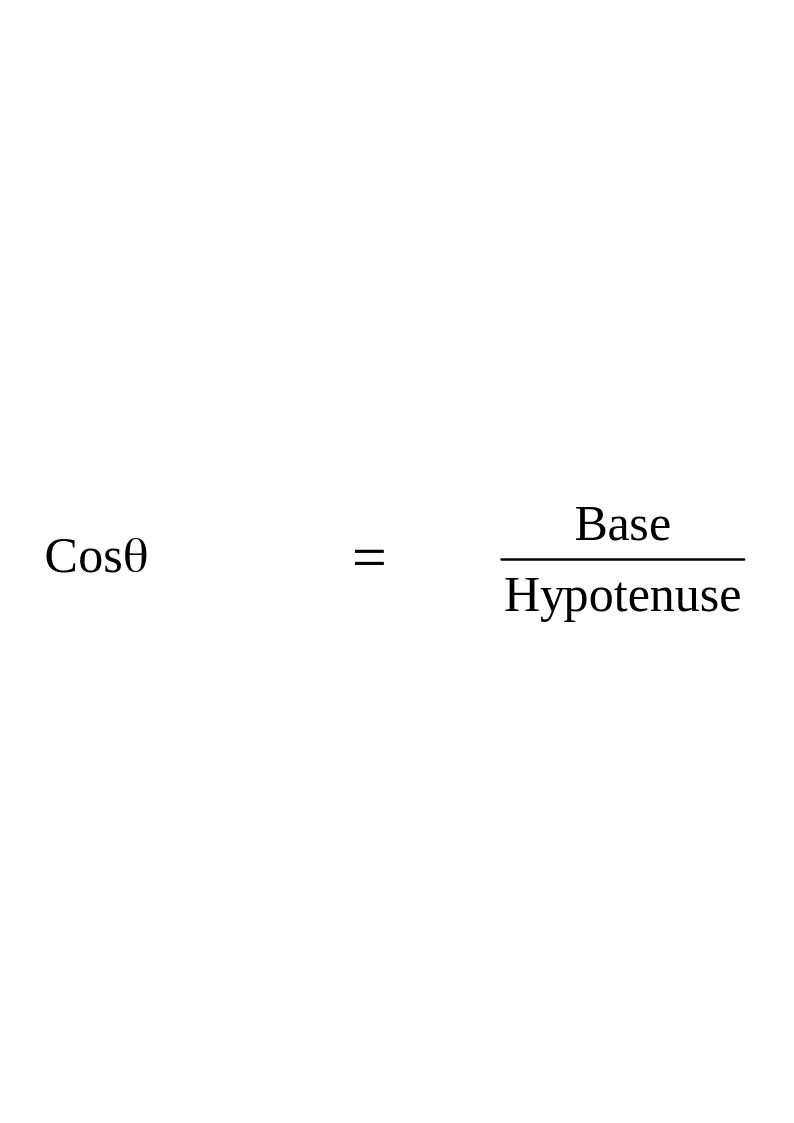
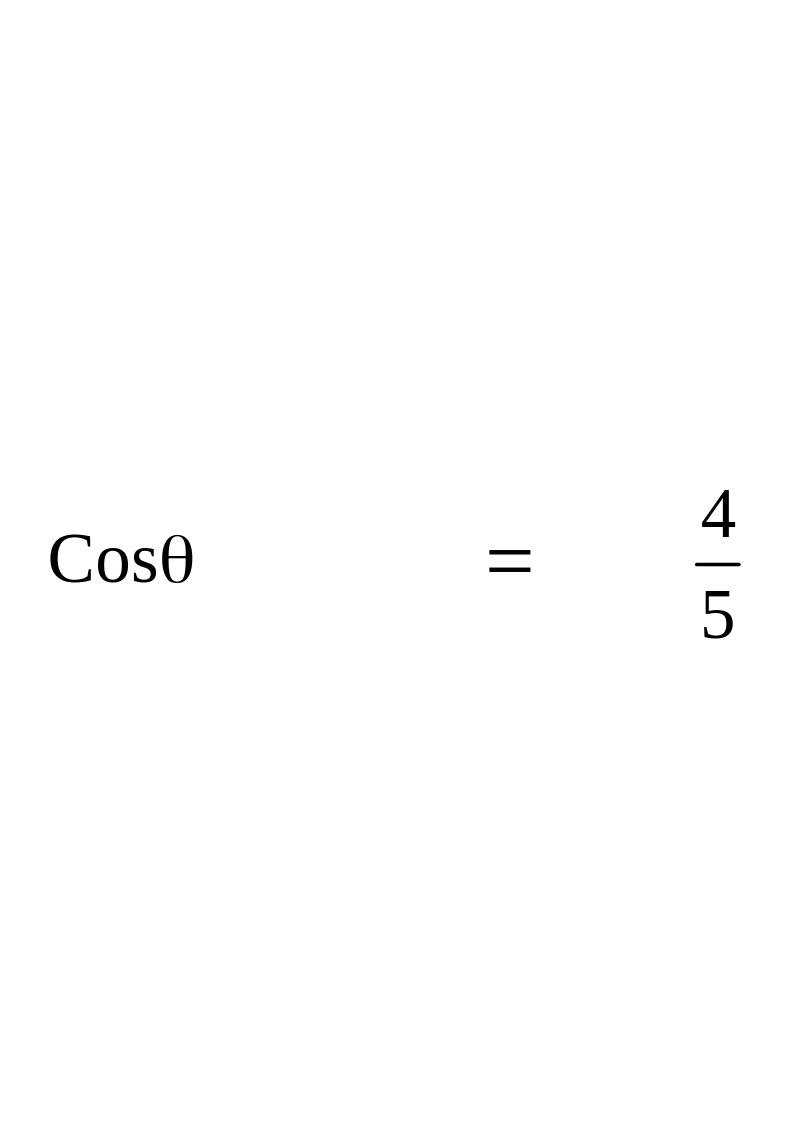
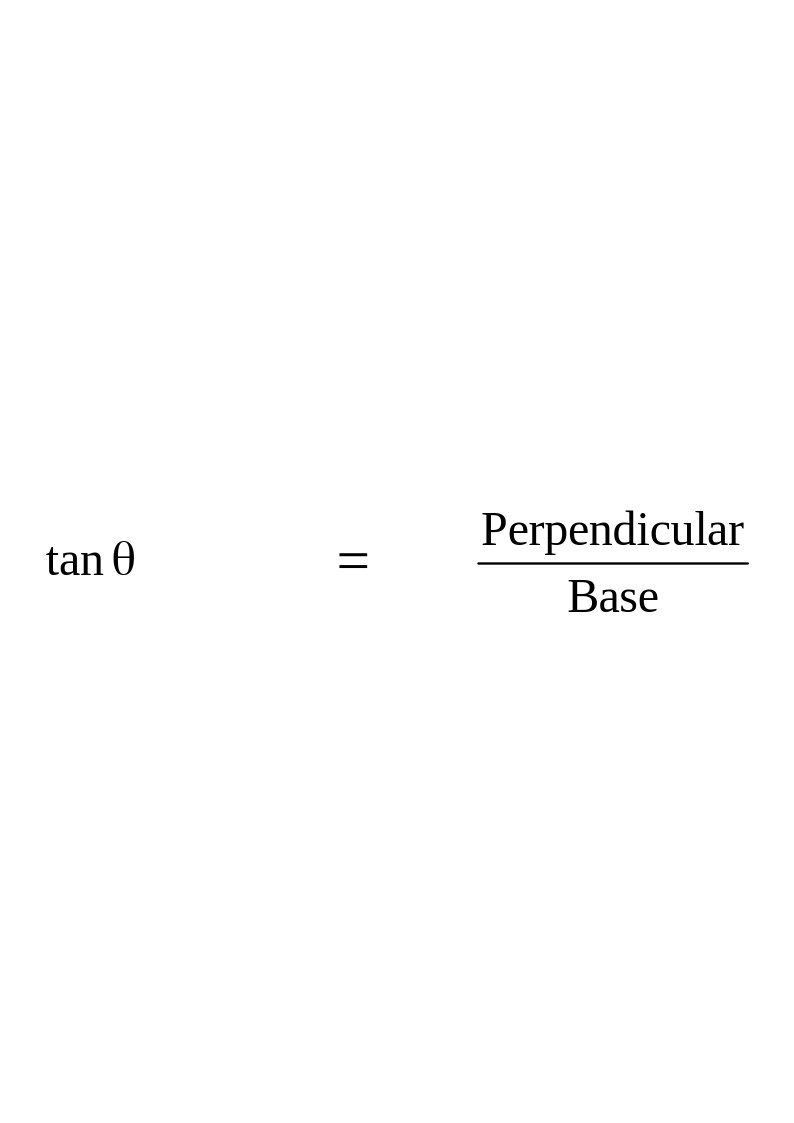
Q5. Find: (i) length of hypotenuse (ii) sin (iii) cos (iv) tan
(i) We know that,
(Hypotenuse)2 = (Base)2 + (Perpendicular)2
= (4)2 + (3)2
= 16+9
= 25
By taking square root on both sides
Hypotenuse = 5cm
(ii) As we know that
So
(iii) As we know
So
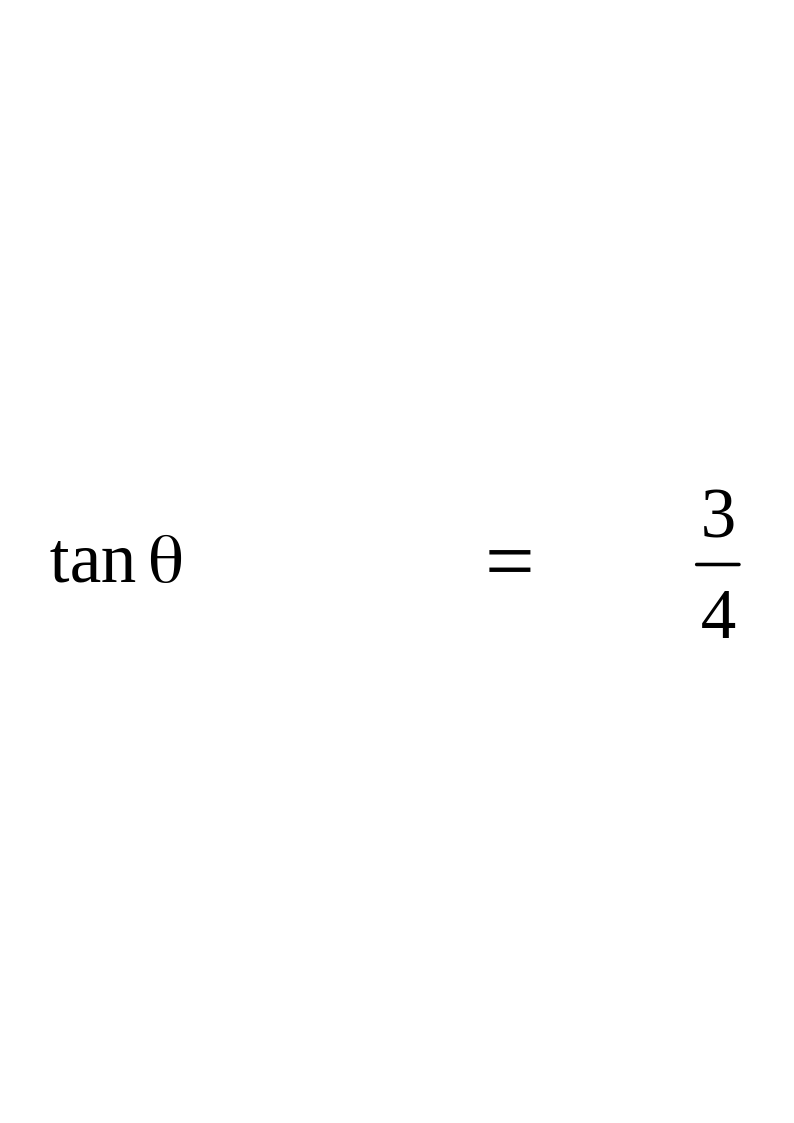
(iv) As we know that
So
EXAMPLE 4.2
Q6. A man is pulling a trolley on a horizontal road with a force of 200 N making 30° with the road. Find the horizontal and vertical components of its force.
Given Data:
Force applied on trolley =F = 200N
Angle of force with the road = θ = 30°
To Find:
Horizontal Component of the force= Fx = ?
Vertical Component of the force= Fy = ?
Calculations:
We Know
Fx = F cos θ
Putting values
Fx = 200 cos 30°
Fx = 200 (0.866)
Fx = 173.2 N
We Know
Fy = F sin θ
Putting values
Fx = 200 sin 30°
Fx = 200 (0.5)
Fx = 100N
Result:
4.4 Torque Or Moment Of A Force
4.5 Principle Of Moments
Short Questions
Q1. Define Torque. Write its formula and unit? (GRW 2017)
TORQUE
Definition:
“The turning effect of a force is called torque. It is also called Moment of Force”.
Formula:
Moment of Force (Torque) is denoted by Greek letter “τ” and its formula is given below:
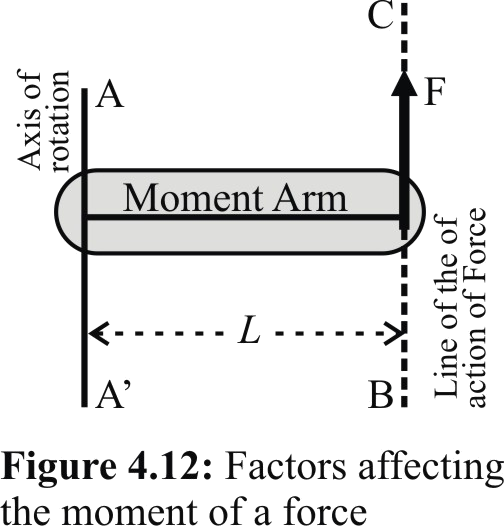
Torque = Moment arm x Force
τ = F x L
Unit:
In the system international, the unit of torque is Newton meter (Nm). A torque of 1 N m
is caused by a force of 1 N acting perpendicular to the moment arm of 1m long.
1Nm = 1 kgm2s-2
Quantity:
Torque is a vector and derived quantity.
Examples:
Common examples of Torque are as follows:
Turning pencil in a sharpener
turning stopcock of a water tap,
turning doorknob
Opening or closing a nut by using spanner
Q2. Write factors effecting Torque
FACTORS EFFECTING TORQUE
We know
τ = F x L
Above formula shows that Moment of force (torque) produced in a body depends on the following two factors:
Force (F)
Moment arm (L)
Force:
Greater is the force; greater is the moment of the force (torque).
Moment Arm: (LHR 2015)
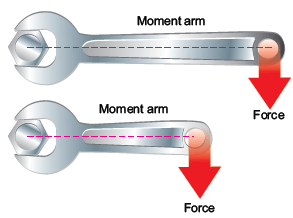
“The perpendicular distance between the line of action of the force and the axis of rotation, is known as moment arm”. It is measured in metres and centimetres. Longer is the moment arm greater is the moment of force.
Q3. Define Moment arm.
MOMENT ARM
Definition:
“The perpendicular distance between the line of action of the force and the axis of rotation, is known as moment arm”.
Unit:
Its SI unit is metre (m) but it is also measure in centimetres.
Effect on Torque:
Longer is the moment arm greater is the moment of force (Torque)
Example:
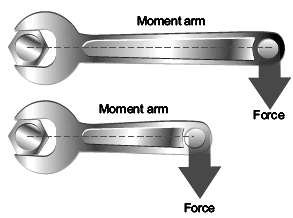
Mechanics loosen or tighten the nut or a bolt with the help of a spanner. A spanner having long arm helps him to do it with greater ease then the one having short arm. It is because the turning effect of the force is different in the two cases. The moment produced by the same force but using a spanner of short arm.
Q4. Why do we prefer a spanner of longer arm for loosening or tightening a nut?
SPANNER OF LONGER ARM
We Know
τ = F x L
Above formula shows that Moment of force (torque) produced in a body depends on the following two factors:
Force
Moment arm
Longer is the moment arm greater is the moment of force (Torque)
Example:
Mechanics loosen or tighten the nut or a bolt with the help of a spanner. A spanner having long arm helps him to do it with greater ease then the one having short arm. It is because the turning effect of the force is different in the two cases. The moment produced by a force using a spanner of longer arm is greater than the torque produced by the same force but using a spanner of shorter arm.
Q5. Why do we put handle of the door at its extreme edge?
HANDLE OF THE DOOR
We Know
τ = F x L
Above formula shows that Moment of force (torque) produced in a body depends on the following two factors:
Force
Moment arm
Longer is the moment arm greater is the moment of force (Torque), In order to increase moment arm we put handle of the door at its extreme edge. Hence we can open or close a door more easily by applying a force at the outer edge of a door rather than near the hinge. Thus, the location where the force is applied to turn a body is very important.
Q6. How can we increase torque by keeping the force constant?
INCREASE IN TORQUE
We Know
τ = F x L
Above formula shows that Moment of force (torque) produced in a body depends on the following two factors:
Force
Moment arm
We can increase the torque by increasing its moment arm while keeping the force constant.
Q7. Define Rigid Body? (LHR 2012, 2014, GRW 2015)
RIGID BODY
Definition:
“A body is composed of large number of small particles. If the distances between all pairs of particles of the body do not change by applying a force then it is called a rigid body. In other words, a rigid body is the one that is not deformed by force or forces acting on it”.
Q8. Define Axis of Rotation. (LHR 2012, 2013, 2017, GRW 2011, 2013, 2015)
AXIS OF ROTATION
Definition:
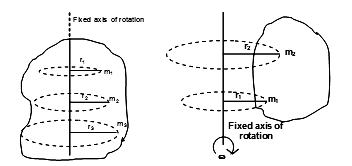
“Consider a rigid body rotating about a line. The particles of the body move in circles with their centres all lying on this line. This line is called the axis of rotation of the body”.
Q9. Differentiate between axis of rotation and point of rotation?
DIFFERENTIATION
Axis of rotation and point of rotation can be differentiated as:
| Axis of Rotation | Point of Rotation |
| Definition | Definition |
| Axis of rotation is a line about which the whole body rotates. | Point of rotation is just a point about which the body rotates. |
| Example | Example |
| When we open the door, the door will move about its hinges or axis of rotation. | If we move a stick about its centre of gravity, then that point becomes the point of rotation. |
Q10. Define types of moment. OR Define clockwise and anticlockwise moments.
TYPES OF MOMENTS
There are two types of moments:
Clockwise Moment:
A force that turns a body in the clockwise direction is generally used to tighten a nut by a spanner. The torque or moment of the force so produced is called clockwise moment.
According to Right Hand Rule clockwise moment is taken as negative.
Anticlockwise Moment:
A force that turns a body in the anticlockwise direction is generally used to loosen a nut by a spanner. The torque or moment of the force so produced is called anticlockwise moment.
According to Right Hand Rule anticlockwise moment is taken as positive.
Q11. What is meant by principle of moments? (GRW 2013, 2014)
PRINCIPLE OF MOMENT
Introduction:
A body initially at rest does not rotate if sum of all the clockwise moments acting on it is balanced by the sum of all the anticlockwise moments acting on it. This is known as the principle of moments.
Statement:
According to Principle of Moment:
“A body is balanced, if the sum of clockwise moments acting on the body is equal to the sum of anticlockwise moments acting on it.”
A force of 150 N can loosen a nut when applied at the end of a spanner 10cm long.
Q12. Find its torque. (Mini Exercise Pg. # 92)
Given Data:
Force used to loosen a nut =F = 150 N
Length of spanner = L = 10 cm
= 0.1 m
To Find:
Torque = = ?
Calculations:
We know
= F x L
= 150 x 0.1
= 15 Nm
What should be the length of the spanner to loosen the same nut with a 60 N force?
As
= F x L
15 = 60 x L
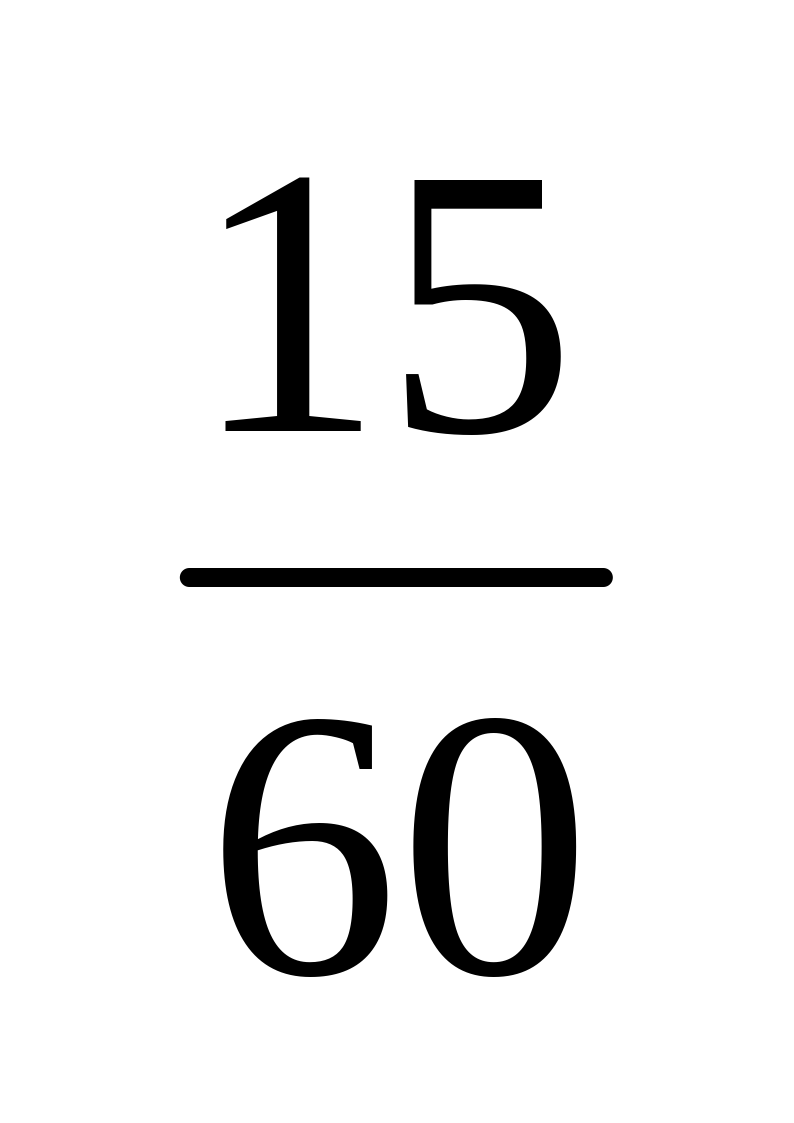
L =
= 0.25 m
= 25 cm
How much force would be sufficient to loosen it with a 6 cm long spanner?
As
L = 6 cm
= 0.06 m
= F x L
15 = F x 0.06 m
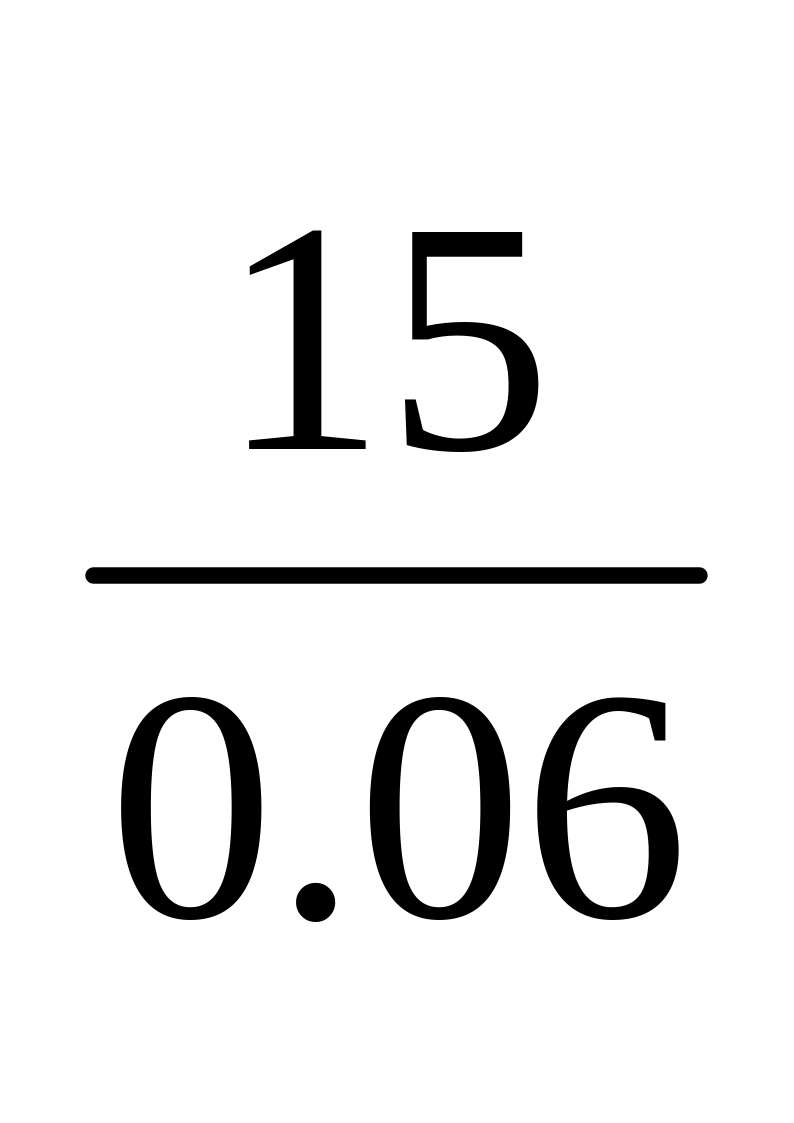
L =
= 250 N
Result:
Q13. Can a small child play with a fat child on the see-saw? Explain how?
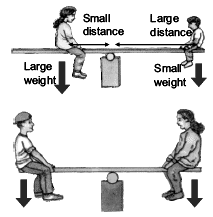
SEE-SAW
Yes, Fat child can play with smart child by adjusting the moment arm, as shown in the figure:
Q14. Two children are sitting on the see-saw, such that they cannot swing. What is the net torque in this situation? (Quick Quiz Pg. # 92)
NET TORQUE ON SEE-SAW
In this case, net torque would be zero because clockwise torque is equal to anticlockwise torque.
EXAMPLE 4.3
Q15. A mechanic tightens the nut of a bicycle using a 15 cm long spanner by exerting a force of 200 N. Find the torque that has tightened it.
Given Data:
Length of spanner = L = 15cm = 0.15m
Force exerted by mechanic = F = 200N
To Find:
Torque used to tighten the nut = = ?
Calculations:
We know
W = F x L
Ass Putting values
= 200 x 0.15
= 30Nm
Result:
EXAMPLE 4.4
Q16. A metre rod is supported at its middle point O as shown in figure below. The block of weight 10 N is suspended at point B, 40 cm from O. Find the weight of the block that balances it at point A, 25 cm from O.
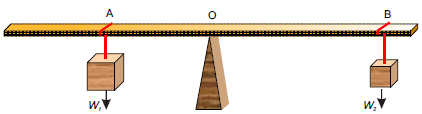
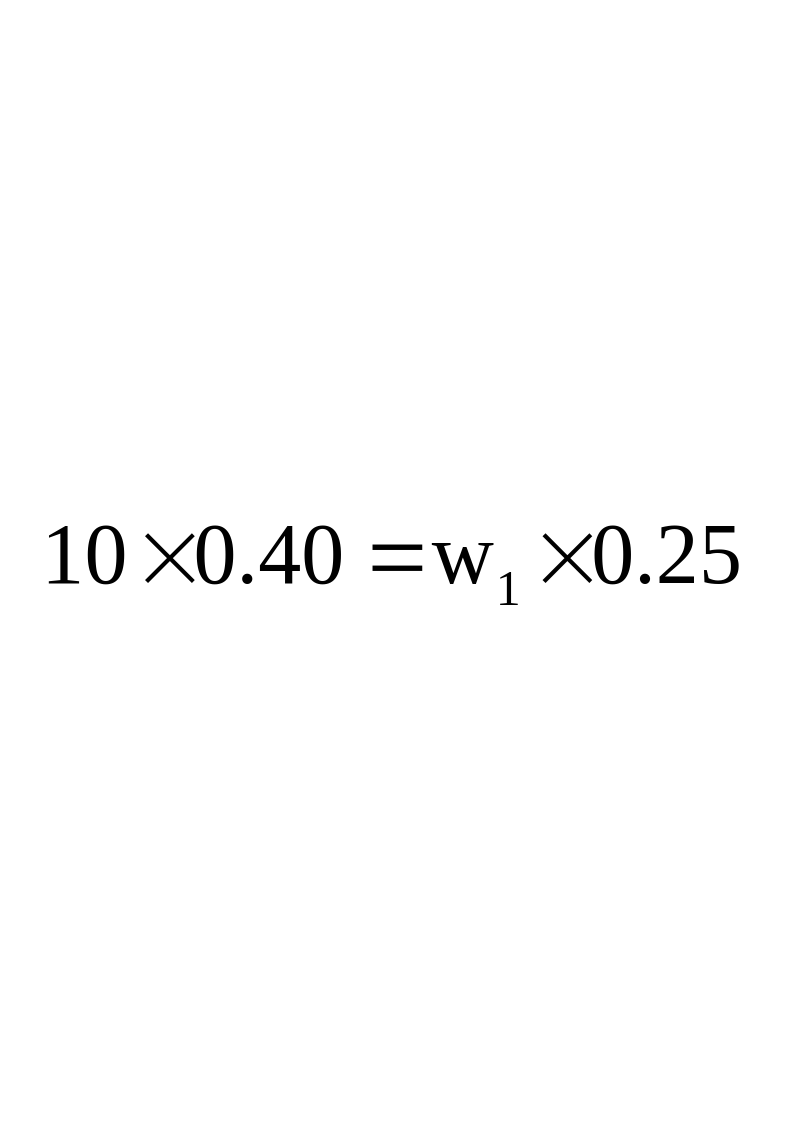
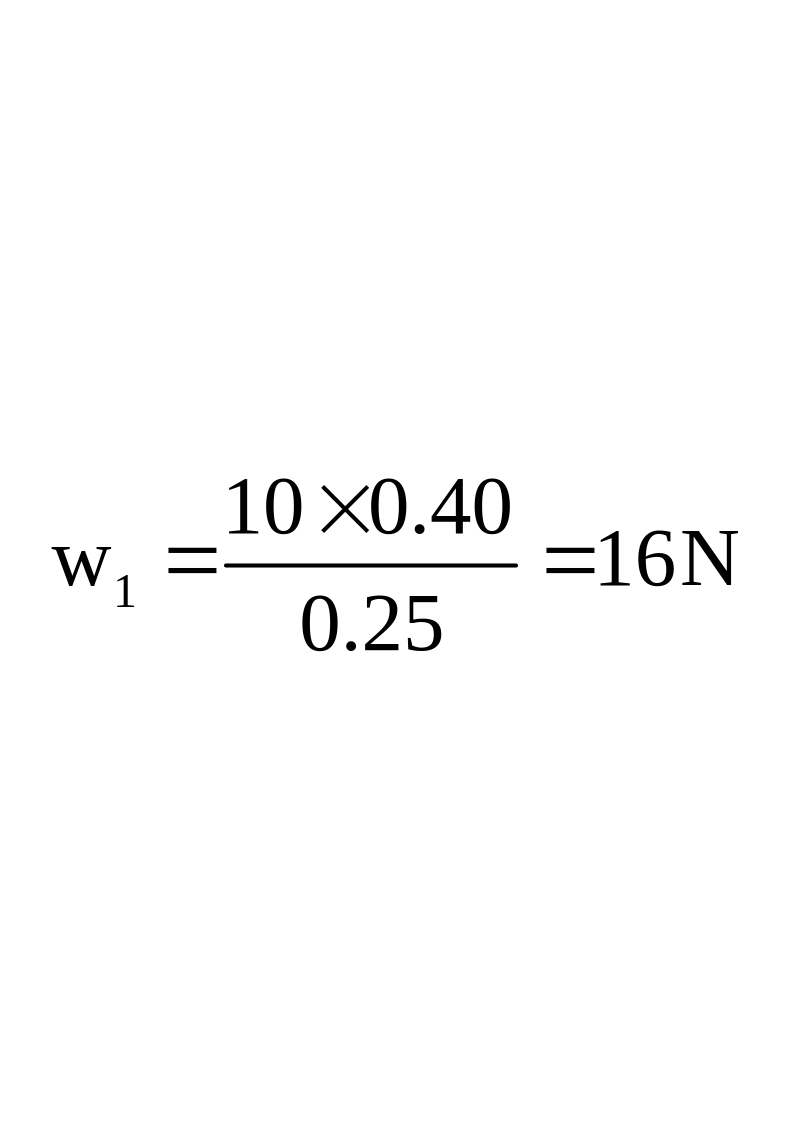
Given Data:
Weight of the suspended block = w2 = 10N
Moment arm of w1 = OA = 25cm = 0.25 m
Moment arm of w2 = OB = 40cm = 0.40 m
To Find:
Weight of the balancing block = w2 = ?
Calculations:
We know that
Clockwise moments = Anticlockwise moments
moment of w2 = moment of w1
Or w2 × momentum arm of w2 = w1 × momentum arm of w1
Putting values
Result:
4.6 Centre Of Mass, Centre Of Gravity
Short Questions
Q1. Define centre of Mass.
CENTRE OF MASS
Definition:
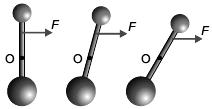
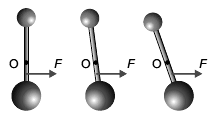
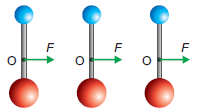
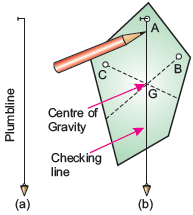
“Centre of mass of a system is such a point where an applied force causes the system to move without rotation.”
It is observed that the centre of mass of a system moves as if its entire mass is confined at that point. A force applied at such a point in the body does not produce any torque in it i.e. the body moves in the direction of net force F without rotation
Q2. Define centre of gravity.

CENTRE OF GRAVITY
Definition:
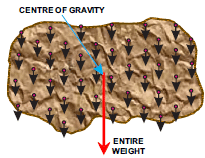
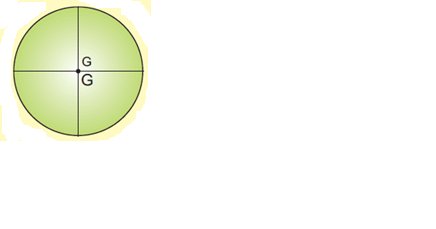
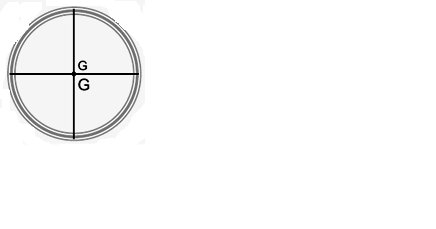
“A point in a body where the weight of the body appears to act vertically downward is called the centre of gravity.”
Position of Centre of Gravity:
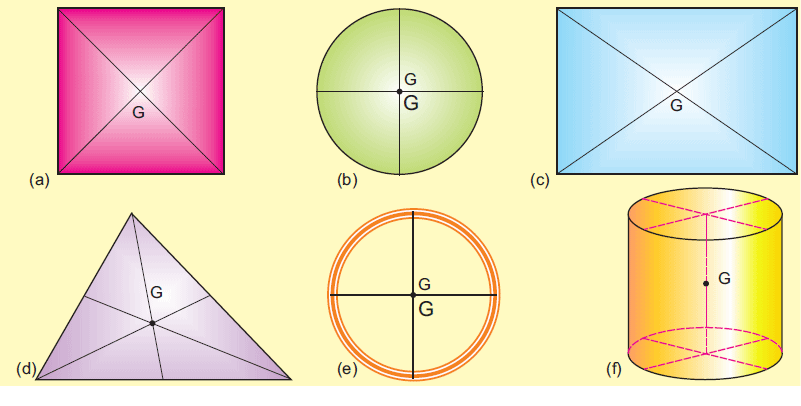
The centre of gravity can exist inside a body or outside the body. Position of the centre of gravity depends upon the shape of the body. A body is balanced when it is supported at its centre of gravity.
Examples:
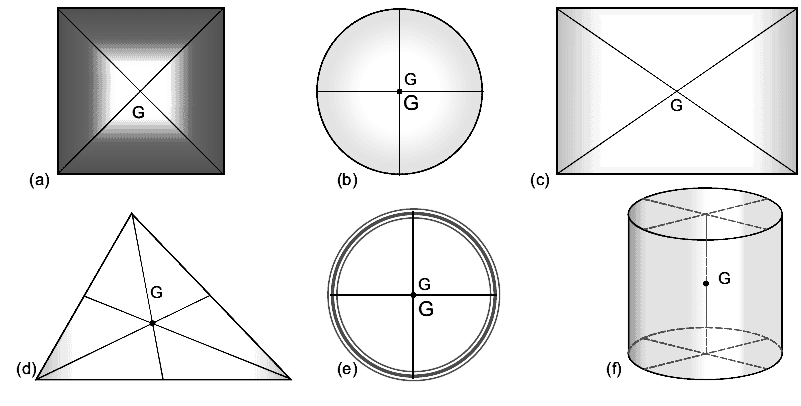
The centre of gravity of a uniform square or a rectangular sheet is the point of intersection of its diagonals.
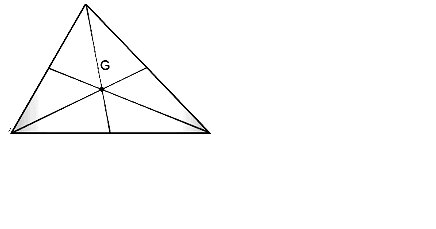
The centre of gravity of uniform triangular sheet is the point of intersection of its medians.
The centre of gravity of a uniform solid or hollow cylinder is the middle point on its axis.
4.7 Couple
Long Questions
Q1. Define and explain couple with examples.
COUPLE
Introduction:
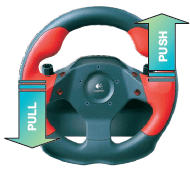
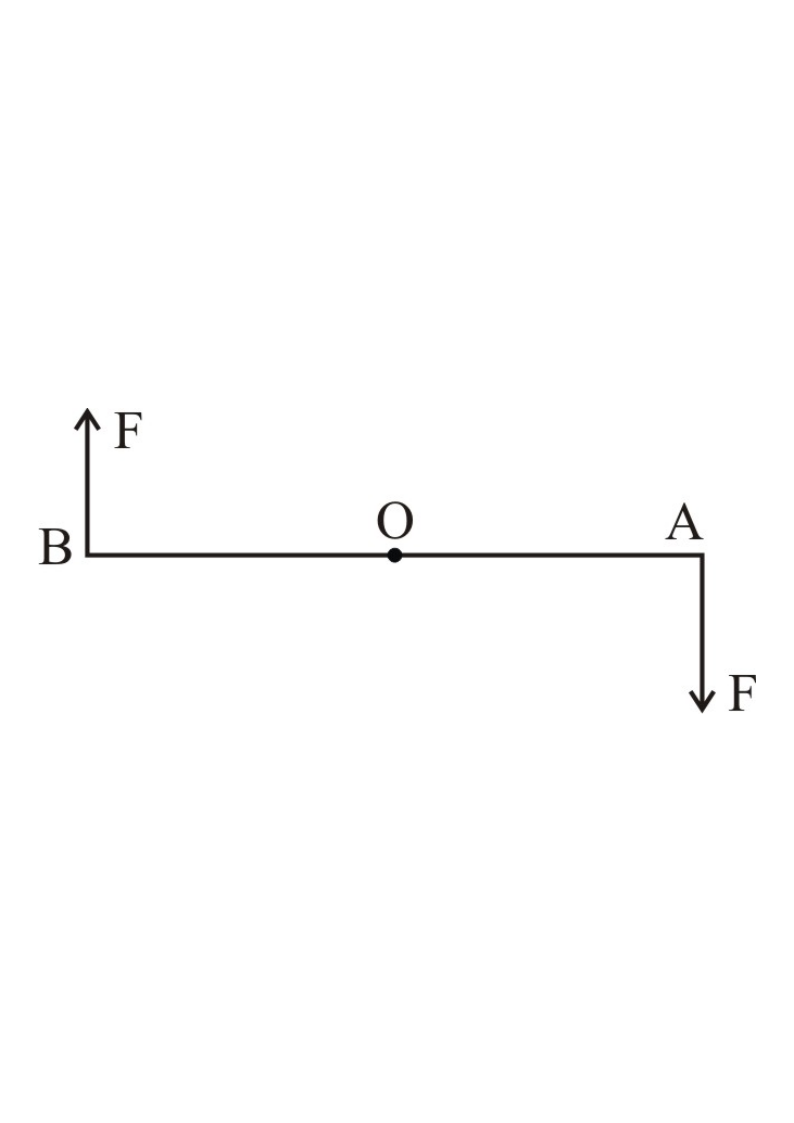
When a driver turns a vehicle, he applies forces that produce a torque. This car turns the steering wheel. These forces act on opposite sides of the steering and are equal in magnitude and opposite in direction as shown in the figure:
Definition:
“A couple is formed by two unlike parallel forces of the same magnitude but not along the same line”.
Examples:
While turning a car, the forces applied on the steering wheel by hands provide the necessary couple.
We apply couple while opening or closing a water tap.
We apply couple while locking or opening the stopper of a bottle or a jar.
Explanation:
A double arm spanner is used to open a nut. Equal forces each of magnitude F are applied
on ends A and B of a spanner in opposite direction as shown in figure:
These forces form a couple that turns the spanner about a point O. the torques produced by both forces of the couple have same direction. The total torque produced by the couple will be,
Total torque of the couple = F x OA + F x OB
= F (OA + OB)
Torque of the couple = F x AB
The above equation shows that torque produced by the couple of forces F and F separated by distance AB.
Torque Due To Couple:
The torque of a couple is given by the product of one of the two forces and perpendicular distance between them.
Couple Arm:
The perpendicular distance “r” between the two forces of the couple is called the couple arm.
Short Questions
Q1. Define couple with some examples.
COUPLE
Definition:
Couple can be defined as:
“A couple is formed by two unlike parallel forces of the same magnitude but not along the same line”
Examples:
While turning a car, the forces applied on the steering wheel by hands provide the necessary couple.
We apply couple while opening or closing a water tap,
We apply couple while locking or opening the stopper of a bottle or a jar.
Q2. Give an example of a case when the resultant force is zero but resultant torque is not zero.
RESULTANT TORQUE IS NOT ZERO
In case of couple, two equal and opposite forces are acting on a same body but even then the body rotates. In this case resultant force is zero but resultant torque is not zero.
Example:
While turning a car, the forces applied on the steering wheel by hands produce rotation in the steering wheel.
Q3. How does couple work when a cyclist pushes the pedals?
COUPLE IN PEDLING
A cyclist pushes the pedals of a bicycle. This forms a couple that acts on the pedals. The pedals cause the toothed wheel to turn making the rear wheel of the bicycle to rotate.
4.8 Equilibrium
4.9 Stability And Position Of Centre Of Mass
Long Questions
Q1. What is equilibrium? State and explain the conditions of equilibrium.
EQUILIBRIUM
Introduction:
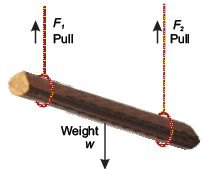
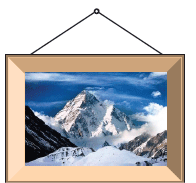
Newton’s first law of motion tells us that a body continues its state of rest or of uniform motion in a straight line if no resultant or net force acts on it. For example, a book lying on a table or a picture hanging on a wall, are at rest. The weight of the book acting downward is balanced by the upward reaction of the table. Consider a log of wood of weight w supported by ropes as shown in figure below:
Here the weight w is balanced by the forces F1 and F2 pulling the log upward. In case of objects moving with uniform velocity, the resultant force acting on them is zero. A car moving with uniform velocity on a levelled road and an aeroplane flying in the air with uniform velocity are the examples of bodies in equilibrium.
Definition:
“A body is said to be in equilibrium if no net force and no net torque acts on it.”
Mathematically:
∑ F = 0 ……………. (1)
∑ = 0 ……………. (2)
Types:
There are two types of equilibrium
Static Equilibrium
Dynamic Equilibrium
Static Equilibrium:
“If a stationary body is in the state of equilibrium then its equilibrium is called as Static Equilibrium.”
Example:
A book lying on a table and a picture hanging on a wall are in static equilibrium.
Dynamic Equilibrium:
“If a moving body is in the state of equilibrium then its equilibrium is called as Dynamic Equilibrium.”
Example:
A paratrooper coming down with terminal velocity (constant velocity) is in dynamic equilibrium.
Q2. State and explain First Condition for equilibrium.
FIRST CONDITION FOR EQUILIBRIUM
Statement:
According to first condition for equilibrium:
“There should be no net force acting on the body. It means a body will be in equilibrium if the resultant of all the forces acting on it is zero”
Mathematically:
∑ F = 0
Explanation:
Let n number of forces F1, F2, F3, ………, Fn are acting on a body such that
F1 + F2 + F3 + …… + Fn
∑ F = 0
The symbol ∑ is a Greek letter called sigma used for summation. The first condition of equilibrium can also be stated in terms of x and y-component of the forces on the body as:
F1x + F2x + F3x + …… + Fnx = 0
And F1y + F2y + F3y + …… + Fny = 0
OR ∑ Fx = 0
∑ Fy = 0
Examples:
Examples of bodies satisfying the first condition of equilibrium are given below:
A book lying on a table or a picture hanging on a wall are at rest because no net force is acting on them.
A paratrooper coming down with terminal velocity (constant velocity) experiences two forces
His weight acts vertically downwards
Up thrust of air (air resistance) acts vertically upwards
Both the forces cancel each other so no net force acts on paratrooper and he falls with constant velocity hence he follows First condition for equilibrium.
Conclusion:
Q3. State and Explain Second Condition For Equilibrium.
SECOND CONDITION FOR EQUILIBRIUM
Statement:
According to Second condition for equilibrium:
“There should be no net torque acting on the body. It means a body will be in equilibrium if the resultant of all the torques acting on it is zero”
Mathematically:
∑ = 0
Explanation:
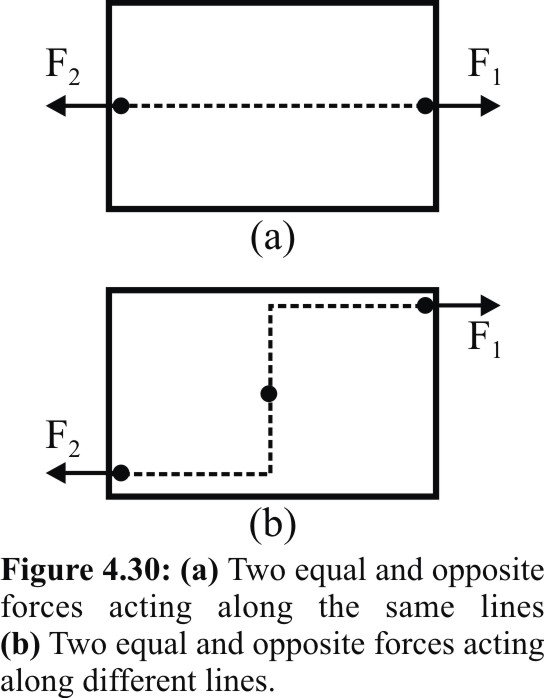
Consider a body pulled by two forces F1 and F2 as shown in figure:
The two forces are equal but opposite to each other. Both are acting along the same line, hence their resultant will be zero. According to first condition of equilibrium, the body will be in equilibrium.
Now shift the location of the forces as shown in the figure.
In this situation, the body is not in equilibrium although the first condition of equilibrium is still satisfied. It is because the body has the tendency to rotate. This situation demands another condition for equilibrium in addition to first condition of equilibrium.
Conclusion:
Q4. Define and explain the three states of equilibrium.
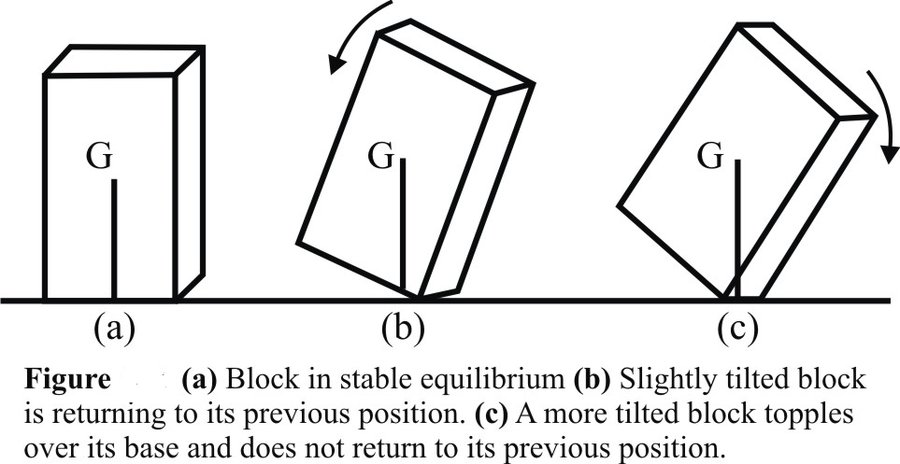
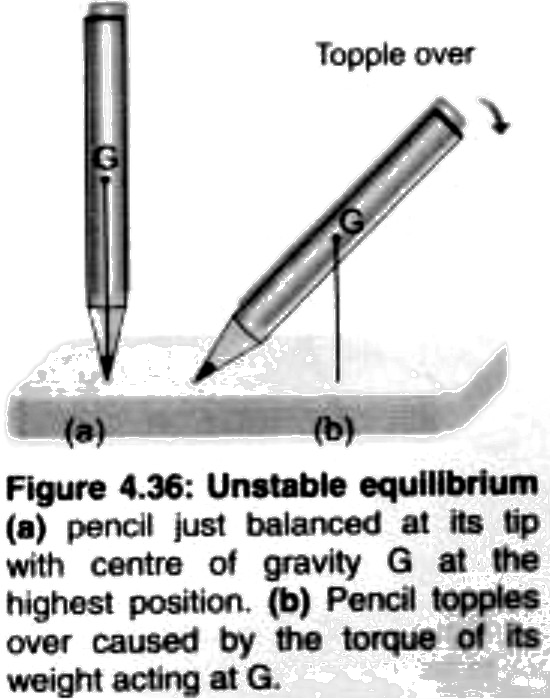
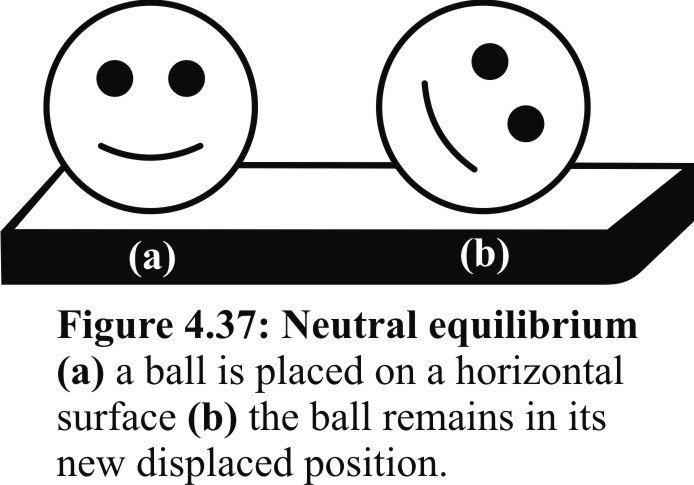
STATES OF EQUILIBRIUM
There are three states of equilibrium:
Stable equilibrium
Unstable equilibrium
Neutral equilibrium
STABLE EQUILIBRIUM
Definition:
“A body is said to in stable equilibrium if after a slight tilt it returns to its previous position.”
Position of Centre of Gravity:
When body is in stable equilibrium, its centre of gravity is at the lowest position. When it is tilted, its centre of gravity rises. When applied force ceases to act the body returns to its stable state by lowering its centre of gravity. A body remains in stable equilibrium as long as the centre of gravity acts through the base of the body.
Explanation:
Consider a block as shown in figure. When the block is tilted, its centre of gravity G rises. If the vertical line through G passes through its base in the tilted position, the block returns to its previous position. If the vertical line through G gets out its base, it does not return to its previous position,
It topples over its base and moves to new stable equilibrium position. That is why a vehicle made heavy at its bottom to keep its centre of gravity as low as possible. A lower centre of gravity keeps it stable. Moreover, the base of the vehicle is made wide so that the vertical lien passing through the centre of gravity should not get out of its base during a turn
Examples:
Table, chair, box and brick lying on a floor are in stable equilibrium.
UNSTABLE EQUILIBRIUM
Definition:
“If a body does not returns to its previous position when sets after a slightest tilt is said to in unstable equilibrium.”
Position of Centre of Gravity:
The centre of gravity of the body is at its highest point in the state of unstable equilibrium. As the body topples over about its base, its centre of gravity moves towards its lower position and does not return to its previous position.
Explanation:
A pencil is made to stand in equilibrium on its tip as vertically upward on a table.
When it is set free, the pencil topples over about its tip and falls down. The body (Pencil) may be made to stay only for a moment. Thus a body is unable to keep itself in the state of unstable equilibrium.
Examples:
A stick standing vertically on the tip of a finger and a cone standing on the tip of a finger are in unstable equilibrium
NEUTRAL EQUILIBRIUM
Definition:
“If a body remains in its new position when disturbed from its previous position, it is said to be in a state of neutral equilibrium.”
Position of Centre of Gravity:
In neutral equilibrium, all the new states in which a body is moved are the stable states and the body, remains in its new state. In neutral equilibrium, the centre of gravity of a body remains at the same height, irrespective of its new position.
Explanation:
A ball lying on a horizontal surface is shown in figure. Roll the ball over the surface and leave it after displacing from the previous position. It remains in its new position and does not return to its previous position
Examples:
A pencil, a sphere, and cylinder, a roller, an egg lying horizontally on a flat surface are examples of neutral equilibrium
Q5. How Stability and Position of centre of mass are related to each other?
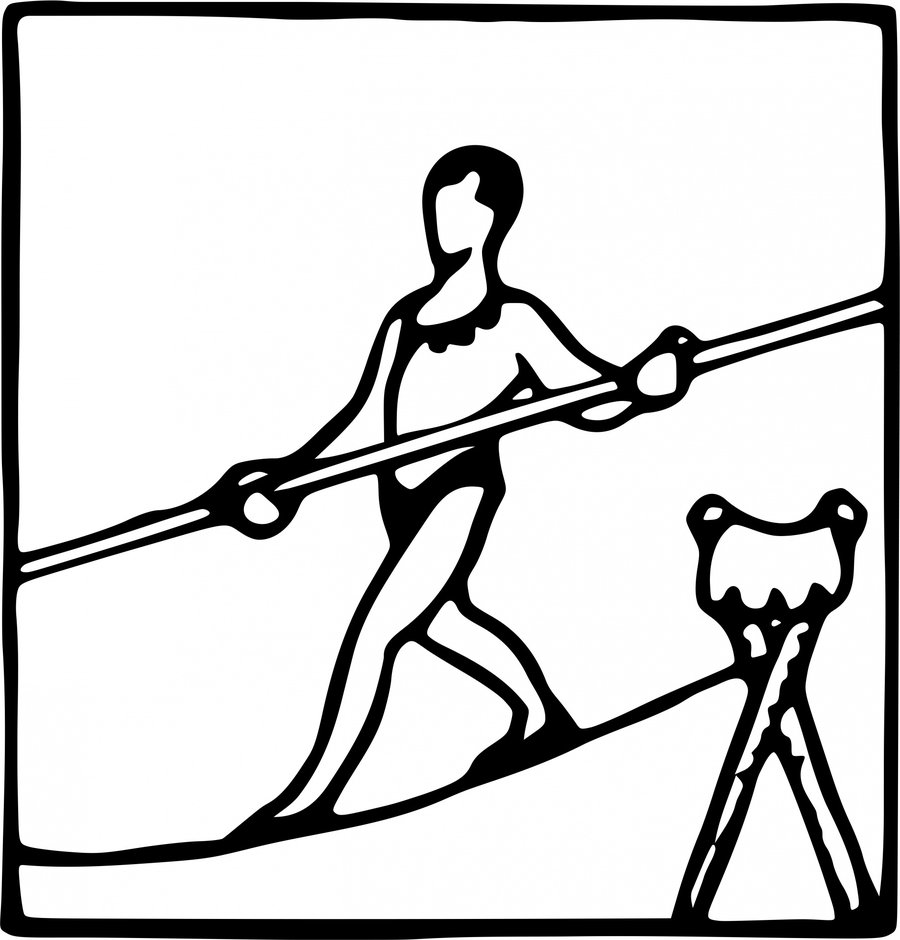
STABILITY
Definition:
“Stability refers to the ability of an object to regain its original position after it has been tilted slightly.”
Factors:
Within uniform gravitational field stability of a body or system depends upon:
The position of its Centre of Mass or Centre of Gravity
To make the objects stable, their Centre of mass or Centre of Gravity must be kept as low as possible. It is due to the reason, racing cars are made heavy at the bottom and their height is kept to be minimum.
Examples:
Here are few examples in which lowering of centre of mass makes the objects stable. These objects return to their stable states when disturbed. In each case centre of mass is vertically below their point of support. This makes their equilibrium stable.
Circus artists such as tight rope walker use long poles to lower their centre of mass. In this way they are prevented from topple over.
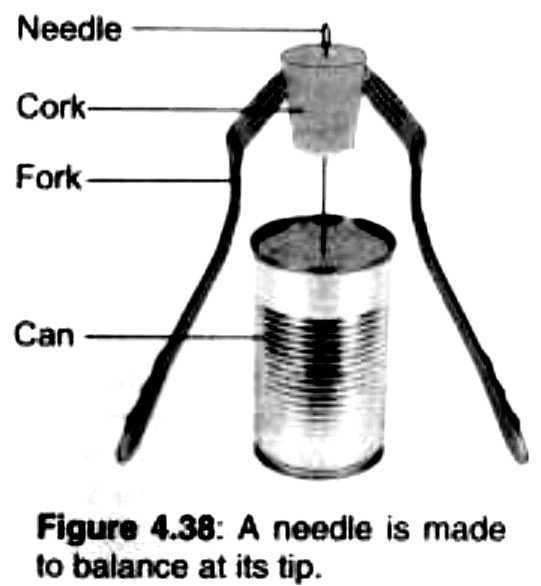
Figure shows a sewing needle fixed in a cork. The cork is balanced on the tip of the needle by hanging forks. The forks lower the centre of mass of the system.
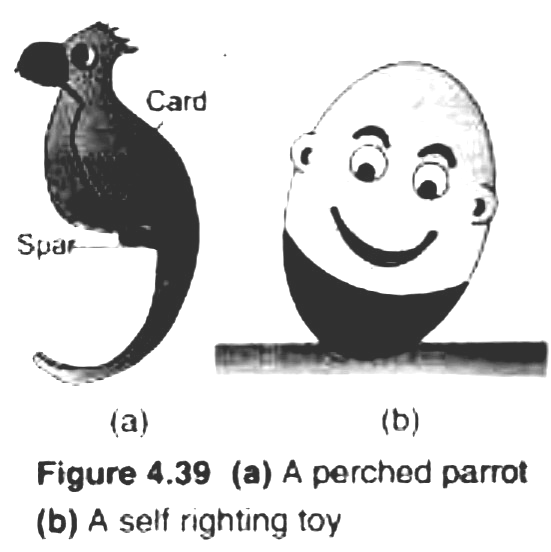
Figure shows a perched parrot which is made heavy at its tail. Figure shows a toy that keeps itself upright when tilted. It has heavy semi spherical base. When it is tilted, its centre of mass rises. It returns to the upright position at which its centre of mass is at the lowest.
Short Questions
Q1. Can a moving body be in equilibrium? Explain.
A MOVING BODY IN EQUILIBRIUM
Yes, if a body is moving with uniform velocity then the body is in equilibrium because neither linear nor rotational acceleration is produced in the body.
Dynamic Equilibrium:
“If a moving body is in the state of equilibrium then its equilibrium is called as Dynamic
Equilibrium.”
Example:
A paratrooper coming down with terminal velocity (constant velocity) is in dynamic equilibrium.
Q2. Can a body be in equilibrium if it is revolving clockwise under the action of a single force?
EQUILIBRIUM WHILE ROTATION
No, the body will not be in equilibrium because second condition of the equilibrium will not be fulfilled. Since single torque can never be zero and rotational acceleration will be produced. Therefore we can say that a body cannot be equilibrium under the action of a single torque.
Q3. How do we know whether a body is in a stable or unstable equilibrium due to position of its centre of gravity?
STATE OF EQUILIBRIUM
If after disturbance, the centre of gravity of the body is raised up as compared to the initial position then the body will be in the state of stable equilibrium and if after disturbance, the centre of gravity of the body is lowered down as compared to the initial position then the body will be in the state of unstable equilibrium.
Q4. Why are vehicle made heavy at the bottom?
HEAVY BOTTOM
Vehicles are made heavy at the bottom. This lowers their centre of gravity and helps to increase their stability.
(QUICK QUIZ PG#99)
Q5. A ladder leaning at a wall as shown in figure below is in equilibrium. How?
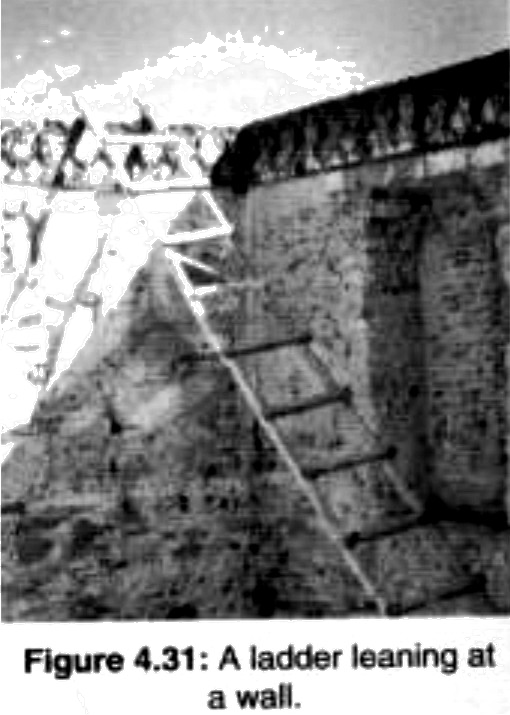
LADDER IN EQUILIBRIUM
Ladder is in equilibrium because it satisfies second condition of equilibrium.
Q6. The weight of the an anticlockwise torque. The wall pushes the ladder at its top end thus produces a clockwise torque. Does the ladder satisfy second condition for equilibrium?
SECOND CONDITION
Yes, it satisfies second condition of equilibrium because both torques are equal in magnitude but opposite in direction.
Q7. Does the speed of a ceiling fan go on increasing all the time?
CEILING FAN
Speed of ceiling fan does not increase all the times. At acquiring maximum speed it moves with uniform speed.
Q8. Does the fan satisfy second condition for equilibrium when rotation with uniform speed?
SECOND CONDITION
No, it does not satisfy the second condition of equilibrium. Because it neither in the state of rest nor moving with uniform velocity.
EXAMPLE 4.5
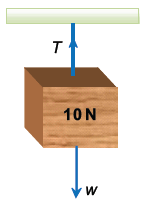
Q9. A block of weight 10 N is hanging through a cord as shown in figure below. Find the tension in the cord.
Given Data:
Weight of the block = w = 10N
To Find:
Tension in the cord = T =?
Calculations:
Applying first condition for equilibrium
∑ Fx = 0
There is no force acting along x-axis
∑ Fy = 0
Or T – w = 0
T = w
Putting values
T = 10 N
Result:
EXAMPLE 4.6
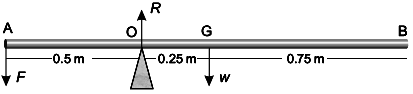
Q10. A uniform rod of length 1.5 m is placed over a wedge at 0.5 m from its one end. A force of 100 N is applied at one of its ends near the wedge to keep it horizontal. Find the weight of the rod and the reaction of the wedge.
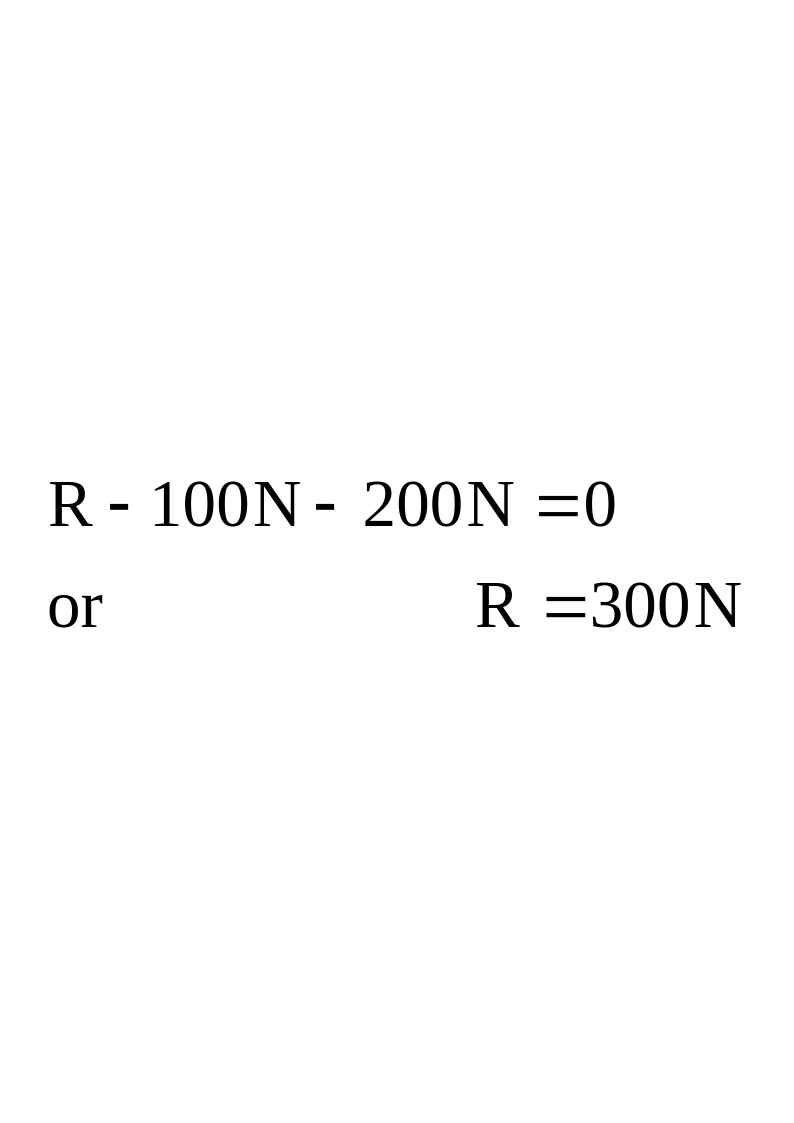
Given Data:
Applied force on the rod = F = 10N
Moment arm of applied force = OA = 0.5m
Moment arm of weight of the rod = 0.25 m
To Find:
Weight of the rod = w =?
Reaction of the wedge = R =?
Calculations:
From Figure above
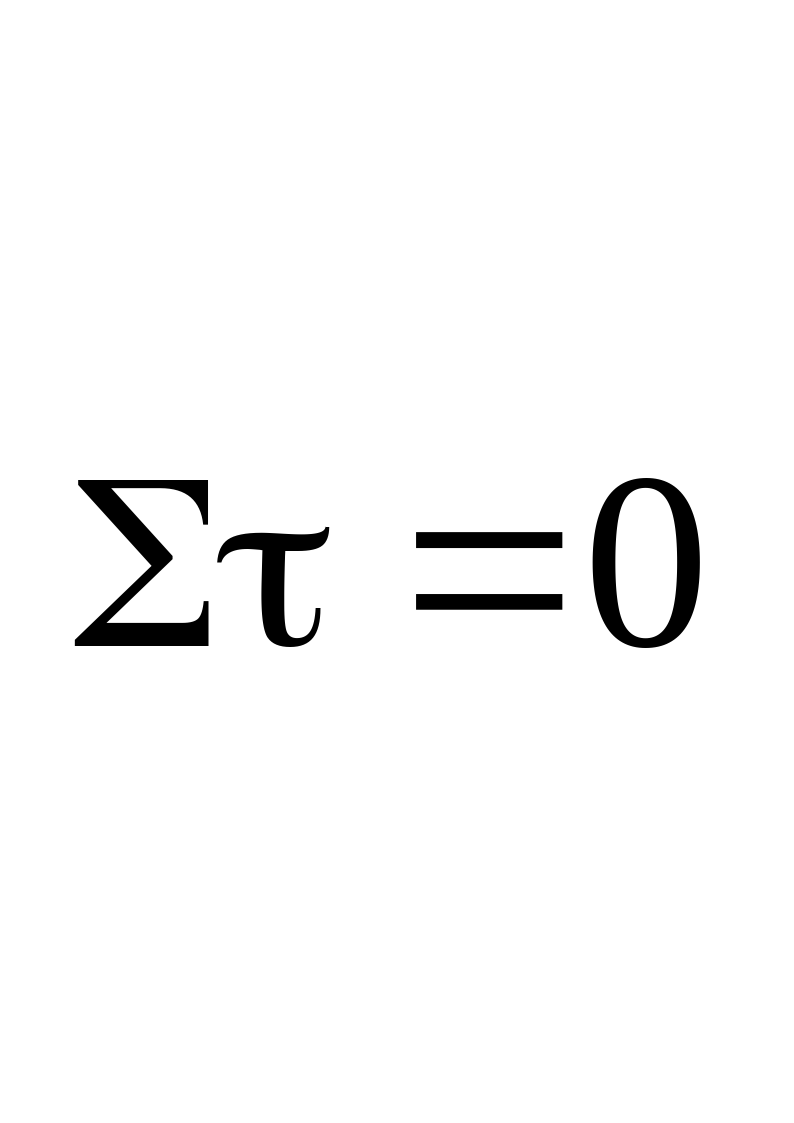
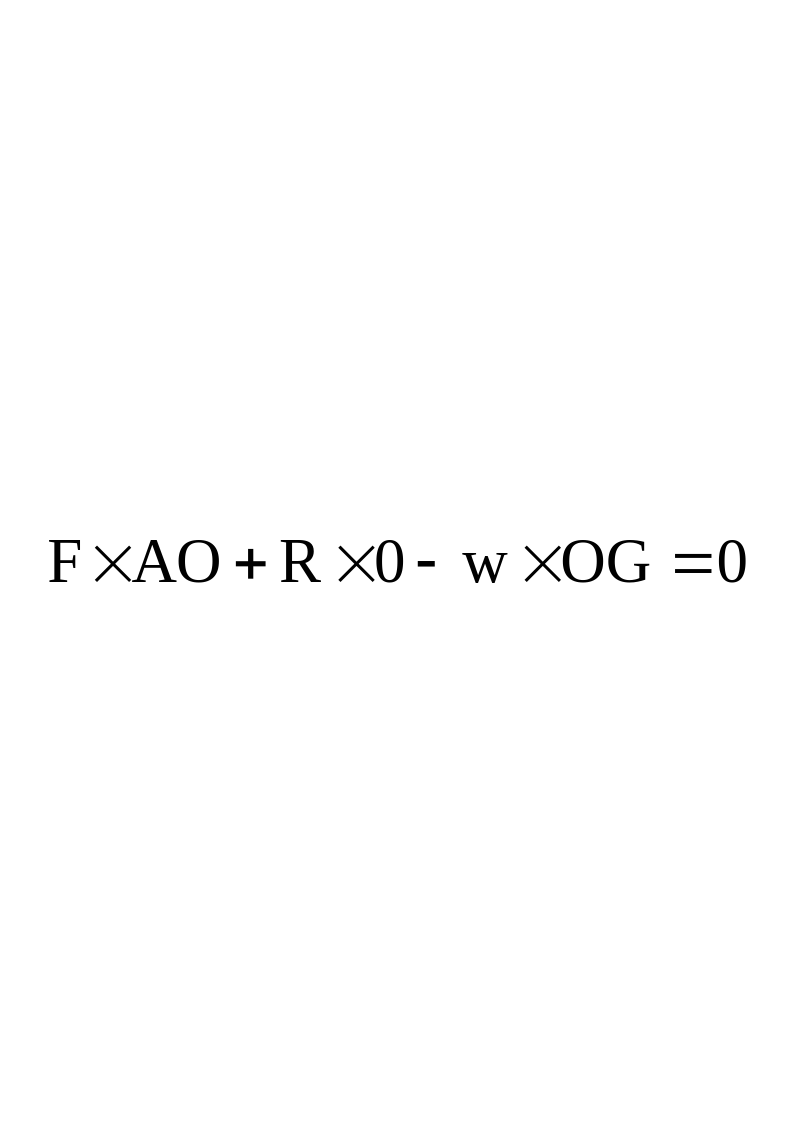
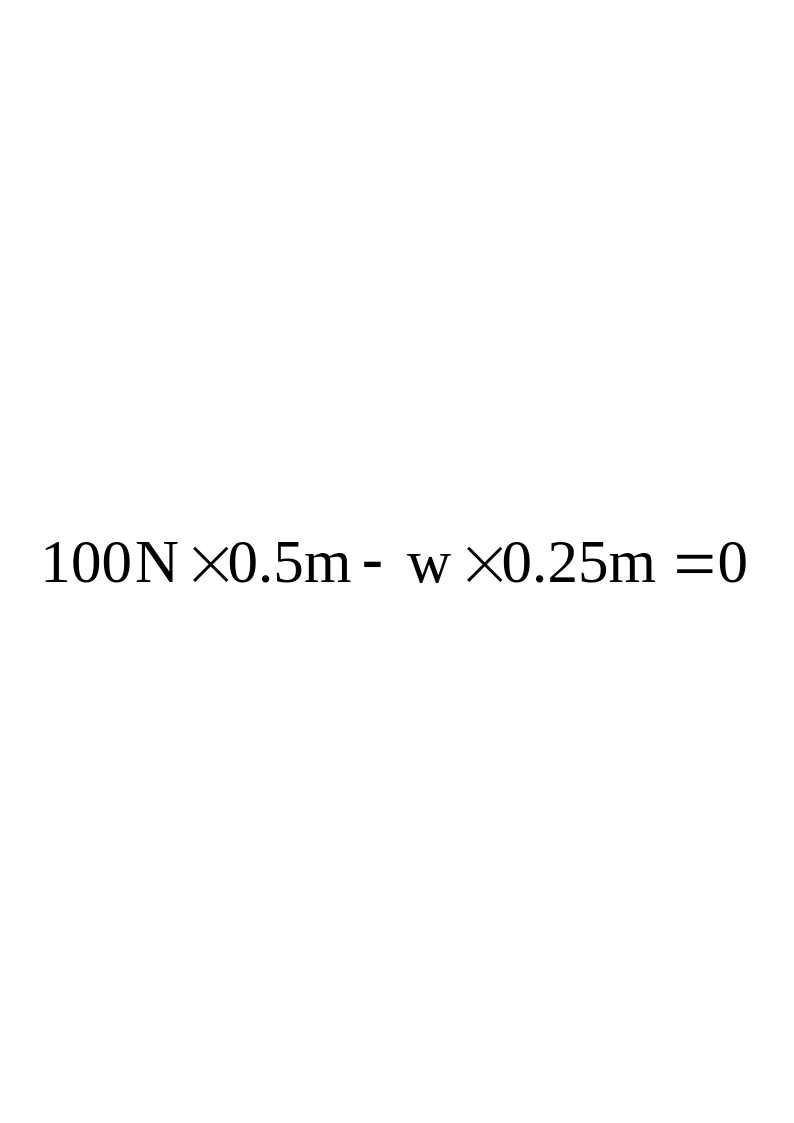
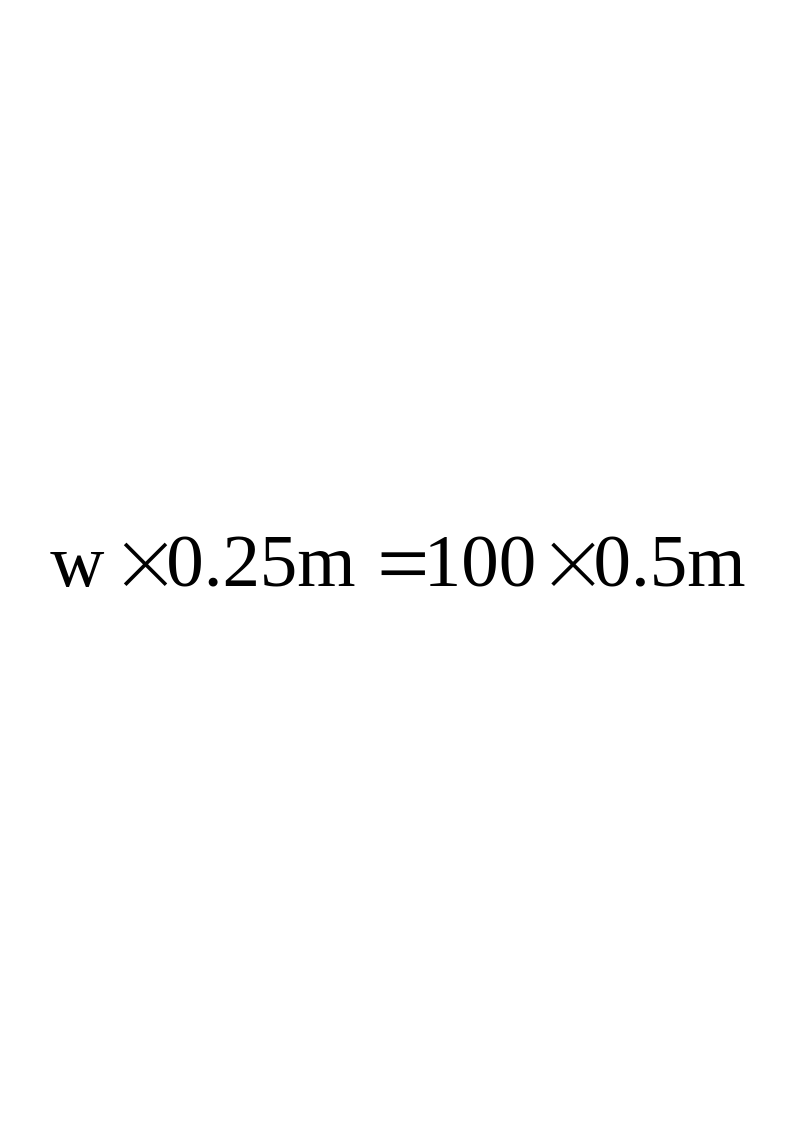
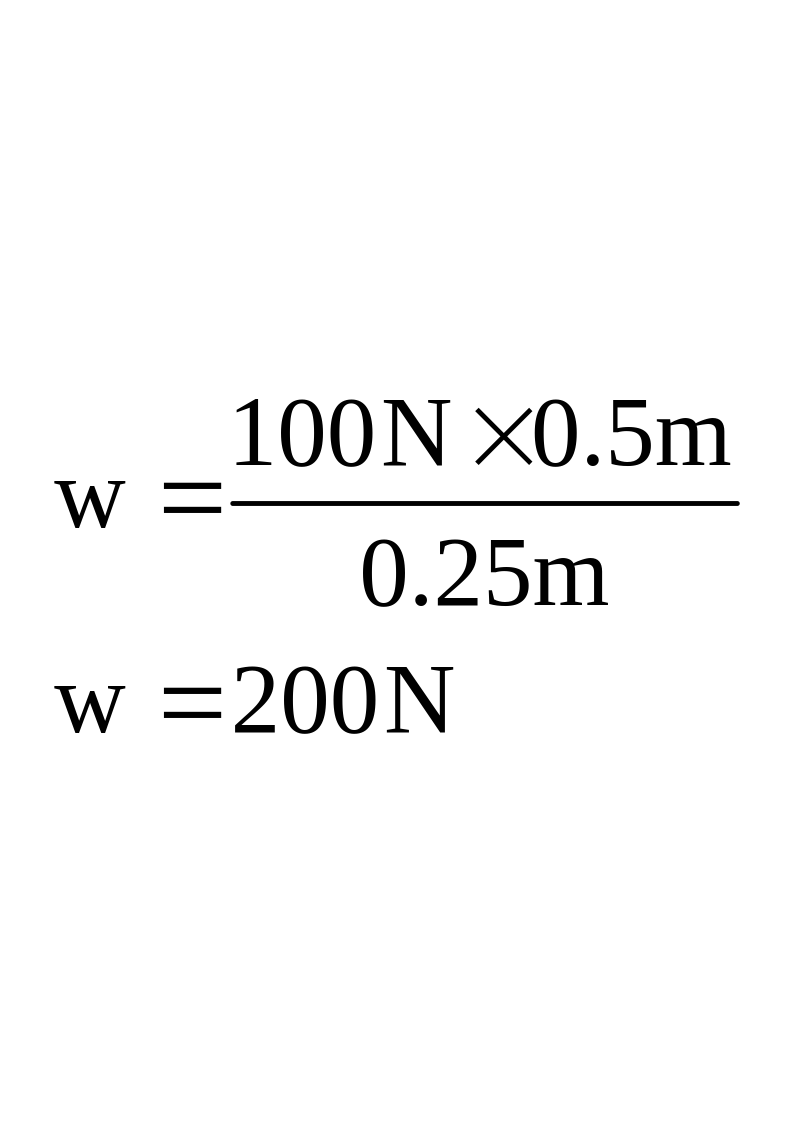
Applying second condition for equilibrium, taking torques about O.
Or
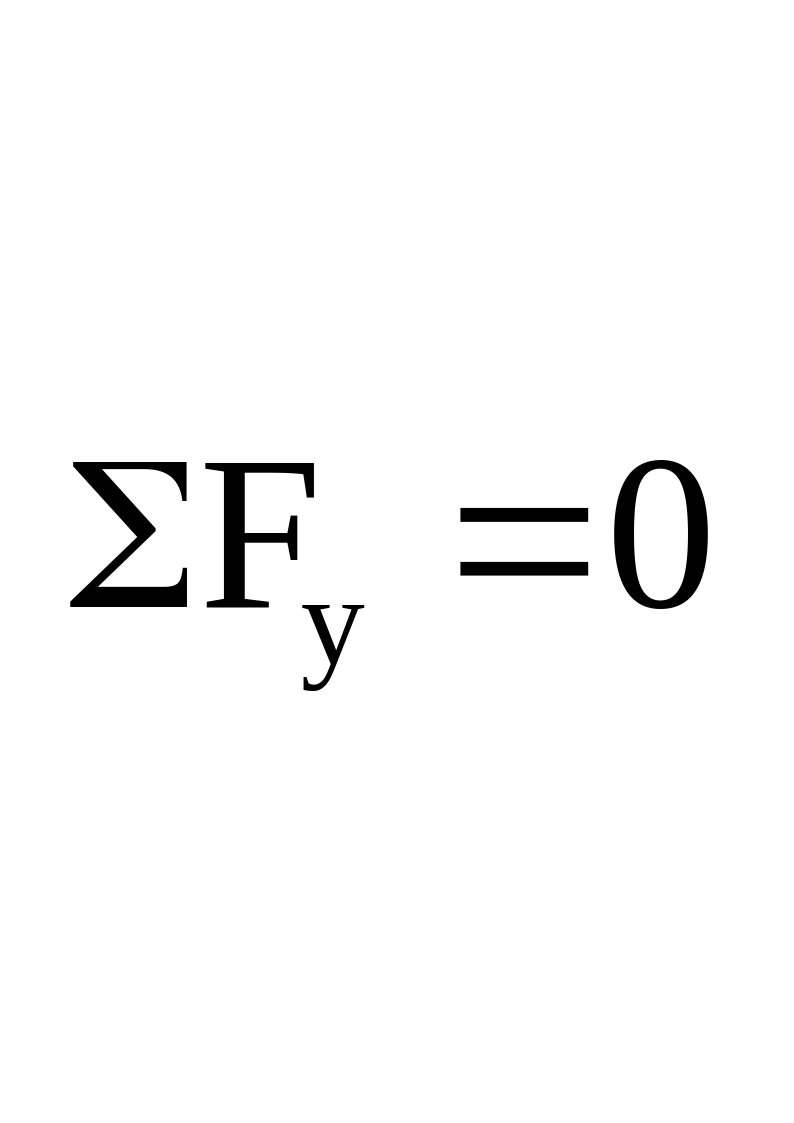
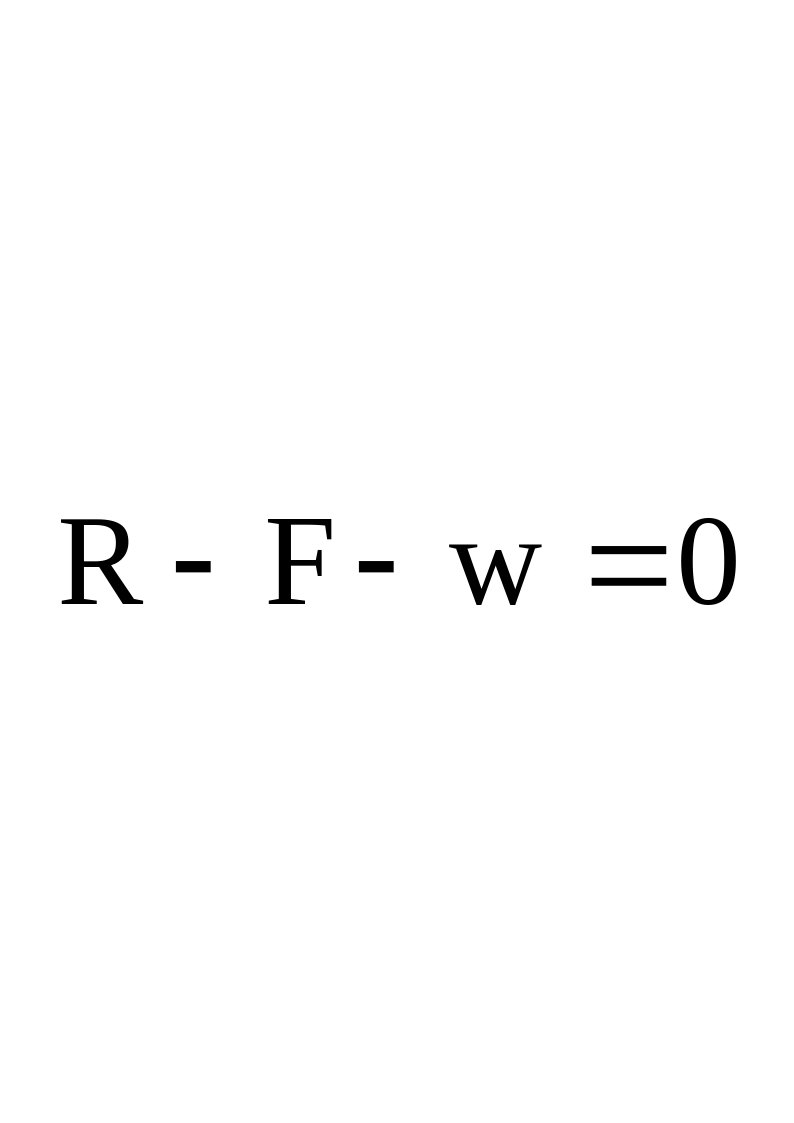
Applying first condition for equilibrium
Result:
TB Text Book Exercise
Long Questions
Q1. Define the following:
Resultant vector
RESULTANT FORCE
Definition:
A resultant force can be defined as:
“A resultant force is a single force that has the same effect as the combined effect of all
the forces to be added”.
Torque
TORQUE
Definition:
“The turning effect of a force is called torque. It is also called Moment of Force”.
Formula:
Moment of Force (Torque) is denoted by Greek letter “τ” and its formula is given below:
Torque = Moment arm x Force
τ = F x L
Unit:
In the system international, the unit of torque is Newton meter (Nm). A torque of 1 N m
is caused by a force of 1 N acting perpendicular to the moment arm of 1m long.
1Nm = 1 kgm2s-2
Quantity:
Torque is a vector and derived quantity.
Examples:
Common examples of Torque are as follows:
Turning pencil in a sharpener
turning stopcock of a water tap
Q2. Centre of mass

CENTRE OF MASS
Definition:
“Centre of mass of a system is such a point where an applied force causes the system to move without rotation.”
Example:
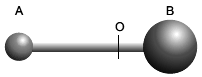
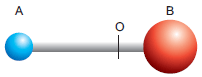
Consider a system of two particles A and B connected by a light rigid rod as shown in figure below:
Let O is the point anywhere between A and B such that the force F is applied at point O as shown in figure above. if the system moves in the direction of force F without rotation, then point O is the centre of mass of the system
Q3. Centre of Gravity
CENTRE OF GRAVITY
Definition:
“A point in a body where the weight of the body appears to act vertically downward is called the centre of gravity.”
Position of Centre of Gravity:
The centre of gravity can exist inside a body or outside the body. Position of the centre of gravity depends upon the shape of the body. A body is balanced when it is supported at its centre of gravity.
Examples:
The centre of gravity of a uniform rod lies at a point where it is balanced. The balance point is its middle point G.
Q4. How can a force be resolved into its rectangular components?
See Q. no.1 Long Question TOPIC 4.1
Q5. When a body is said to be in equilibrium?
EQUILIBRIUM
Definition:
“A body is said to be in equilibrium if no net force and no net torque acts on it.”
Mathematically:
∑ F = 0 ……………. (1)
∑ = 0 ……………. (2)
Types:
There are two types of equilibrium
Static Equilibrium
Dynamic Equilibrium
Q6. Explain the first condition for equilibrium.
See Q. no.2 Long Question TOPIC 4.9
Q7. Whey there is need of second condition for equilibrium if a body satisfies first condition for equilibrium.
NEED FOR SECOND CONDITION
Consider a body pulled by two forces F1 and F2 as shown in figure.
The two forces are equal but opposite to each other. Both are acting along the same line, hence their resultant will be zero. According to first condition of equilibrium, the body will be in equilibrium.
Now shift the location of the forces as shown in the figure.
In this situation, the body is not in equilibrium although the first condition of equilibrium is still satisfied. It is because the body has the tendency to rotate. This situation demands another condition for equilibrium in addition to first condition of equilibrium.
Conclusion:
Q8. What is second condition of equilibrium?
SECOND CONDITION FOR EQUILIBRIUM
Statement:
According to Second condition for equilibrium:
“There should be no net torque acting on the body. It means a body will be in equilibrium if the resultant of all the torques acting on it is zero”
Mathematically:
∑ = 0
Q9. Give an example of a moving body which is in equilibrium.
A MOVING BODY IN EQUILIBRIUM
If a body is moving with uniform velocity then the body is in equilibrium because neither linear nor rotational acceleration is produced in the body.
Dynamic Equilibrium:
“If a moving body is in the state of equilibrium then its equilibrium is called as Dynamic
Equilibrium.”
Example:
A paratrooper coming down with terminal velocity (constant velocity) is in dynamic equilibrium.
Q10. Explain what is meant by stable, unstable, and neutral equilibrium. Give one example in each case.
See Q. no.4 Long Question TOPIC 4.8
Short Questions
Q1. Differentiate the following. (GRW 2017) Like and unlike parallel forces
DIFFFERENTIATION
Like and unlike parallel forces can be differentiated as:
| Like Parallel Forces | Unlike Parallel Forces |
| Definition | Definition |
| Like parallel forces are the forces that are parallel to each other and have the same direction. | Unlike parallel forces are the forces that are parallel but have direction opposite to each other. |
| Example | Example |
| Consider a bag with apples in it. The weight of the bag is due to the weight of all the apples in it. Since the weight of every apple in the bag is the force of gravity acting on it vertically downwards, therefore, weights of apples are the parallel forces. All these forces are acting in the same direction. Such forces are called like parallel forces. | Suppose an apple is suspended by a string. The string is stretched due to weight of the apple. The forces acting on it are; weight of the apple acting vertically downward and tension in the string pulling it vertically upward. The two forces are parallel but opposite to each other. These forces are called unlike parallel forces. |
Q2. Torque and Couple
DIFFFERENTIATION
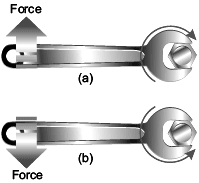
Torque and couple can be differentiated as:
| Torque | Couple |
| Definition | Definition |
| The rotational effect of a force is measured by a quantity, known as torque. | A couple is formed by two unlike parallel forces of the same magnitude but not along the same line. |
| Unit | Unit |
| SI unit of torque is Nm | SI unit of couple is newton (N) |
| Figure | Figure |
| Figure: Torque in Spanner | Figure: Couple on Steering |
Q3. Stable and Neutral Equilibrium
DIFFFERENTIATION
Stable and neutral equilibrium can be differentiated as:
| Stable Equilibrium | Neutral Equilibrium |
| Definition | Definition |
| A body is said to in stable equilibrium if after a slight tilt it returns to its previous position. | If a body remains in its new position when disturbed from its previous position, it is said to be in a state of neutral equilibrium. |
| Position of Centre of Gravity | Position of Centre of Gravity |
| When body is in stable equilibrium, its centre of gravity is at the lowest position. When it is tilted, its centre of gravity rises. When applied force ceases to act the body returns to its stable state by lowering its centre of gravity. A body remains in stable equilibrium as long as the centre of gravity acts through the base of the body. | In neutral equilibrium, the centre of gravity of a body remains at the same height, irrespective of its new position |
| Examples | Examples |
| Table, chair, box and brick lying on a floor are in stable equilibrium. | A pencil, a sphere, and cylinder, a roller, an egg lying horizontally on a flat surface are examples of neutral equilibrium. |
Q4. How head to tail rule helps to find the resultant of forces?
HEAD TO TAIL RULE
Draw the representative lines of all the force to be added in such a way that head of first force coincides with the tail of second force, head of second force coincides with the tail of third force and so on. The line obtained by joining the tail of first force with the head of last force represent resultant force.
Q5. Think of a body which is at rest but not in equilibrium.
BODY AT REST
A ball thrown upward becomes at rest at the top. At this state it is not in equilibrium although it is at rest.
Q6. When a body cannot be in equilibrium due to a single force on it? (LHR 2015)
THE ACTION OF SINGLE FORCE
No, the body will not be in equilibrium because first condition of the equilibrium will not be fulfilled. Since single force can never be zero and linear acceleration will be produced. Therefore we can say that a body cannot be equilibrium under the action of a single force.
Q7. Why the height of vehicles is kept as low as possible?
HEIGHT OF RACING CARS
We know that smaller the height of centre of gravity of a body, greater will be its stability. The height of vehicles is kept low to lower their centre of gravity and as a result their stability increases.
Numerical Problems
Numerical 1. Find the resultant of the following forces. 10 N along x – axis 6 N along y – axis 4 N along negative x – axis
Scale 2N = 1cm
10N = 5cm
6N = 3cm
4N = 2cm
So we can find Resultant force by Graphical Method as:
Result:
Numerical 2. Find the rectangular components of a force of 50 N making an angle of 300 with x – axis. (GRW 2015)
Given Data:
Force = F = 50 N
Angle = θ = 300
To Find:
Horizontal component of force = Fx = ?
Vertical component of force = Fy = ?
Calculations:
As we know that
Fx = F cosθ
By putting the values, we have
Fx = 50 x cos 300
Fx = 50 x 0.866
Also we know that
Fy = F sinθ
Fy = 50 x sin 300
Fy = 50 x 0.5
Result:
Numerical 3. Find the magnitude and direction of a force. If its x – component is 12 N and y – component is 5 N. (GRW 2013)
Given Data:
X – component of the force = Fx = 12N
Y – component of the force = Fy = 5N
To Find:
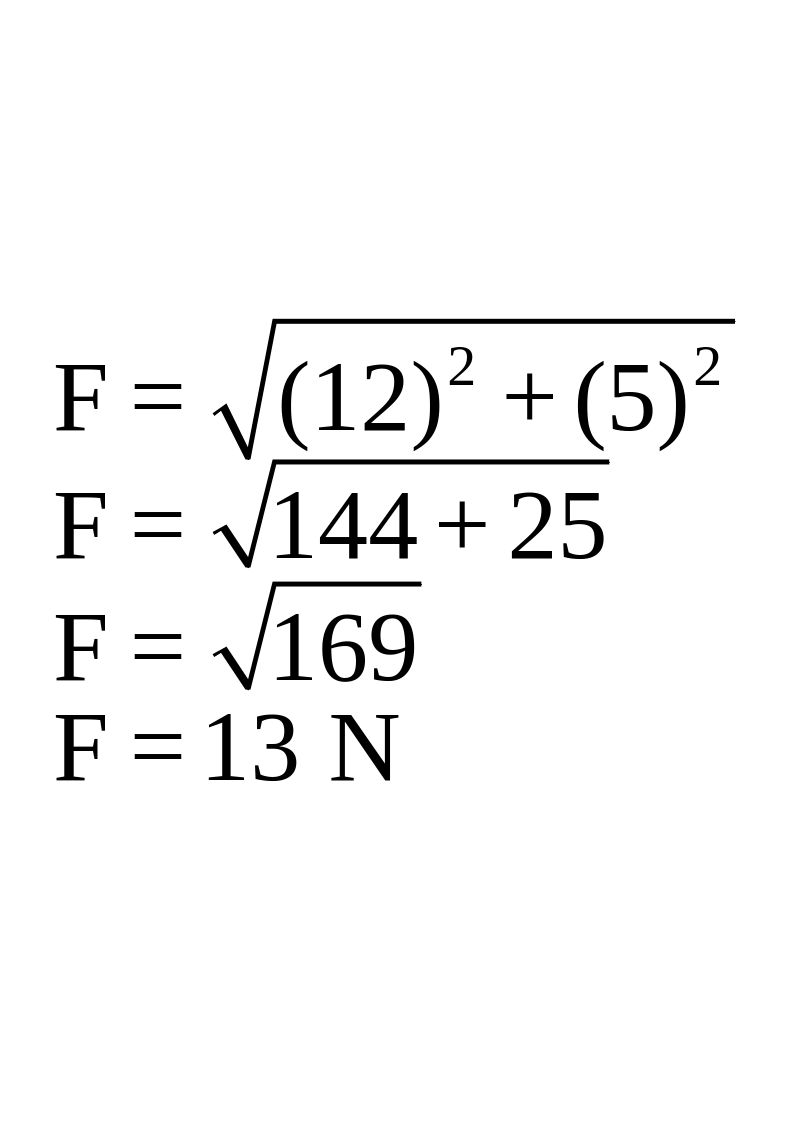
Magnitude of the resultant force = F =?
Direction of the resultant force = θ =?
Calculations:
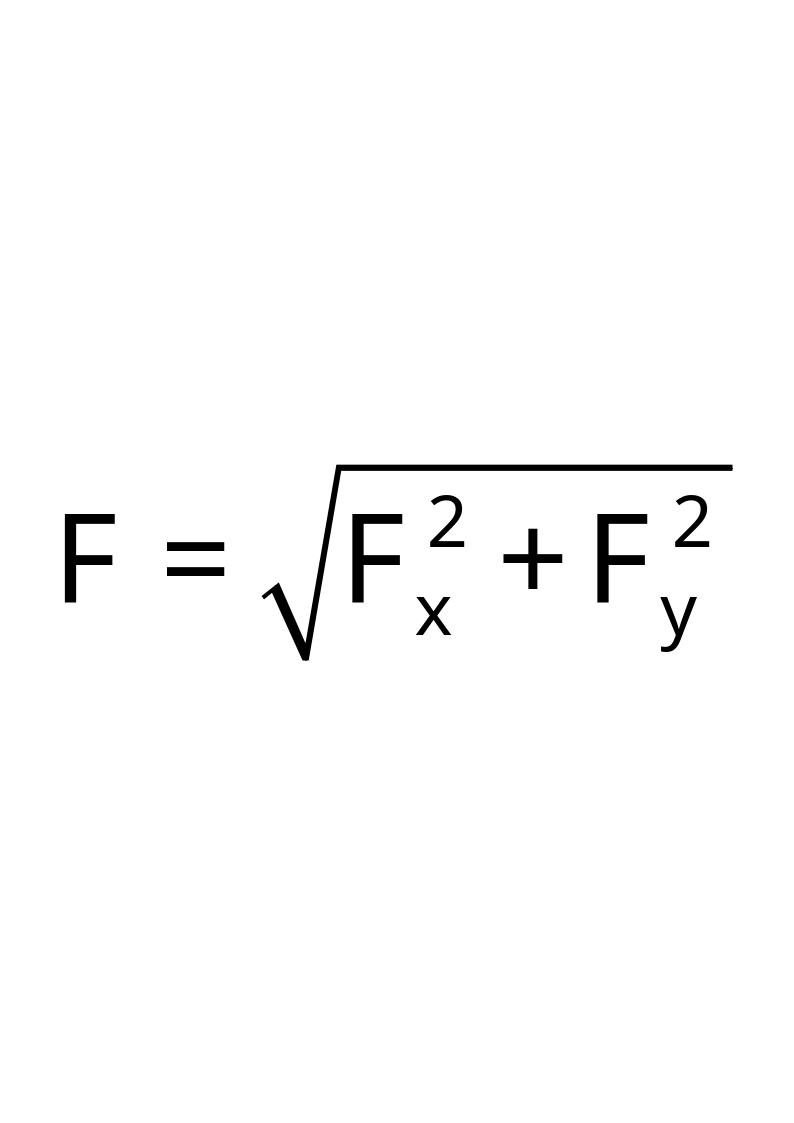
According to Pythagoras theorem
By putting the values, we have
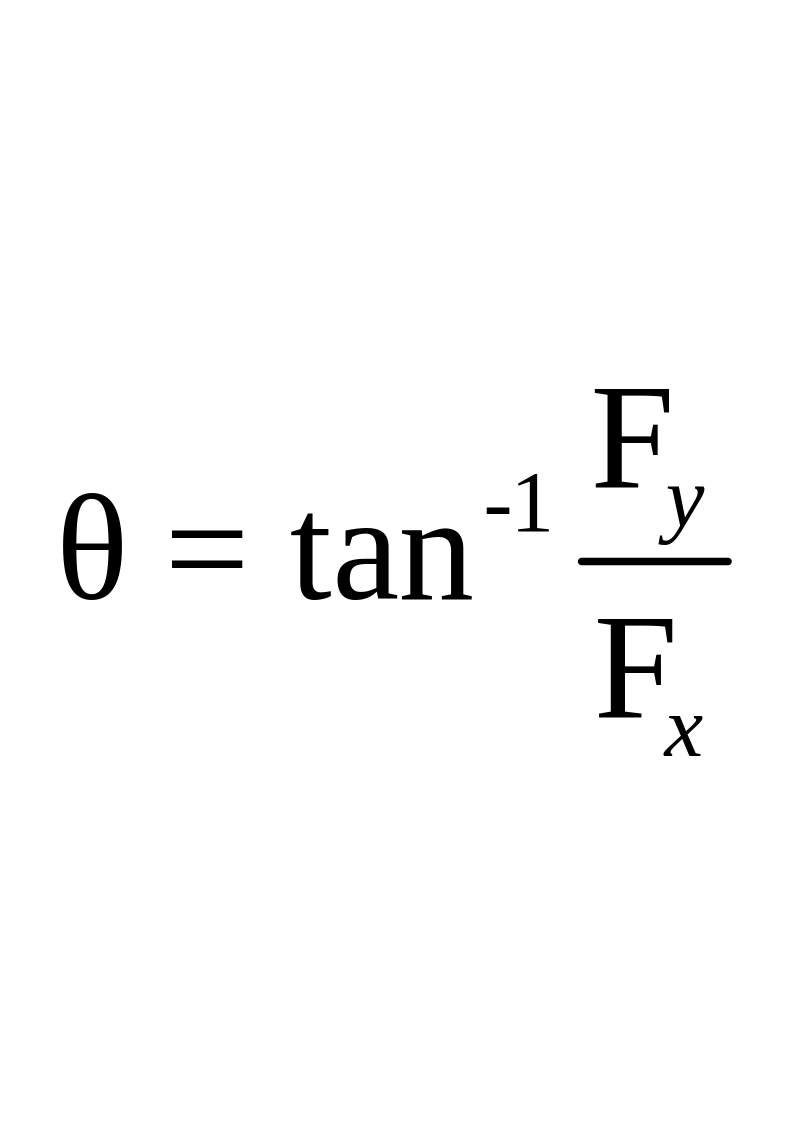
We also know that
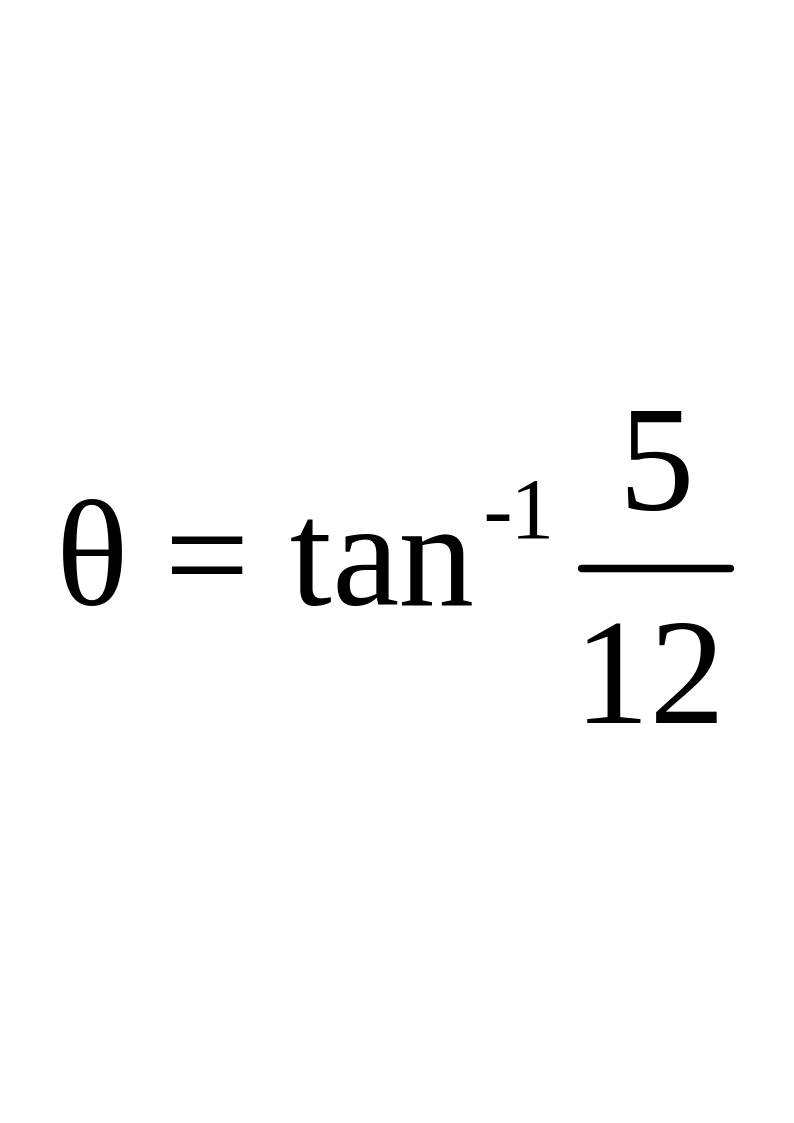
θ = tan -1 0.4166
θ = 22.6o with x-axis
Result:
Numerical 4. A force of 100 N is applied perpendicularly on a spanner at a distance of 10 cm from a nut. Find torque produced by the force. (GRW 2013, 2014, 2015)
Given Data:
Force acting on spanner = F = 100 N
Distant from nut = L = 10 cm = 0.1 m
To Find:
Torque produced by the force = τ = ?
Calculations:
As we know that
τ = F x L
By putting the values, we have
τ = 100 x 0.1
τ = 10 Nm
Result:
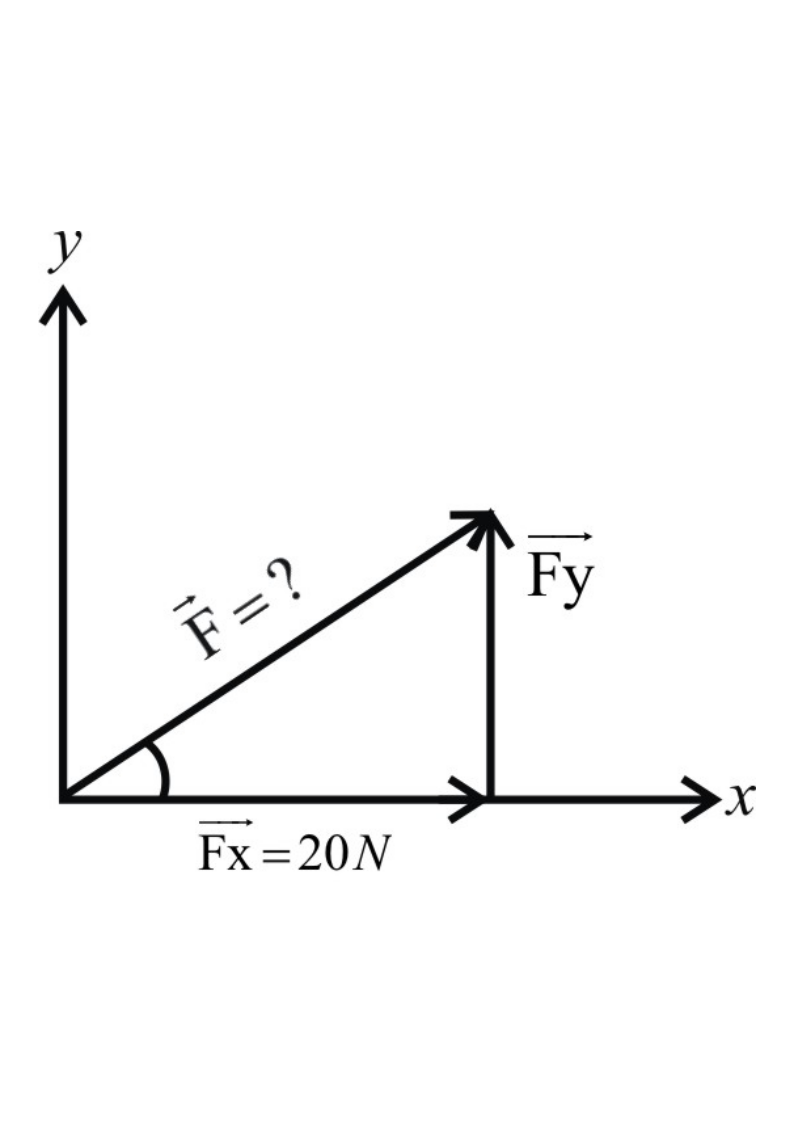
Numerical 5. A force is acting on a body making an angle of 300 with the horizontal. The horizontal component of force is 20 N. Find the force. (LHR 2015)
Given Data:
Horizontal component of the force = Fx = 20 N
Angle formed with the horizontal = θ = 300
To Find:
Force applied = F = ?
Calculations:
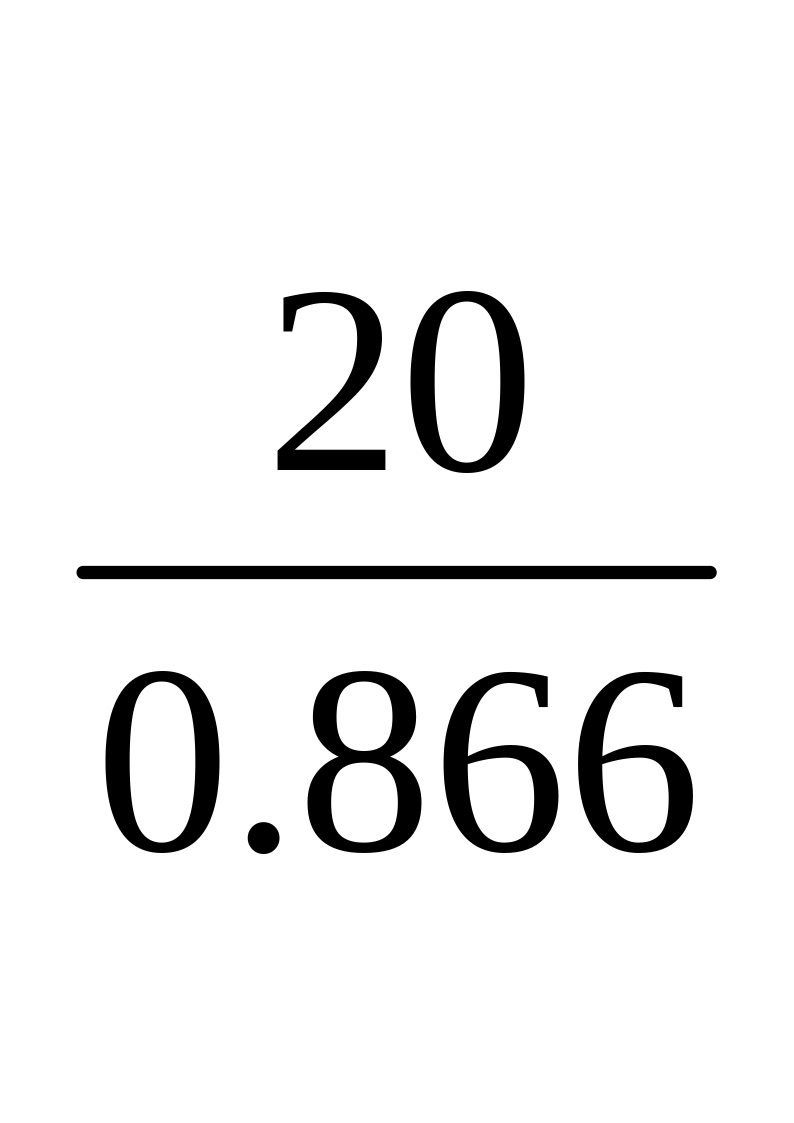
As we know that
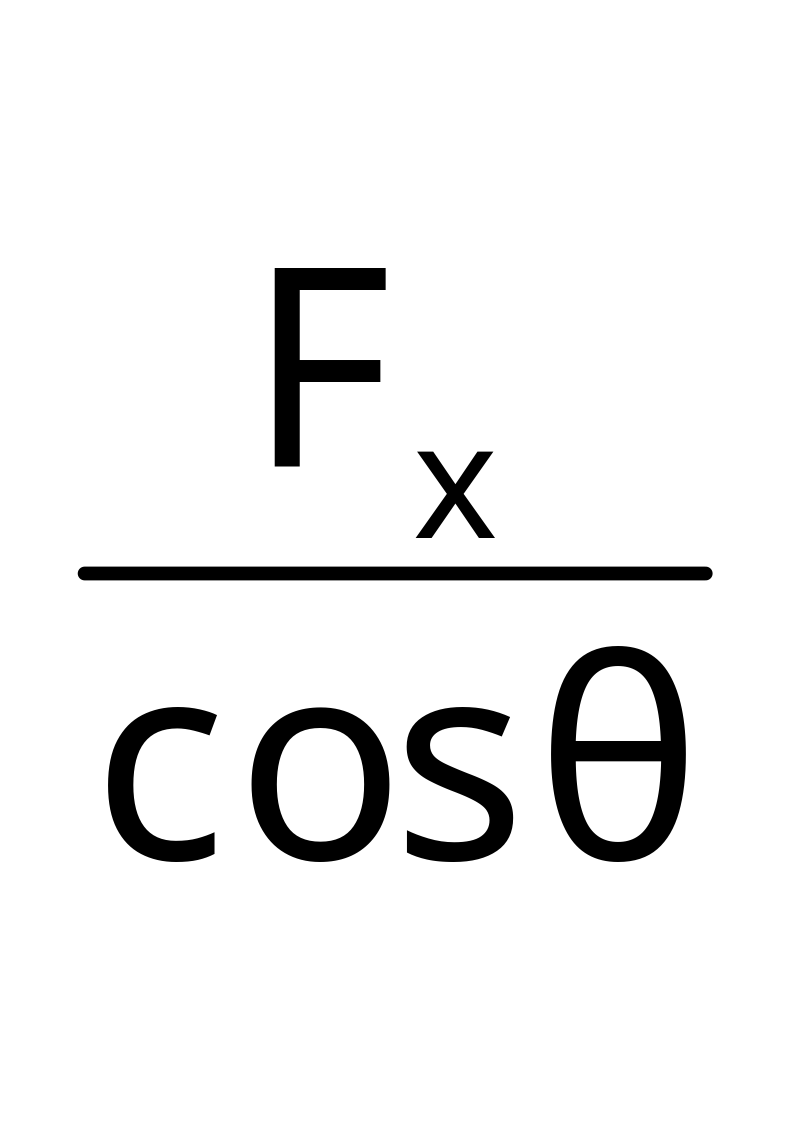
Fx = F cosθ
So F =
By putting the values, we have
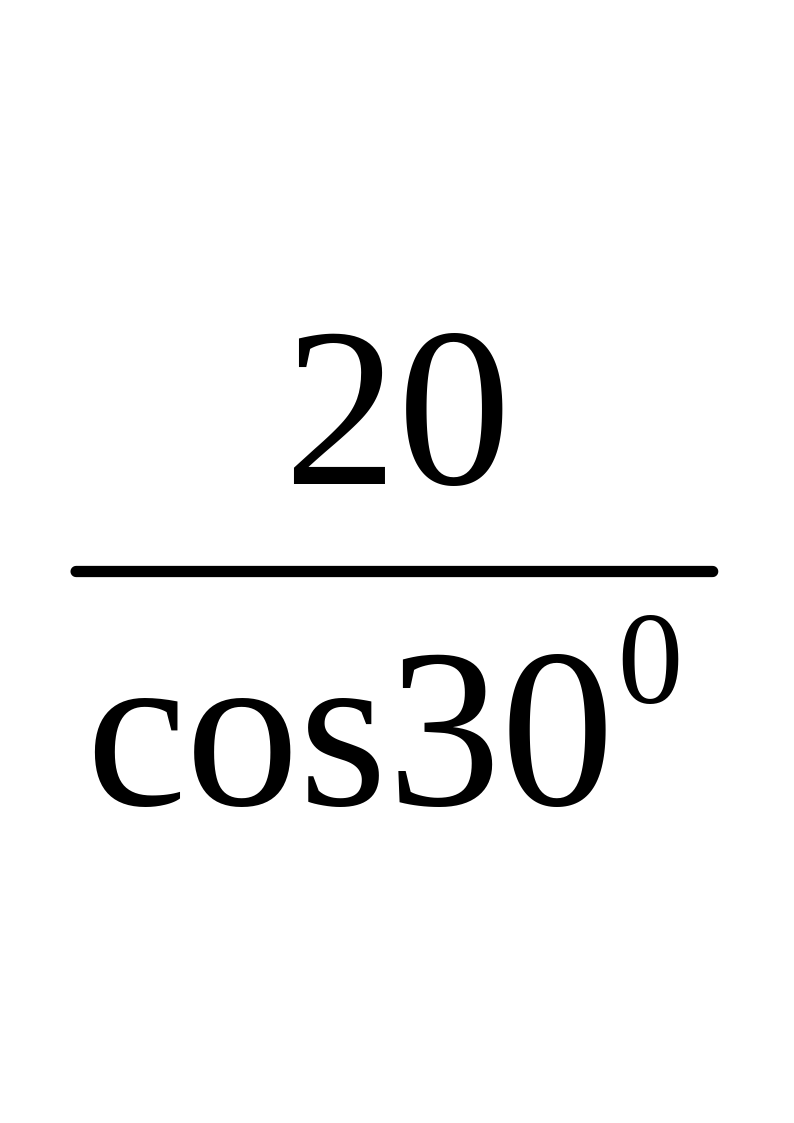
F =
F =
F = 23.09 N = 23.1 N
Result:
Numerical 6. The steering of a car has a radius 16 cm. Find the torque produced by a couple of 50 N. (LHR 2013, 2014, 2015)
Given Data:
Force of the couple = F = 50 N
Radius of the steering = r = 16cm
Couple arm = d = AB = 32 cm = 0.32 m
To Find:
Torque produced by the couple = τ = ?
Calculations:
As we know that
τ = F x AB
By putting the values, we have
τ = 50 x 0.32
τ = 16 Nm
Result:
Numerical 7. A picture frame is hanging by two vertical strings. The tensions in the strings are 3.8 N and 4.4 N. Find the weight of the picture frame.
Given Data:
Tension in the first string = T1 = 3.8 N
Tension in the second string = T2 = 4.4 N
To Find:
Weight of the picture frame = w = ?
Calculations:
From first condition of equilibrium, we have
∑ Fy = 0
Or Sum of downward forces = Sum of upward forces
w = T1 + T2
By putting the values, we have
w = 3.8 N + 4.4 N
w = 8.2 N
Result:
Numerical 8. Two blocks of 5 kg and 3 kg are suspended by the two strings are shown. Find the tension in each string.
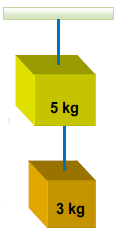
Given Data:
Mass of upper block = m1 = 5 kg
Mass of below block = m2 = 3 kg
Weight of the upper block = w1 = m1g = 5 x 10 = 50 N
Weight of the below block = w2 = m2g = 3 x 10 = 30 N
To Find:
Tension in upper string = T1 = ?
Tension in lower string = T2 = ?
Calculations:
From second condition of equilibrium, we have
∑ Fy = 0
Or Tension in the lower string = weight of the lower block
T2 = w2
T2 = 30 N
Tension in upper string = weight of lower block + weight of upper block
T1 = w1 + w2
T1 = 50 N + 30 N
T1 = 80 N
Result:
Numerical 9. A nut has been tightened by a force of 200 N using 10 cm long spanner. What length of spanned is required to loosen the same nut with 150 N force? (LHR 2013, GRW 2014)
Given Data:
Initial force used for tightening = F1 = 200 N
Initial moment arm of the force used for tightening = L1 = 10 cm = 0.1 m
Second force used for loosen = F2 = 150 N
To Find:
Second moment arm for loosen= L2 = ?
Calculations:
According to second condition of equilibrium, we have
∑τ = 0
Or Clockwise torque = Anticlockwise torque
F2 x L2 = F1 x L1
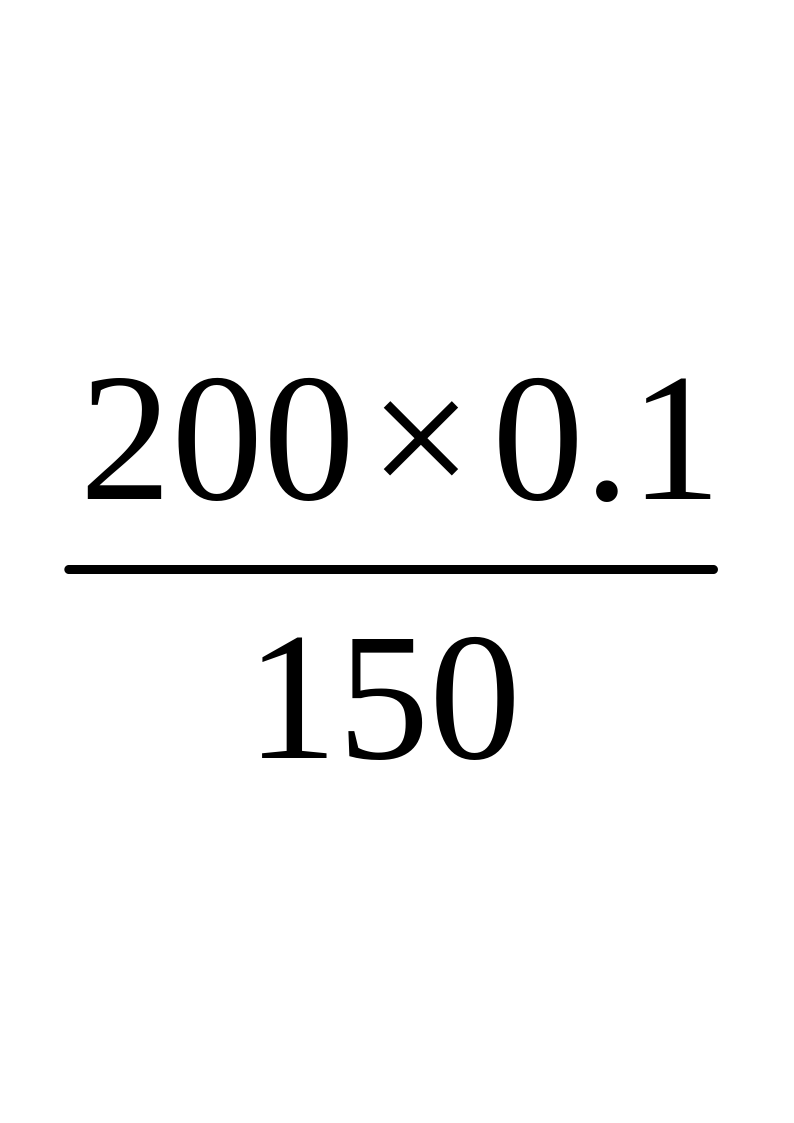
150 x L2 = 200 x 0.1
L2 =
L2 = 0.133 m
L2 = 13.3 cm
Result:
Numerical 10. A block of 10 kg is suspended at a distance of 20 cm from the centre of uniform bar 1m long. What force is required to balance it at its centre of gravity by applying the force at the other end of the bar?
Given Data:
Mass of block = m = 10kg
Weight of the block = w = F1= mg = 10 x 10 = 100 N
First moment arm = L1 = 20 cm = 0.2 m
Second moment arm = L2 = 50 cm = 0.5 m
To Find:
Second force = F2 =?
Calculations:
According to second condition of equilibrium, we have
∑τ = 0
Or Clockwise torque = Anticlockwise torque
F2 x L2 = F1 x L1
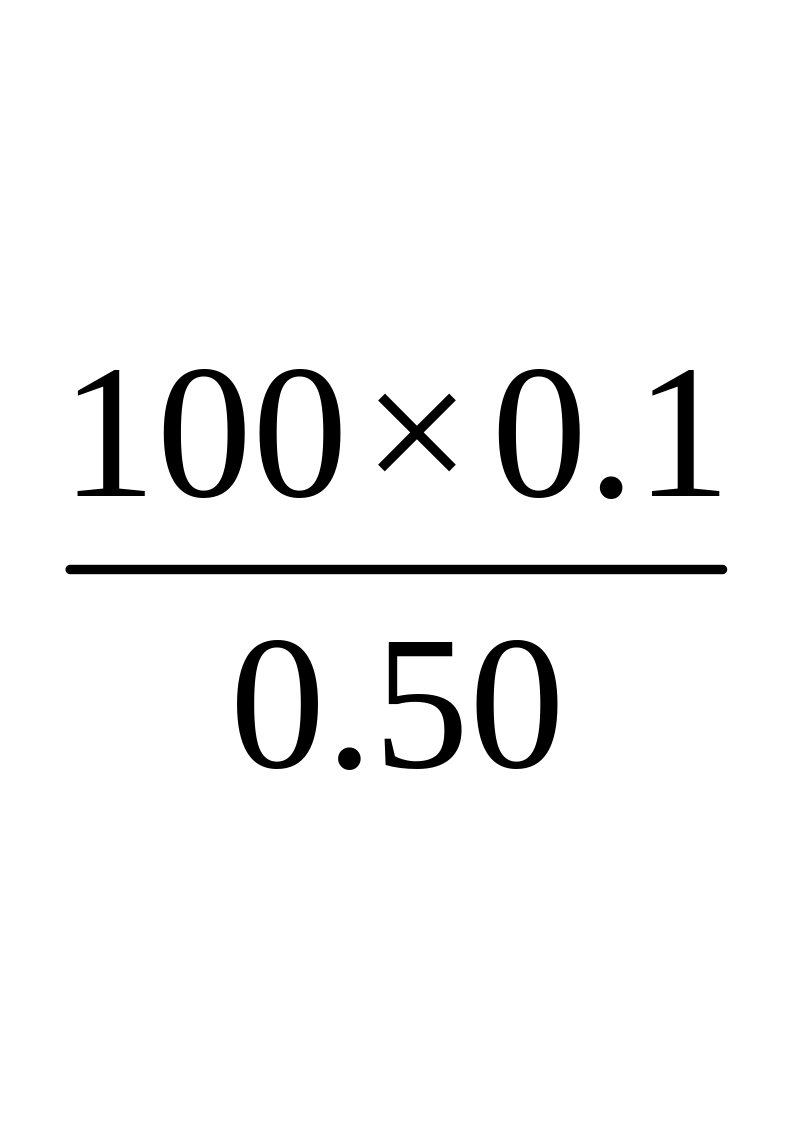
F2 x 0.5 = 100 x 0.2
F2 =
F2 = 40 N
Result:
TB.ST Self Test
Long Questions
Q1. Define and Explain Resolution of Forces.
Q2. A nut has been tightened by a force of 200 N using 10 cm long spanner. What length of a spanner is required to loosen the same nut with 150 N force?
Q3. Note:
Q4. Parents or guardians can conduct this test in their supervision in order to check the skill of students.
Short Questions
Q1. Differentiate like and unlike parallel forces.
Q2. Find a force from its perpendicular components.
Q3. Why handle of door is kept at its outer edge?
Q4. State principle of moments.
Q5. Why do we need second condition for equilibrium?