
Unit 8: Thermal Properties of Matter — Notes
8.1 Temperature And Heat
8.2 Thermometer
Long Questions
Q1. What is thermometer? Explain its different types.

THERMOMETER
“The instrument which is used to measure the temperature is called a thermometer”
Thermometric Material:
“The material that is used in thermometer for measuring temperature is called thermometric material.”
Some substances have property that changes with temperature. Substance that show change with temperature can be used as thermometric material. For example some substances expand on heating, some change their colours, some change their electric resistance etc. Nearly all the substances expand on heating liquids also expand on heating and are suitable as thermometric materials.
Common thermometers are generally made using some suitable liquid as thermometric material.
Properties of Thermometric Properties:
A thermometric liquid should have the following properties:
It should be visible
It should have uniform thermal expansion
It should have a low freezing point
It should have high boiling point
It should not wet glass
It should be a good conductor of electricity
It should have small specific heat capacity
Liquid – In – glass Thermometer:
A liquid – in – glass thermometer has a bulb with a long capillary tube of uniform and fine bore. A suitable liquid is filled in the bulb. When the bulb contacts a hot object, the liquid in it expands and rises in the tube. The glass stem of a thermometer is thick and acts as a cylindrical lens. This makes it easy to see the liquid level in the glass tube as shown in the figure:
Mercury the Best Thermometric Material:
Mercury freezes at -39 oC and boils at 357 oC. It has all the thermometric properties listed above. Thus mercury is one of the most suitable thermometric materials. Mercury – in – glass thermometers are widely used in laboratories, clinics and houses to measure temperatures in range from -10 oC to 150 oC.
Reference Points: (GRW 2017)
A thermometer has a scale on its stem. This scale has two fixed points.
Lower Fixed Point:
The lower fixed point is marked to show the position of liquid in the thermometer when it is placed in ice.
Upper Fixed Point:
The upper fixed point is marked to show the position of liquid in the thermometer when it is placed in steam at standard pressure above boiling water.
Scales of Temperature:
The distance between two reference points is divided in different divisions. A scale is marked on the thermometer. The temperature of the body in contact with the thermometer can be read on that scale.
Types of Temperature Scale: (LHR 2017)
There are three types of temperature scale, which are as follows:
Celsius scale or centigrade scale
Fahrenheit scale
Kelvin scale
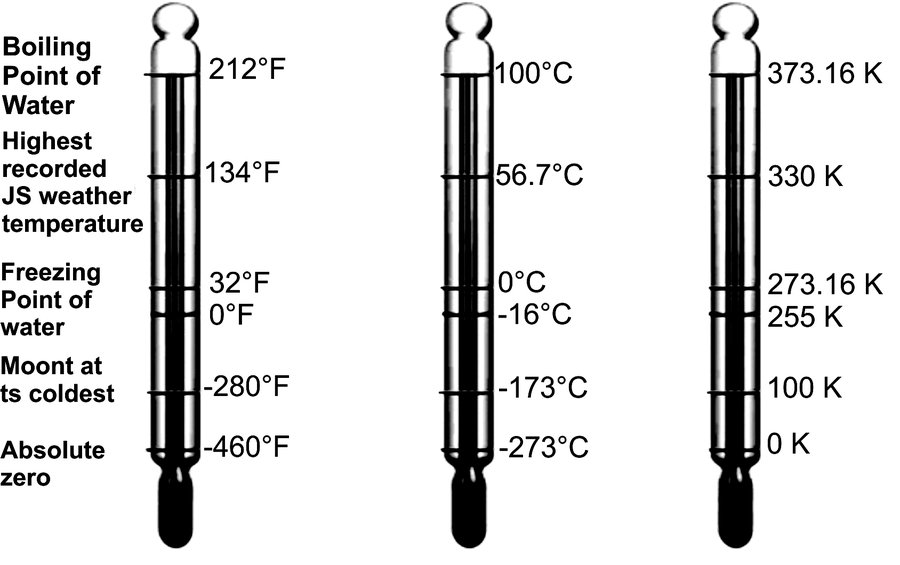
Fahrenheit and centigrade or Celsius scales are used to measure temperatures in ordinary life while Kelvin scale is in practice for scientific purposes. Various scales of temperature are shown below:
Celsius Scale:
On Celsius scale, for water the interval between lower and upper fixed point is divided into 100 equal divisions. The lower fixed point is marked as 0 oC and the upper fixed point is marked as 100 oC.
Fahrenheit Scale:
On Fahrenheit scale, the interval between lower and upper fixed points is divided into 180 equal divisions. The lower fixed point is marked as 32 oF and the upper fixed point is marked as 212 oF.
Kelvin Scale:
In SI units, the unit of temperature is Kelvin (K) and its scale is called Kelvin scale of temperature. The interval between the lower and upper fixed points is divided into 100 equal divisions. Thus a change in 1oC is equal to a change of 1 K. the lower fixed point on the scale corresponds to 273 K and the upper fixed point is referred as 373 K. The zero on this scale is called the absolute zero and is equal to – 273 oC.
Scale Conversion Formulae:
Following are scale conversion formulae
From Celsius to Kelvin Scale:
The temperature T on Kelvin scale can be obtained by adding 273 in the temperature C on Celsius scale thus
T (K) = 273+C
From Kelvin to Celsius Scale:
The temperature on Celsius scale can be found by subtracting 273 from the temperature in Kelvin Scale. Thus
C = T (K) – 273
From Celsius to Fahrenheit Scale:
Since 100 divisions on Celsius scale are equal to 180 divisions on Fahrenheit scale. Therefore, each division on Celsius scale is equal to 1.8 divisions on Fahrenheit scale. Moreover, 0°C corresponds to 32°F.
F = 1.8 C + 32
Here F is the temperature on Fahrenheit scale and C is the temperature on Celsius scale
Q2. Define and explain internal energy of a body.
INTERNAL ENERGY
Introduction:
Heat is called as the energy in transit. Once heat enters a body, it becomes its internal energy and no longer exists as heat energy.
Definition:
The sum of kinetic energy and potential energy associated with the atoms, molecules and particles of a body is called its internal energy.
Dependence:
Internal energy of a body depends on many factors such as the mass of the body, kinetic and potential energies of molecules etc. Kinetic energy of an atom or molecule is due to its motion which depends upon the temperature. Potential energy of atoms or molecules is the stored energy due to intermolecular forces.
Short Questions
Q1. Define temperature and write its unit. (LHR 2014, GRW 2015)
TEMPERATURE
Definition:
“Degree of coldness or hotness of the body is a measure of its temperature”
Quantity:
Temperature is a base and scalar quantity.
Unit:
SI unit of temperature is kelvin (K)
Q2. Define heat. Write its unit. (LHR 2014)
HEAT
Definition:
“Heat is the energy that is transferred from one body to the other in thermal contact with each other as a result of the difference of temperature”
Quantity:
Heat is a derived and scalar quantity.
Unit:
SI unit of heat is Joule (J)
Q3. Define thermal contact
THERMAL CONTACT
“Such a contact of bodies in which exchange of heat takes place is called thermal contact.”
Example:
To store ice in summer, people wrap it with cloth or keep it in wooden box or in thermos flask. In this way, they avoid the thermal contact of ice with its hot surroundings otherwise ice will soon melt away.
Q4. Define thermal equilibrium.
THERMAL EQUILIBRIUM
“The state of thermal contact at which two bodies attain same temperature and no exchange of heat takes place is called thermal equilibrium.”
Example:
Q5. When you place a cup of hot tea or water in a room, it cools down gradually. It stops cooling as it reaches the room temperature. Thus, temperature determines the direction of flow of heat. Heat flows from a hot body to a cold body until thermal equilibrium is reached. What happens when we touch a hot body?
TOUCH OF A HOT BODY
Q6. When we touch a hot body the thermal energy flows from hot body to our body and this flow of heat continue until both the bodies become at same temperature i.e. Thermal equilibrium. Define thermometer. (LHR 2013)
THERMOMETER
“The instrument which is used to measure the temperature is called a thermometer”
Thermometric Material:
“The material that is used in thermometer for measuring temperature is called thermometric material.”
Some substances have property that changes with temperature. Substance that show change with temperature can be used as thermometric material. Common thermometers are generally made using some suitable liquid as thermometric material.
Q7. Define absolute zero.
ABSOLUTE ZERO
Absolute zero is the point at which the fundamental particles of nature have minimal vibrational motion, retaining only quantum mechanical, zero-point energy-induced particle motion.
By international agreement, absolute zero is defined as precisely; 0 K on the Kelvin scale, which is a thermodynamic (absolute) temperature scale; and –273.15 degrees Celsius on the Celsius scale.
Q8. What is clinical thermometer? (Do you know Pg. # 173)

CLINICAL THERMOMETER
A clinical thermometer is used to measure the temperature of human body. It has a narrow range from 35oC to 42oC. It has a constriction that prevents the mercury to return. Thus, its reading does not change until reset as shown in the figure:
Q9. Write down the conversions of thermometer scales. (LHR 2013, GRW 2014, 2015)
CONVERSIONS OF SCALES
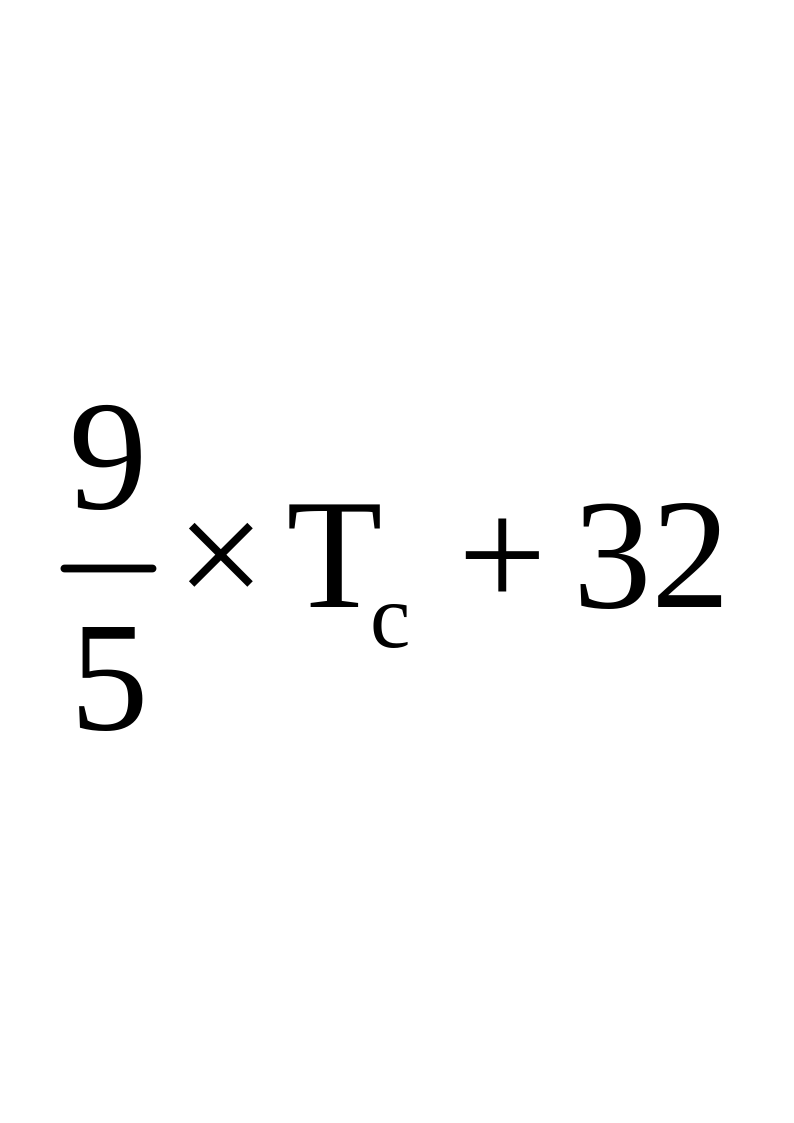
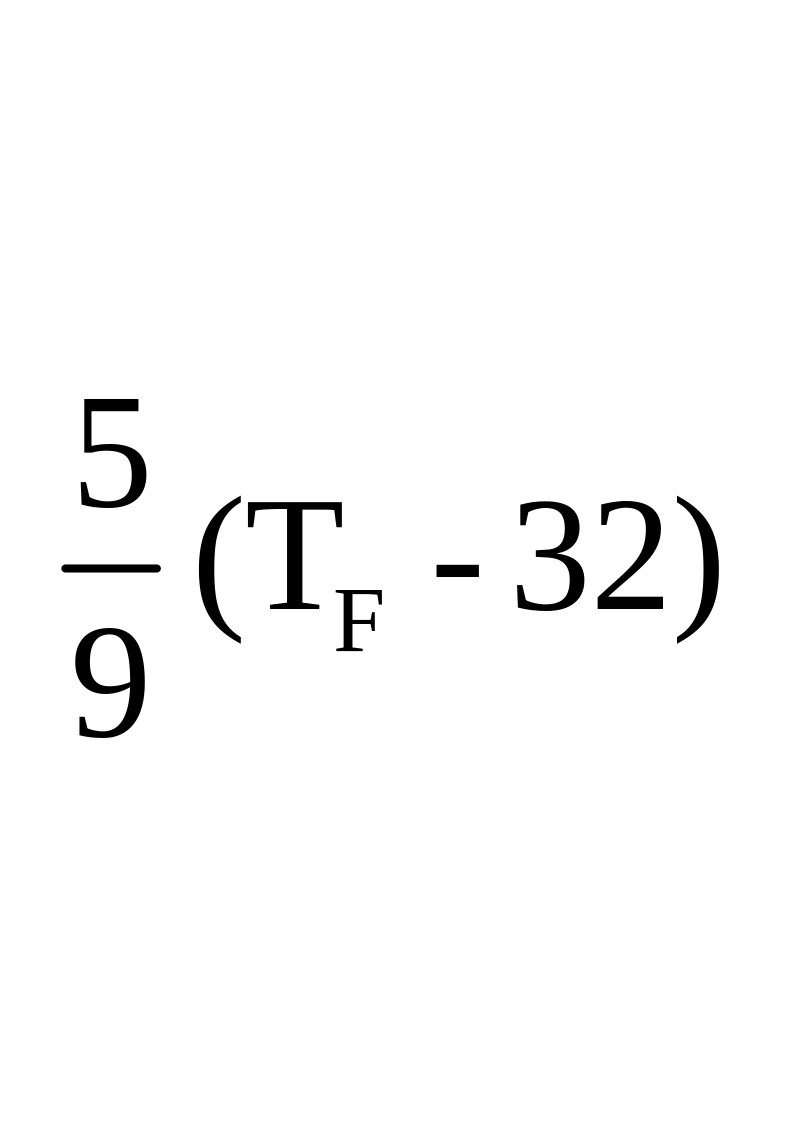
Following are scale conversion formulae.
Conversion of Celsius (centigrade) to Fahrenheit scale:
TF =
Conversion of Fahrenheit to Celsius scale:
Tc =
Relationship between Kelvin and Celsius scales:
Tk = Tc + 273
Every thermometer makes use of some property of a material that varies with temperature. Name the property used in: (Mini exercise Pg. # 170)
Strip thermometers
Mercury thermometers
Ans. PROPERTIES OF MATERIALS
(a) In strip thermometers, colour variation is used.
(b) Uniform thermal expansion of liquids is used in mercury thermometer.
EXAMPLE 8.1
Q10. What will be the temperature on Kelvin scale of temperature, when it is 20 oC on Celsius scale?
Given Data:
Temperature on Celsius scale = C = 20 0C
To Find:
Temperature on Kelvin scale = T (K) = 20 0C
Calculations:
We know
T (K) = 273 + C
Putting values
T (K) = 273 + 20 = 293 K
Result:
20 oC on Celsius scale is equal to 293 K.
EXAMPLE 8.2
Q11. Change 300K on Kelvin scale into Celsius scale of temperature.
Given Data:
Temperature on Kelvin scale = T (K) = 300K
To Find:
Temperature on Celsius scale = C =?
Calculations:
We know
T (K) = 273 + C
And C = T (K) -273
Putting values
C= 300 – 273 = 27 oC
Result:
300 K is equal to 27 oC.
EXAMPLE 8.3
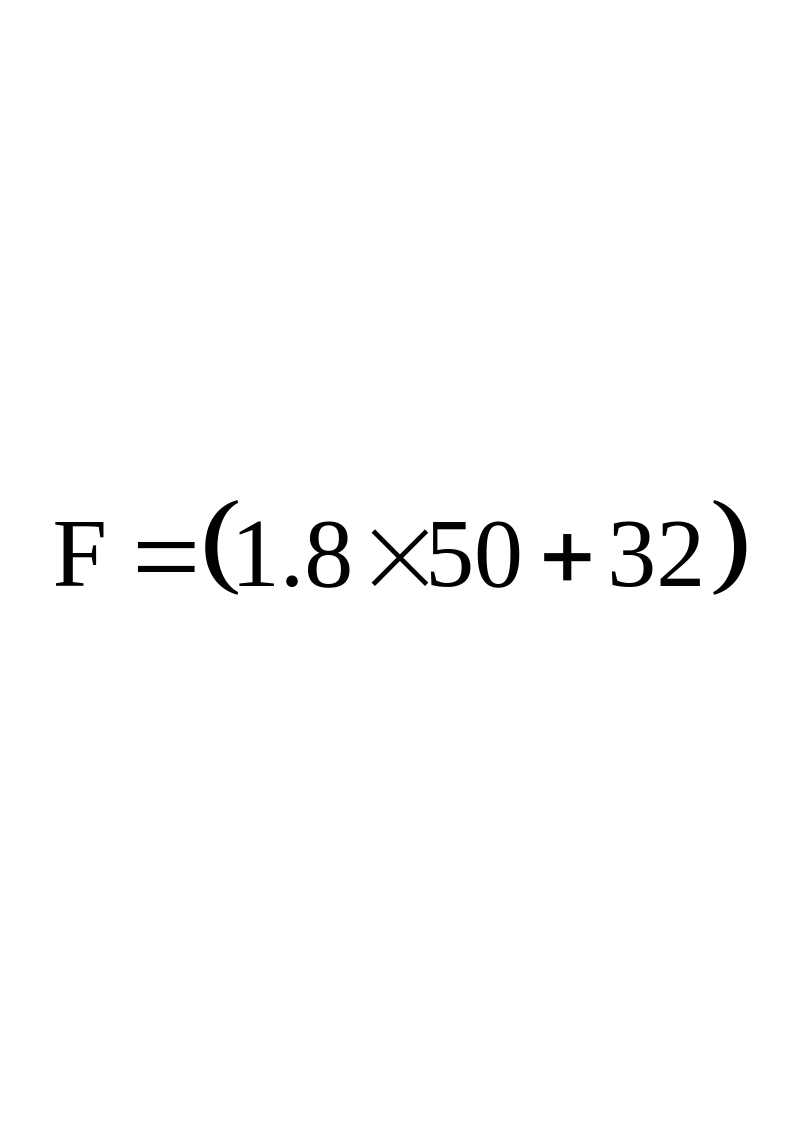
Q12. Convert 50°C on Celsius scale into Fahrenheit temperature scale.
Given Data:
Temperature on Celsius scale = C = 50 0C
To Find:
Temperature on Fahrenheit scale = F =?
Calculations:
We know
Putting values
F = 122 oF
Result:
50 oC on Celsius scale is equal to 122 oF.
EXAMPLE 8.4
Q13. Convert 100 oF into the temperature of Celsius scale. (GRW 2017)
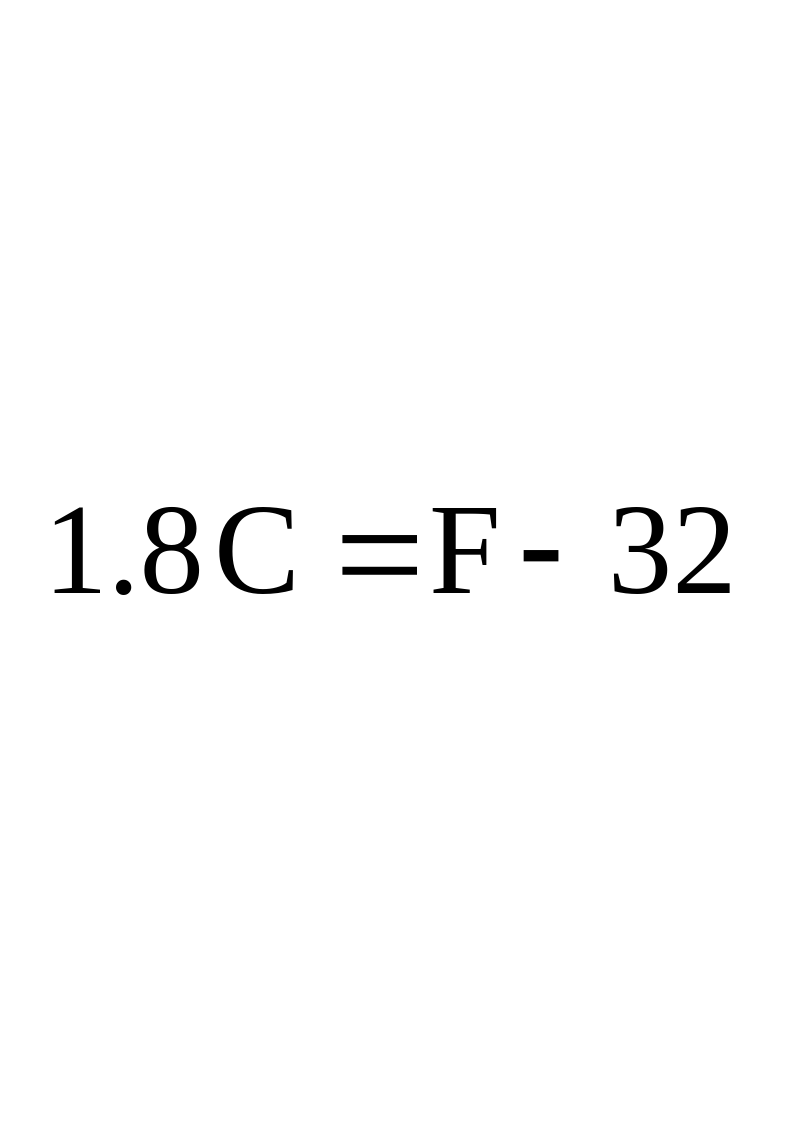
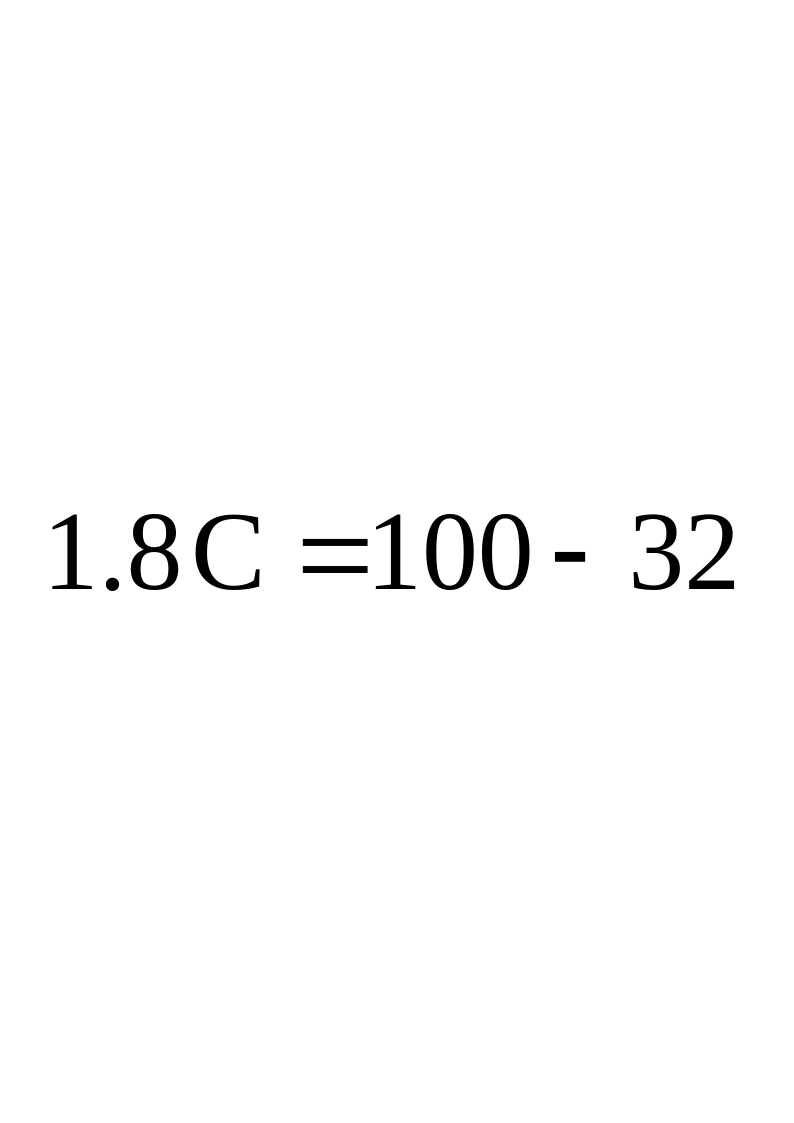
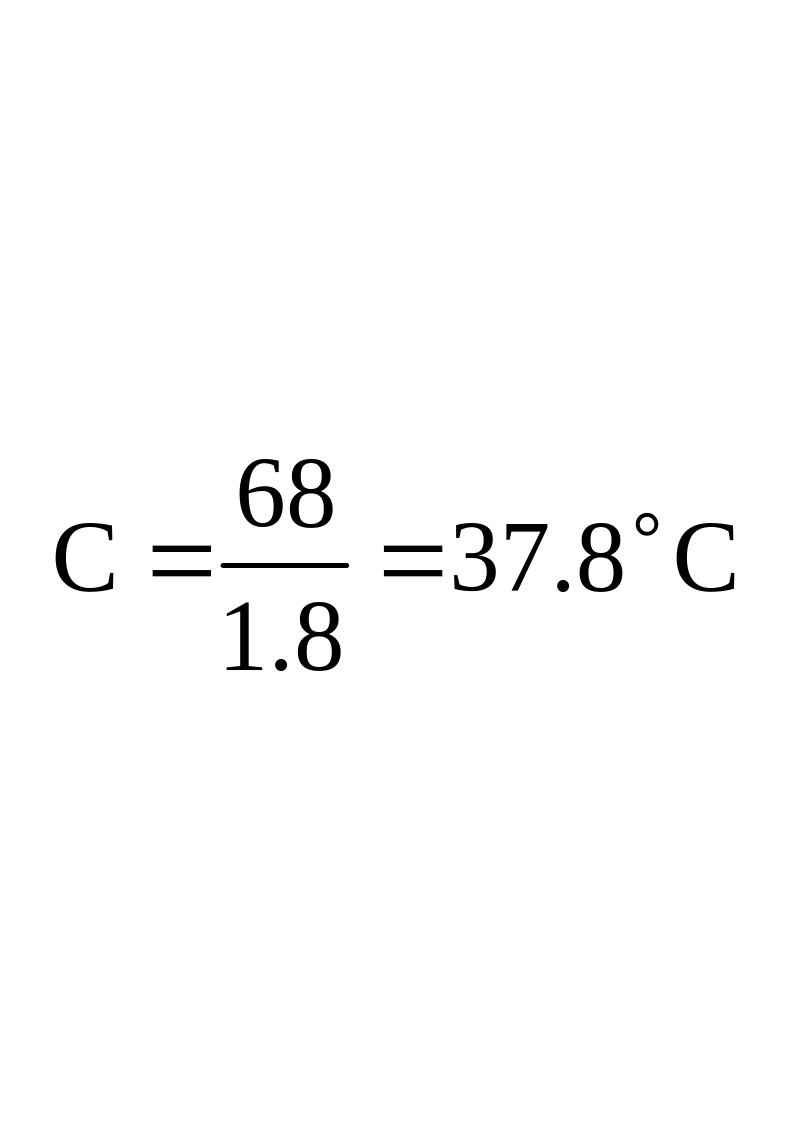
Given Data:
Temperature on Fahrenheit scale = F =100°F
To Find:
Temperature on Celsius scale = C =?
Calculations:
We know
Putting values
1.8 C = 68
Results:
100 oF is equal to 37.8 oC.
8.3 Specific Heat Capacity
Long Questions
Q1. What is specific heat? Explain with examples and derive its mathematical formula.
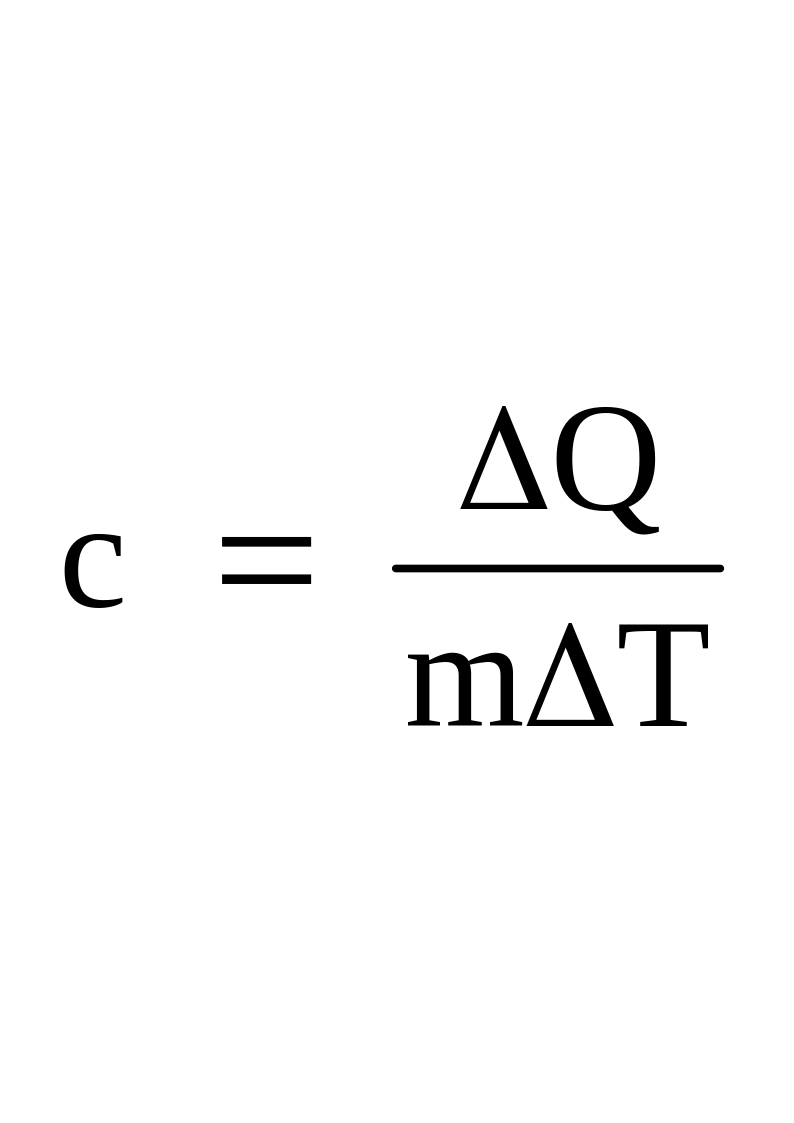
SPECIFIC HEAT CAPACITY
Definition:
“Specific heat of a substance is the amount of heat that is required to raise the temperature of 1 kg mass of that substance through 1K”.
Formula:
Unit:
SI unit of specific heat capacity is Jkg-1K-1.
Explanation:
Generally, when a body is heated, its temperature increases. Increase in the temperature of a body is found to be proportional to the amount of heat absorbed by it.
It has also been observed that the quantity of heat ∆Q required to raise the temperature ∆T of a body is proportional to the mass m of the body.
Thus ∆Q α m ∆T
or ∆Q = c m ∆T
Here ∆Q is the amount of heat absorbed by the body and c is the constant of proportionality called the specific heat capacity or simply specific heat.
So
Examples:
Specific heat capacity of water is 4200 Jkg-1K-1 and specific heat capacity of dry soil is 810 Jkg-1K-1
Q2. Explain the importance of large specific heat capacity of water.
LARGE SPECIFIC HEAT OF WATER
Introduction:
Specific heat of water is 4200 Jkg-1K-1 and of dry soil is about 810 Jkg-1K-1. As a result the temperature of soil would increase five times more than the same mass of water by the same amount of heat.
Importance:
Water has a large specific heat capacity. For this reason, it is very useful in storing and carrying thermal energy due to its high specific heat capacity.
Some roles of water due to its large specific heat are given below
Keeping a Moderate Temperature:
The temperature of land rises and falls more rapidly than that of the sea. Hence, the temperature variations from summer to winter are much smaller at places near the sea than land far away from the sea. So climate of the regions near sea shore, like Karachi, remains moderate.
The presence of large water reservoir such as lakes and sees keep the climate of nearby land moderate due to the large heat capacity of these reservoirs.
Cooling System of Automobiles:
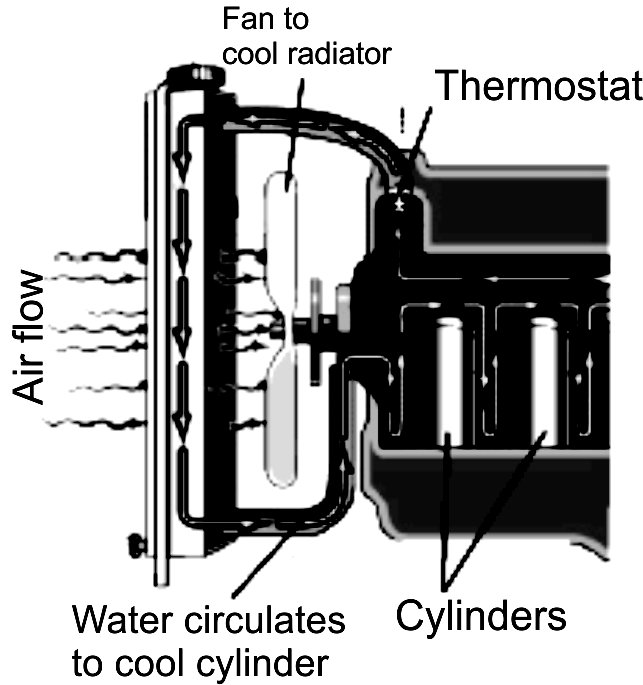
The cooling system of the automobiles uses water to carry away unwanted thermal energy. In an automobile, large amount of heat is produced by its engine due to which its temperature goes on increasing. The engine would cease unless it is not cooled down. Water circulating around the engine maintains the temperature. Water absorbs unwanted thermal energy of the engine and dissipates heat through its radiator as shown in the figure:
Water in Central Heating System:
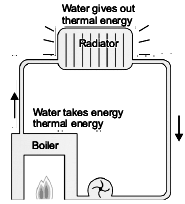
In central heating systems hot water is used to carry thermal energy through pipes from boiler to radiators. Theses radiators are fixed inside the house at suitable places as shown in the figure:
Q3. Define heat capacity and derive its mathematical formula.
HEAT CAPACITY
Definition:
“Heat capacity of a body is the quantity of thermal energy absorbed by it for one Kelvin (1K) increases in its temperature.”
Mathematical Form:
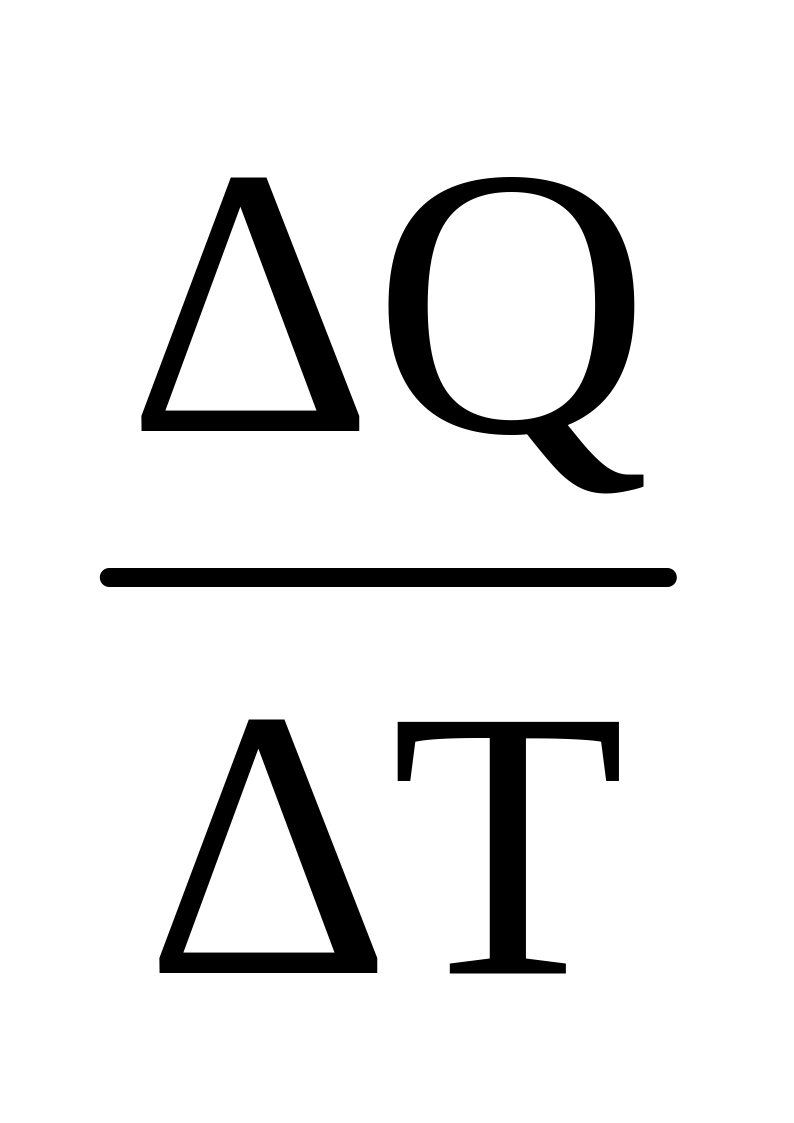
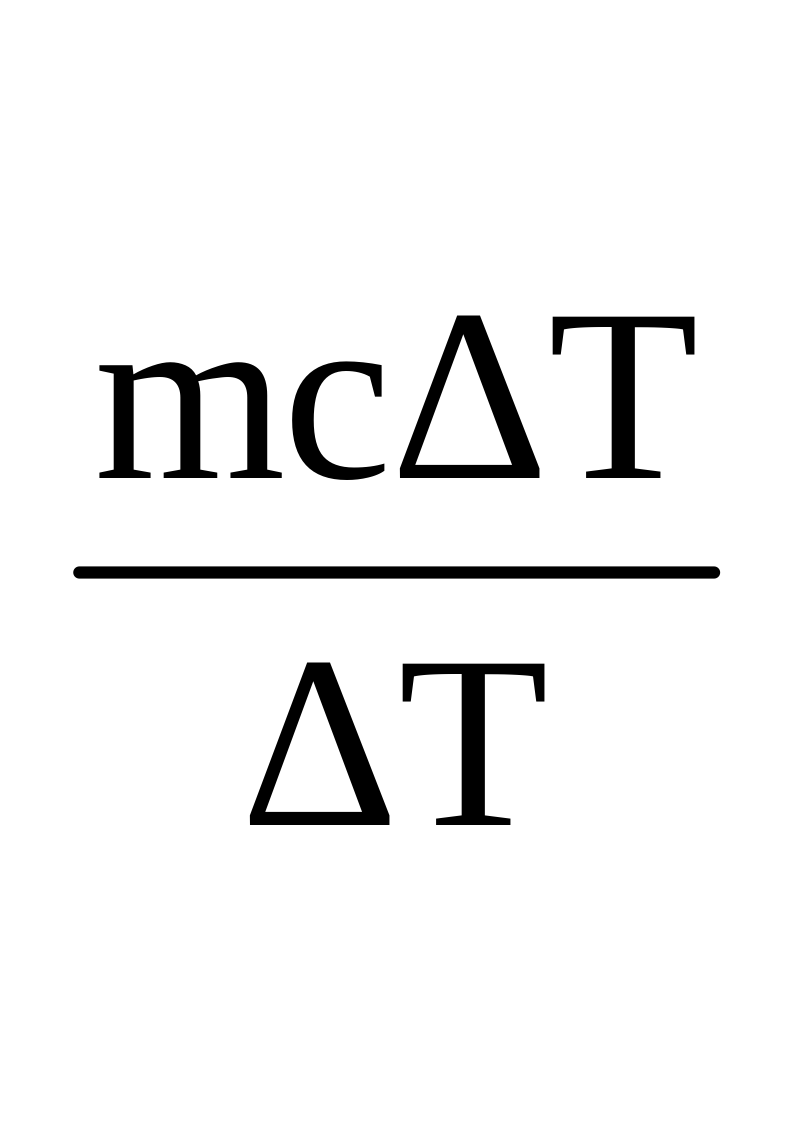
Thus, if the temperature of a body increases through ∆T on adding ∆Q amount of heat, then its heat capacity will be ∆Q/∆T. putting the value of ∆Q, we get
Heat capacity = =
Heat capacity = mc
The above equation shows that heat capacity of a body is equal to the product of its mass of the body and its specific heat capacity.
Unit:
SI unit of heat capacity is JK-1
Example:
Heat capacity of 5 kg of water is (5 kg x 4200 Jkg-1K-1) 21000 Jkg-1. That is 5 kg of water needs 21000 joules of heat for every 1 K rise in its temperature. Thus, larger is the quantity of a substance, larger will be its heat capacity.
Short Questions
Q1. Define specific heat capacity. Write its formula and unit.
SPECIFIC HEAT CAPACITY
Definition:
“Specific heat of a substance is the amount of heat that is required to raise the temperature of 1 kg mass of that substance through 1K”.
Formula:
Unit:
SI unit of specific heat capacity is Jkg-1K-1.
Examples:
Specific heat capacity of water is 4200 Jkg-1K-1 and specific heat capacity of dry soil is 810 Jkg-1K-1
Q2. Define heat capacity. Write its formula and unit. (GRW 2015)
HEAT CAPACITY
Definition:
“Heat capacity of a body is the quantity of thermal energy absorbed by it for one Kelvin (1K) increases in its temperature.”
Formula:
Heat capacity = =
Heat capacity = mc
Unit:
SI unit of heat capacity is JK-1
Example:
Heat capacity of 5 kg of water is (5 kg x 4200 Jkg-1K-1) 21000 Jkg-1. That is 5 kg of water needs 21000 joules of heat for every 1 K rise in its temperature. Thus, larger is the quantity of a substance, larger will be its heat capacity.
Q3. How specific heat differs from heat capacity? (Mini exercise Pg. # 182)
DIFFERENTIATION
Specific heat and heat capacity can be differentiated as:
| Specific Heat | Heat Capacity |
| Definition | Definition |
| Specific heat of a substance is the amount of heat required to raise the temperature of 1 kg mass of that substance through 1K. | Heat capacity of a body is the quantity of thermal energy absorbed by it for one Kelvin (1 K) increase in its temperature. |
| Unit | Unit |
| Its unit is Jkg–1K–1 | Its unit is JK–1 |
| Example | Example |
| Specific heat capacity of water is 4200 Jkg-1K-1 |
Heat capacity of 5 kg of water is (5kg×4200 Jkg-1K-1) 21000 Jkg-1. |
EXAMPLE 8.5
Q4. A container has 2.5 litres of water at 20°C. How much heat is required to boil the water? (LHR 2017)
Given Data:
Volume of water = V =2.5 litres
As 1 litre = 1 kg so
Mass of water = m = 2.5 kg
Specific heat of water = c = 4200 Jkg-1K-1
Initial temperature = T1 = 20 oC
Finall temperature (As water is boiling) = T2 = 100 oC
To Find:
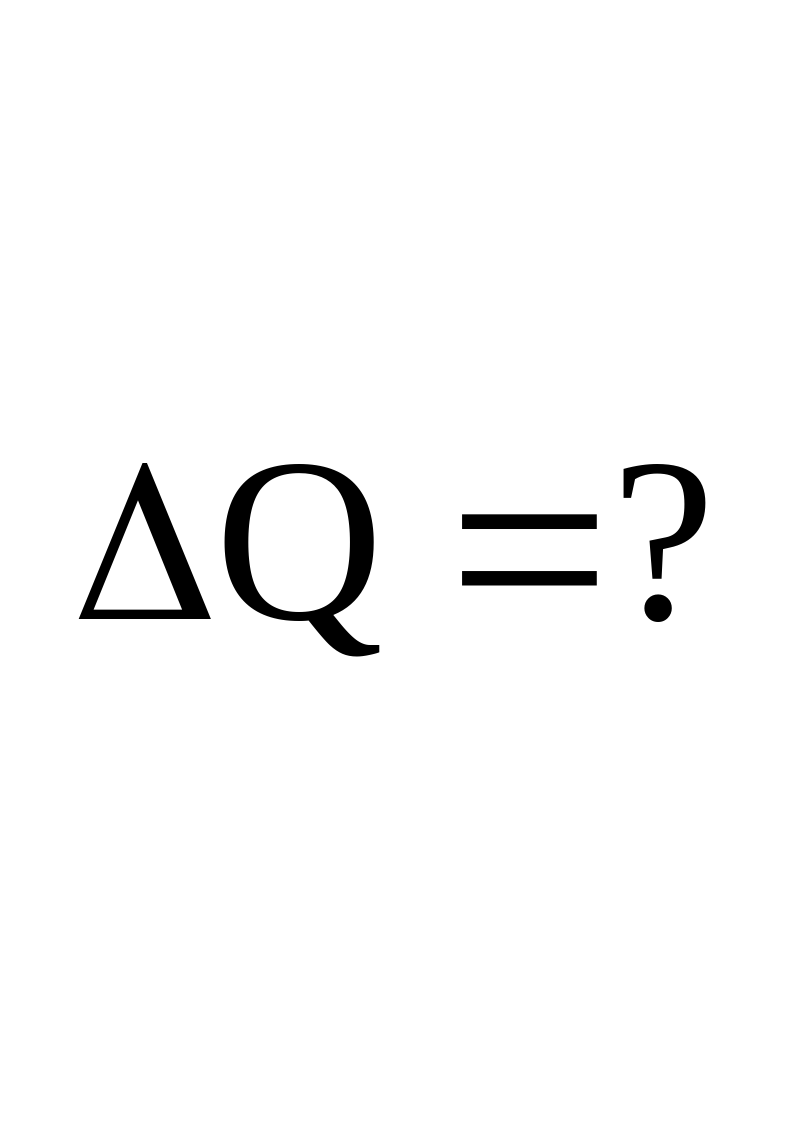
Heat required to boil the water =
Calculations:
We know
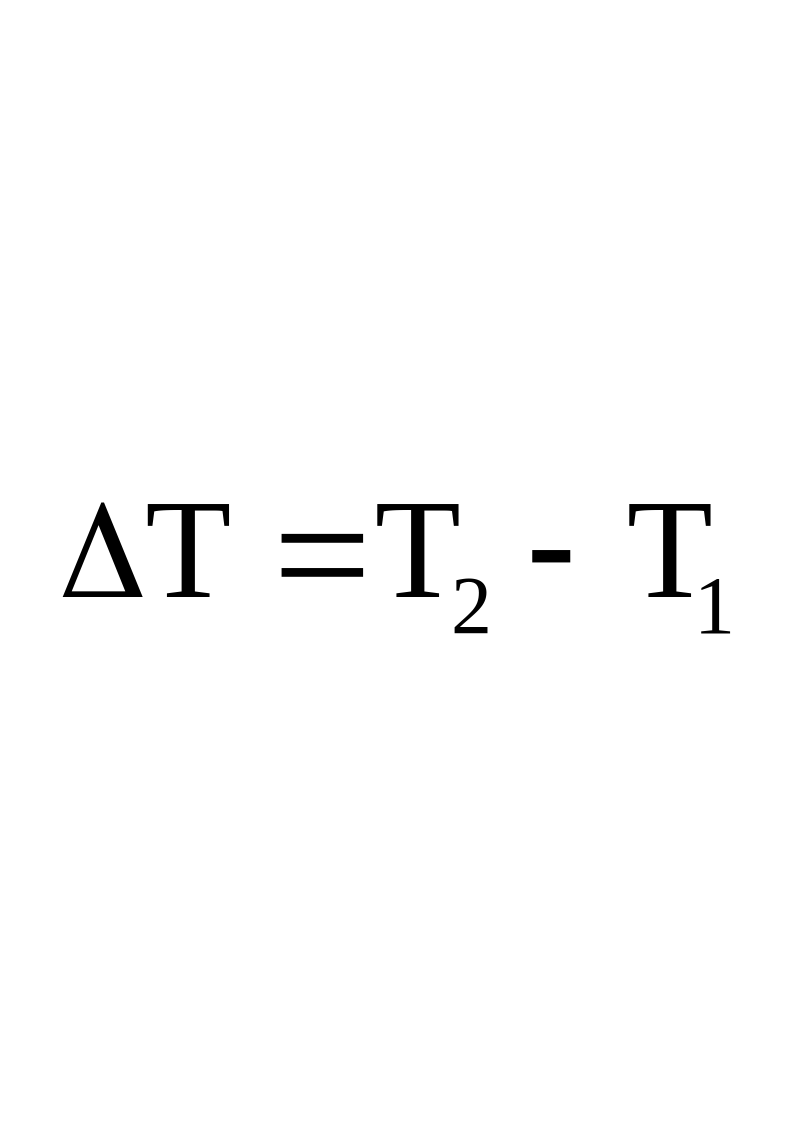
Change in temperature
Putting values
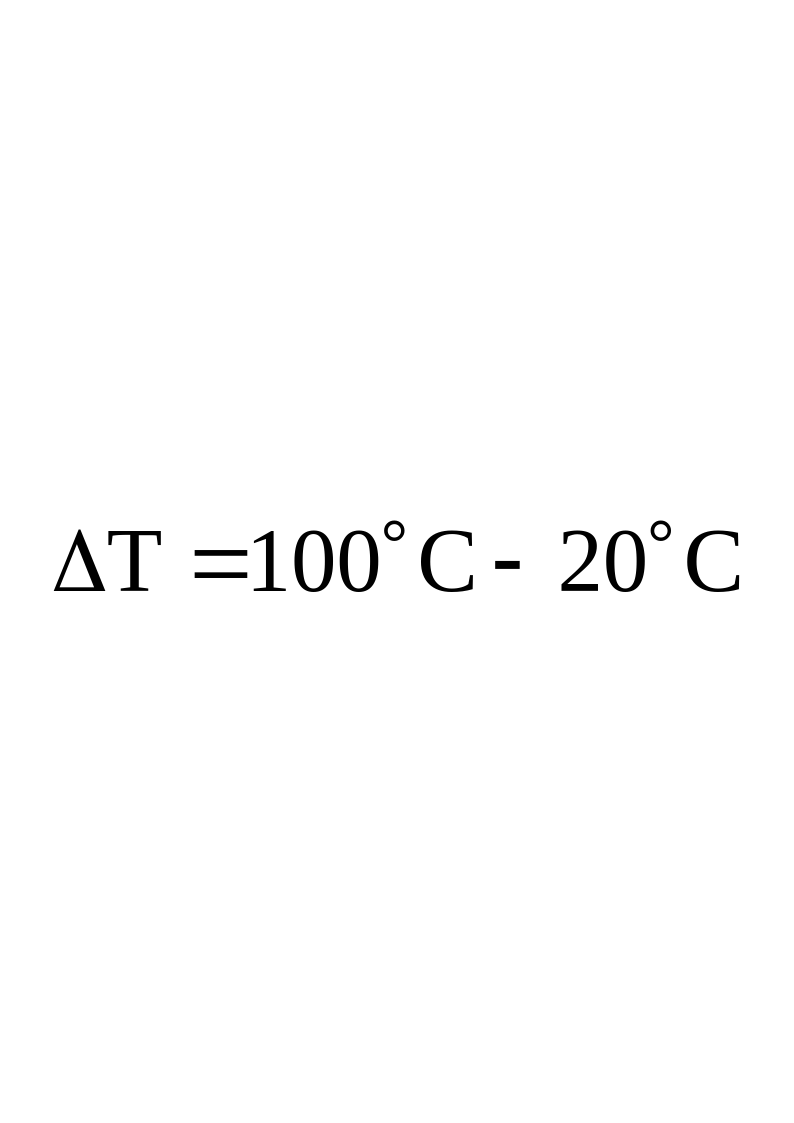
Change in temperature
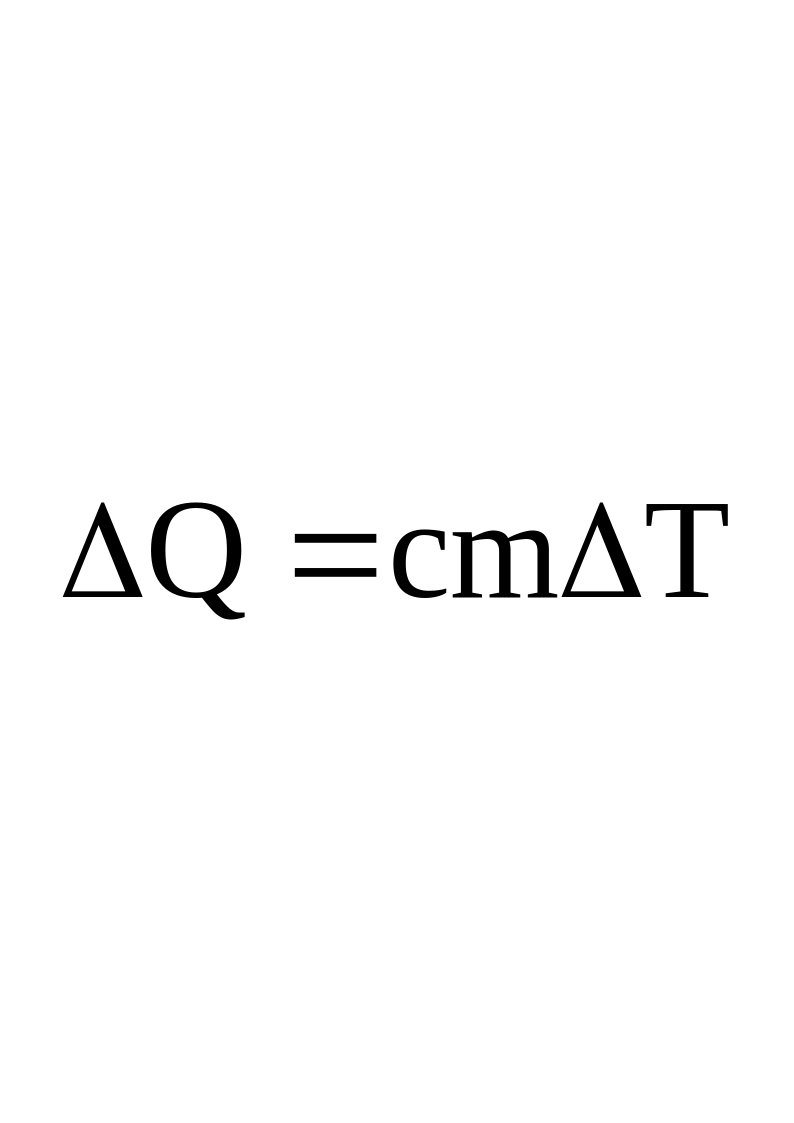
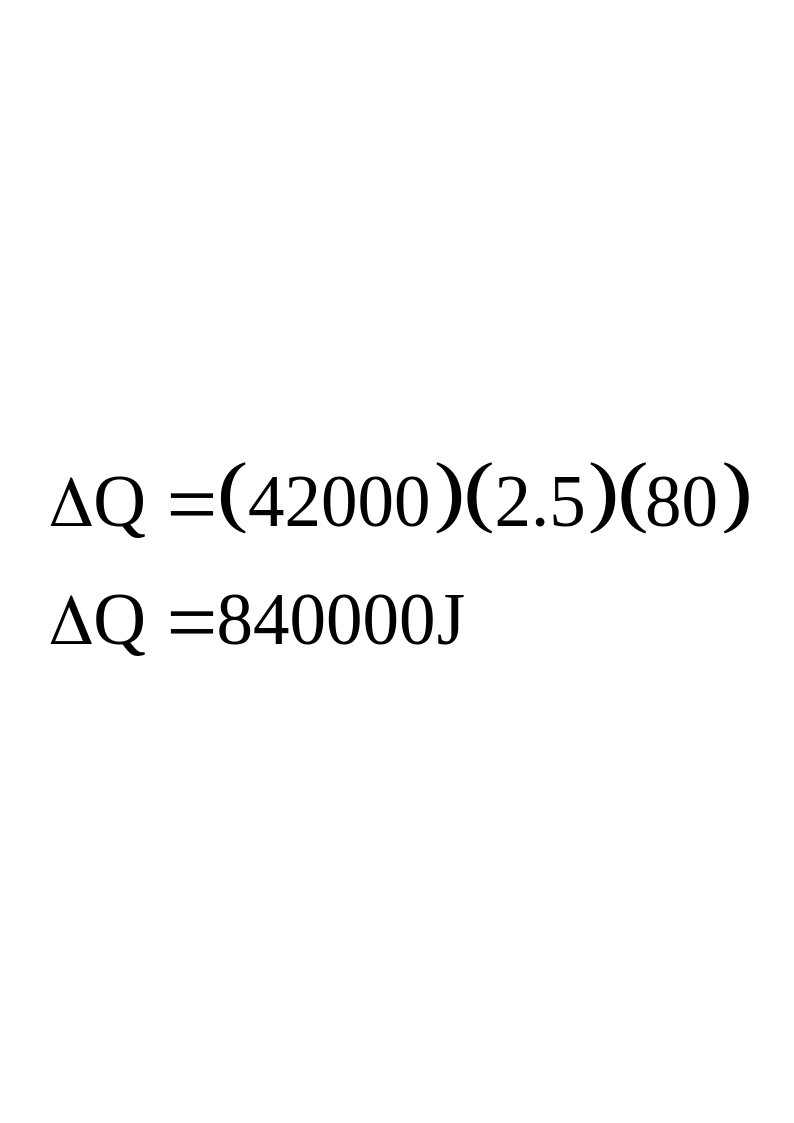
Now we find Heat required to boil the water
Putting values
Result:
Hence, the heat required to boil the water will be 84000 J or 840 kJ.
8.4 Change Of State
8.5 Latent Heat Of Fusion
8.6 Latent Heat Of Vaporization
Long Questions
Q1. Explain with an activity the change of states of matter.
STATES OF MATTER
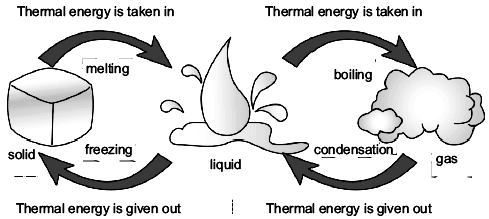
Matter exists in three states:
Solid
Liquid
Gas
Matter can be changed from one state to another. For such a change to occur, thermal energy is added to or removed from a substance as shown in the figure:
Activity:
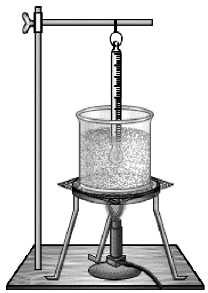
Take a beaker and place it over a stand. Put small pieces of ice in the beaker and suspend a thermometer in the beaker to measure the temperature of ice.
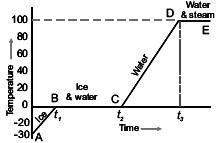
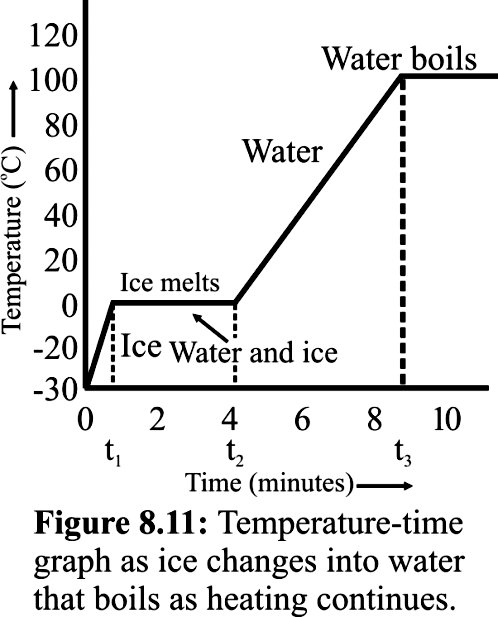
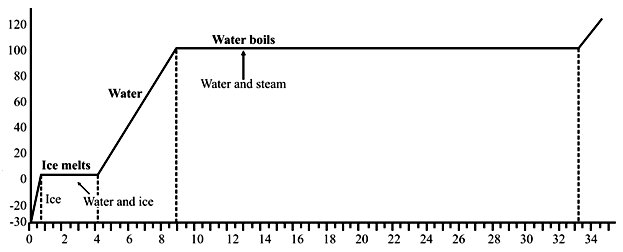
Now place a burner under the beaker. The ice will start melting. The temperature of the mixture containing ice and water will not increase above 0 oC until all the ice melts and we get water at 0o C If this water at 0o C is further heated, its temperature will begin to increase above 0o C as shown in figure.
Explanation of the Graph:
Different parts of the graph can be explained as:
Part AB: On this portion of the curve, the temperature of ice increases from -30oC to 0oC.
Part BC: when the temperature of ice reaches 0oC, the ice water mixture remains at this temperature until all the ice melts.
Reason For Not Changing Temperature:
At this stage temperature does not increase for a while because whole thermal energy is being utilized in breaking intermolecular forces and converting solid state into liquid state.
Part CD: The temperature of the substance gradually increases from 0oC to 100oC. The amount of energy so added is used up in increasing the temperature of water.
Part DE: At 100oC water begins to boil and changes into steam. The temperature remains 100°C until all the water changes into steam.
Reason For Not Changing Temperature:
At this stage again temperature does not increase for a while because whole thermal energy is being utilized in breaking intermolecular forces and converting liquid state into gaseous state.
Q2. Define latent heat of fusion. Write down its mathematical formula and unit also find Latent Heat of Fusion of ice by an experiment.

LATENT HEAT OF FUSION
Introduction:
When a substance is changed from solid to liquid state by adding heat, the process is called melting or fusion. The temperature at which a solid starts melting is called its fusion point or melting point. When the process is reversed i.e. when a liquid is cooled, it changes into solid state. The temperature at which a substance changes from liquid to solid state is called its freezing point. Different substances have different melting points. However, the freezing point of a substance is the same as its melting point.
Definition:
“Heat energy required to change unit mass of a substance from solid to liquid state at its melting point without change in the temperature is called its latent heat of fusion”.
Mathematical Formula:
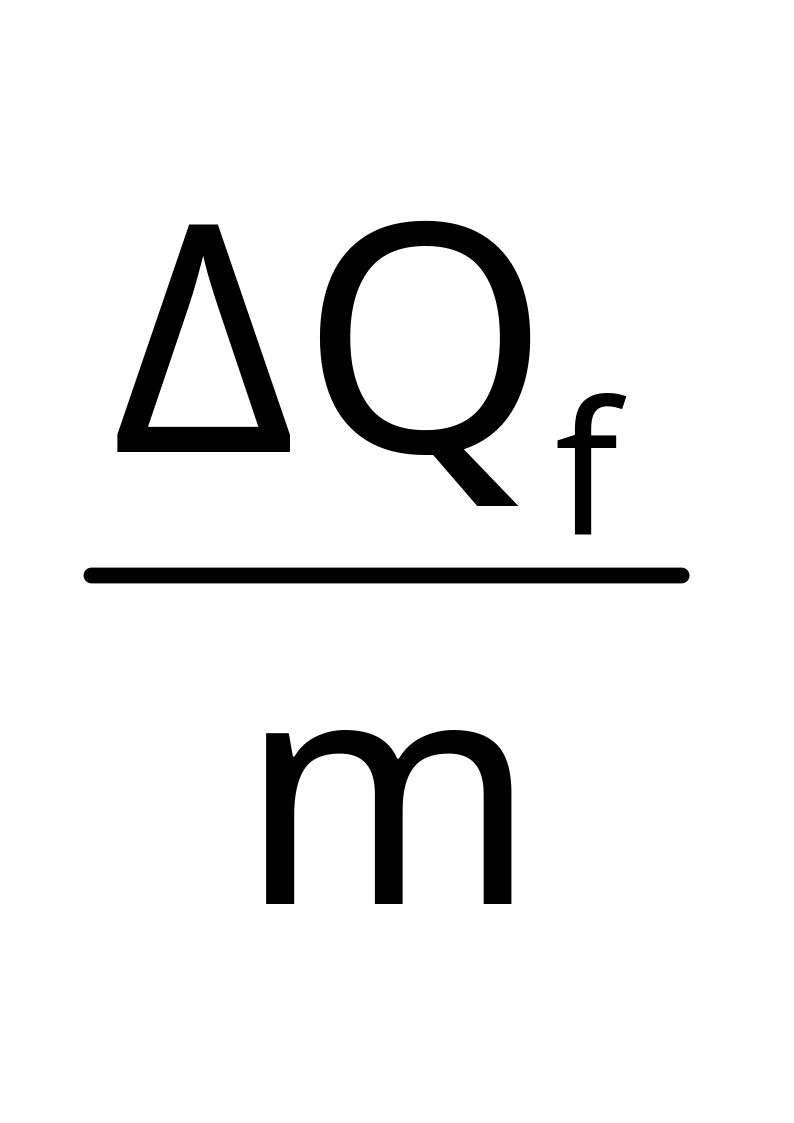
It is denoted by Hf.
Hf =
Or
∆Qf = m Hf
Unit:
SI unit of Latent Heat of Fusion is Jkg-1
Latent Heat of Fusion of Ice:
Ice changes at 0o C into water. Latent heat of fusion of ice is 3.36×10⁵ Jkg-1. That is; 3.36×10⁵ joules heat is required to melt 1 kg of ice into water 0o C.
Experiment:
Take a beaker and place it over a stand. Put small pieces of ice in the beaker and suspend a thermometer in the beaker to measure the temperature. Place a burner under the beaker as shown in the figure:
The ice will start melting. The temperature of the mixture containing ice and water will not increase above 0°C until all the ice melts. Note the time which the ice takes to melt completely into water at 0°C.
Continue heating the water at 0°C in the beaker. Its temperature will begin to increase. Note the time which the water in the beaker takes to reach its boiling point at 100°C from 0°C. Draw a temperature-time graph such as shown in figure
Calculations:
Calculate the latent heat of fusion of ice from the data as follows:
Let the mass of ice =m
Finding the time from the graph
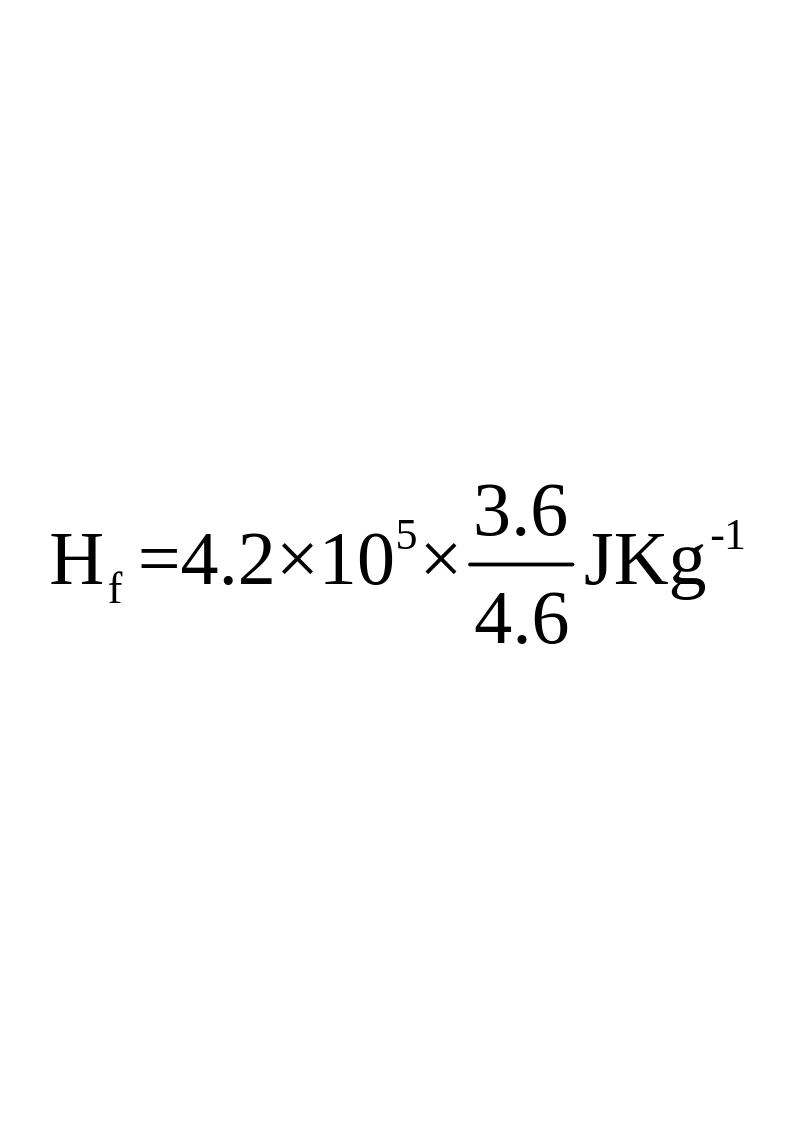
Time taken by ice to melt completely at 0o C = tf =t2 – t1 =3.6 minutes
Time taken by water to heat from 0oC to 100o C = to = t3 – t2 = 4.6 minutes
Specific heat of water c = 4200 JKg-1 K-1
Increase in the temperature of water ∆T = 100o C = 100K
Heat required by water from 0o C to 100o C = ∆Q = ?
As we know that
∆Q = m c ∆T
= m x 4200 x 100
= m x 42000
= m x 4.2 x 103 x 102
= 4.2 x 10⁵ x m JKg-1
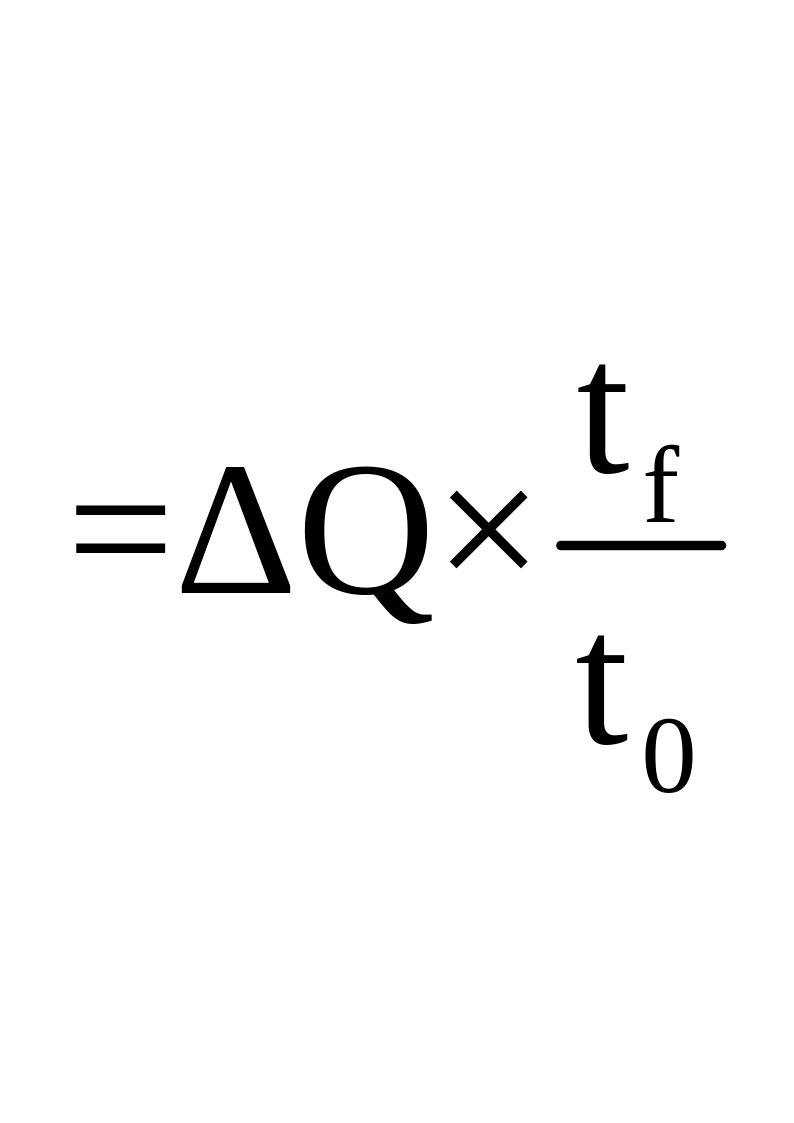
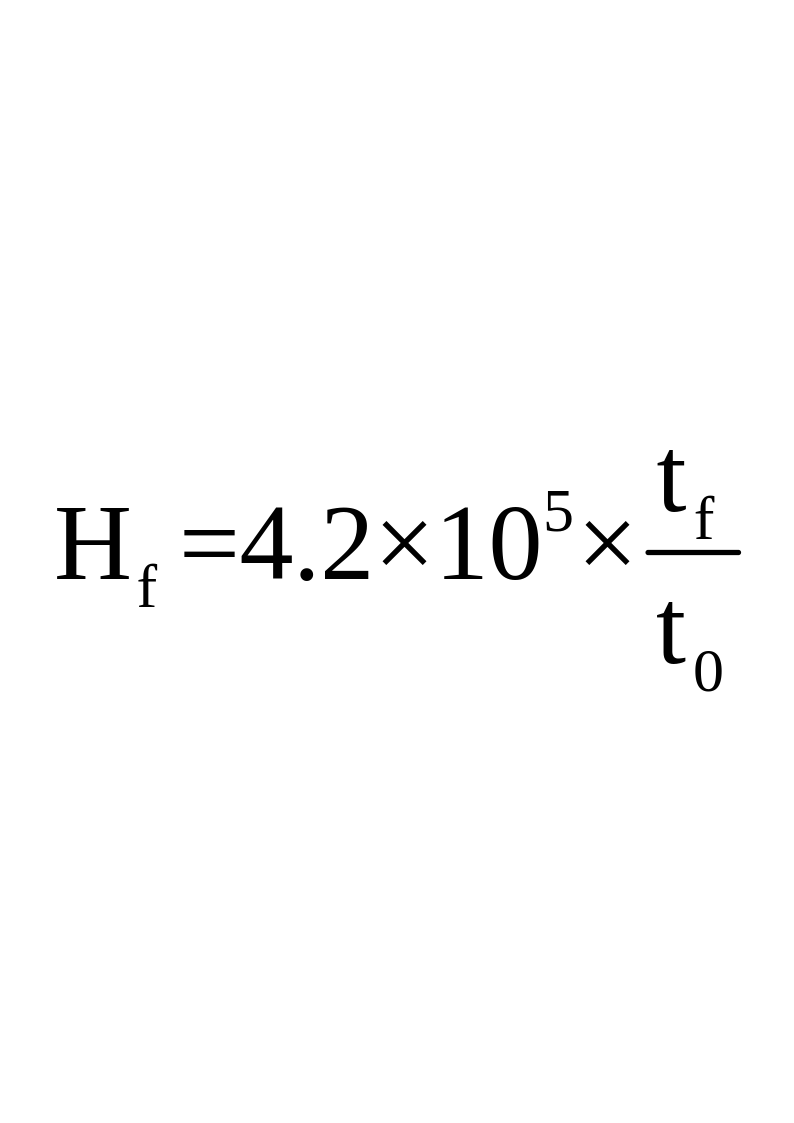
Heat ∆Q is supplies to water in time to to raise the temperature of the water from 0o C to 100o C, Hence, the rate of absorbing heat by water in beaker can be given by
Rate of absorbing heat
= ∆Q/to
As we know that
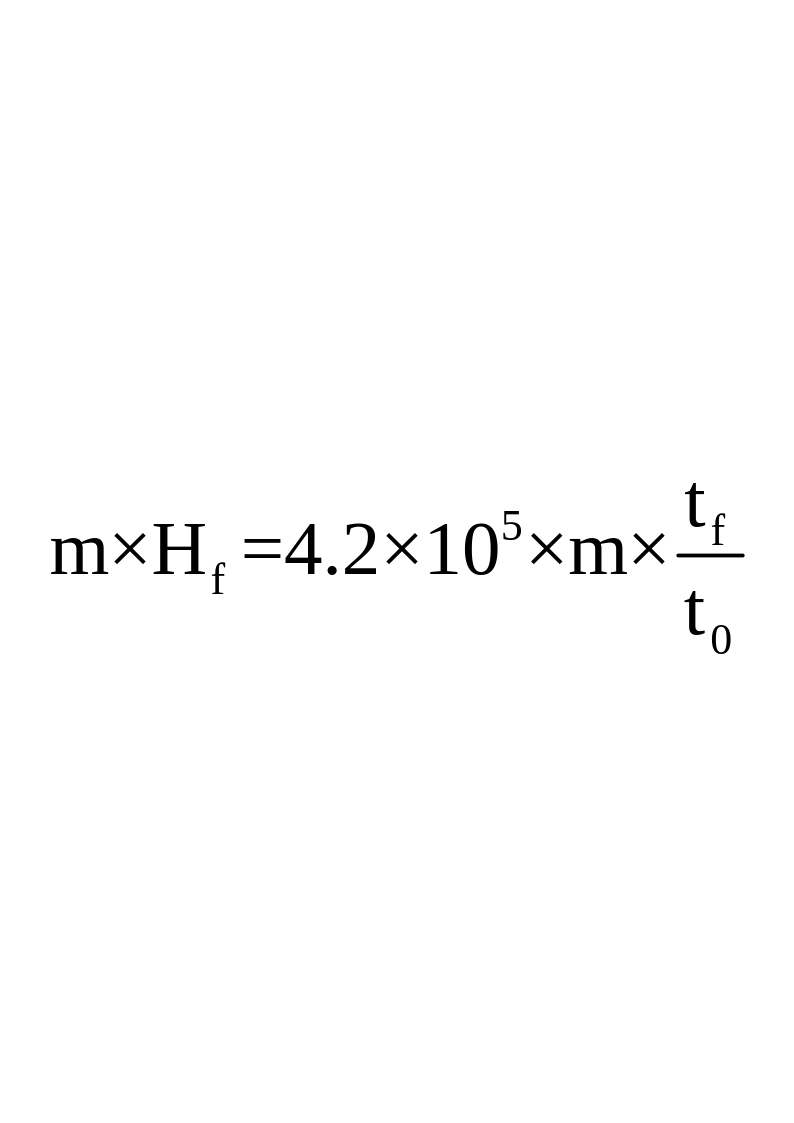
∆Qf = m x Hf
Putting the values of tf and to which can be found though graph
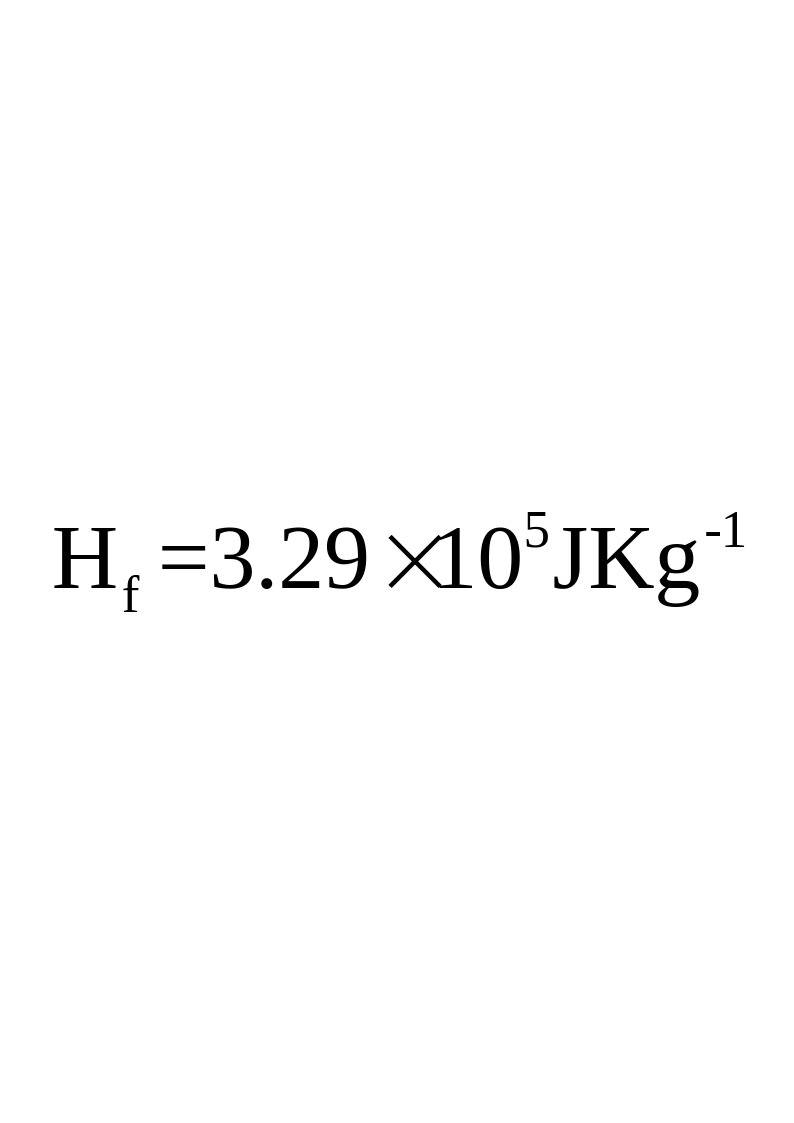
Conclusion:
The latent heat of fusion of ice (Hf) found for above experiment is 3.29×10⁵ JKg-1 however actual value is 3.36×10⁵ JKg-1.
Q3. Define latent heat of vaporization. Write its mathematical formula.
LATENT HEAT OF VAPORIZATION
Introduction:
When heat is given to a liquid at its boiling point, its temperature remains constant. The heat energy given to liquid at its boiling point is used up in changing its state from liquid to gas without any increase in its temperature.
Definition:
“The quantity of heat that changes unit mass of a liquid completely into gas at its boiling point without any change in its temperature is called its latent heat of vaporization”.
Mathematical Form:
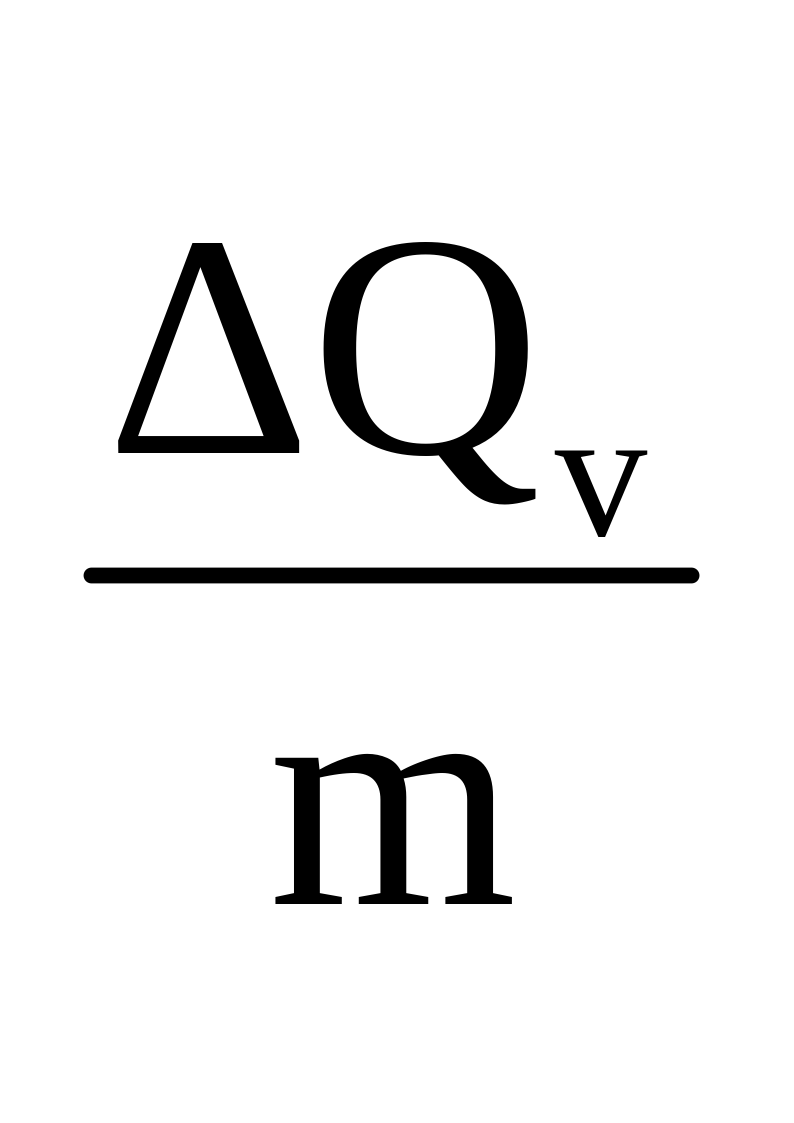
It is denoted by Hv
Hv =
OR
Δ Qv = m Hv
Unit:
SI unit of Latent Heat of vaporization is Jkg-1
Latent Heat of Vaporization of Water:
When water is heated, it boils at 100 oC under standard pressure. Its temperature remains 100oC until it is changed into steam. Its latent heat of vaporization is 2.26 x 10⁶ Jkg-1. That is; one kilogram of water requires 2.26 x 10⁶ joule heat to change it completely into gas (steam) at its boiling point.
Experiment:
Take a beaker and place it over a stand. Put small pieces of ice in the beaker and suspend a thermometer in the beaker to measure the temperature. Place a burner under the beaker as shown in the figure:
The ice will start melting and will convert into water. Continue heating water till all the water changes into steam. Note the time which the water in the beaker takes to change completely into steam at its boiling point 100°C.
Extend the temperature time graph such as shown in the figure:
Calculations:
Calculate the latent heat of vaporization of boiled water with the data as given:
Let
The mass of ice = m
Measuring the time from the graph
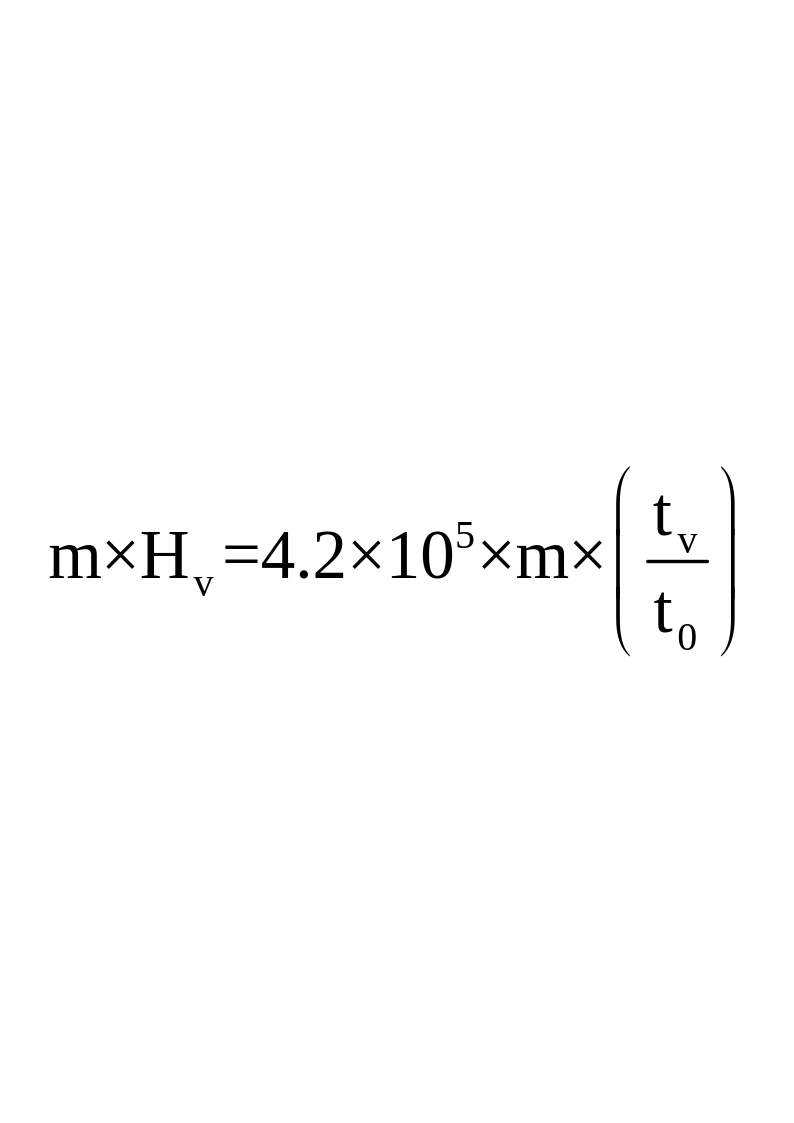
Time taken by water to heat from 0o C to 100o C = to = t3 – t2 = 4.6 minutes
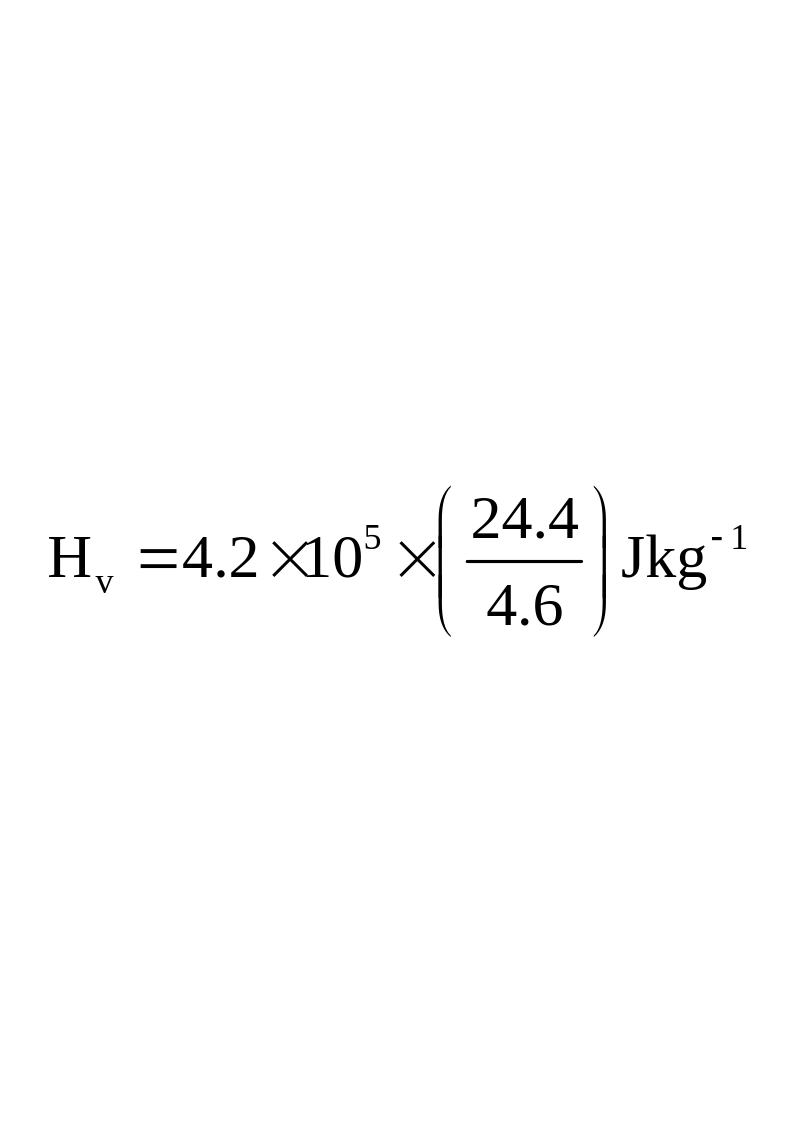
Time taken by water 100o C to get changed into steam = tv = t4 – t3 = 24.4 minutes
Specific heat of water c = 4200 JKg-1 K-1
Increase in the temperature of water ∆T = 100o C
Heat required to heat water from 0o C to 100o C =∆Q = m c ∆T
= m x 4200 x 100
= m x 4.2 x 103 x 102
= 4.2 x 10⁵ x m JKg-1
To raise the temperature of the water from 0o C to 100o C, ∆Q is given to water. So the heat absorption rate of water in beaker can be given by
Rate of absorbing heat = ∆Q/to
Since heat absorption in time tv
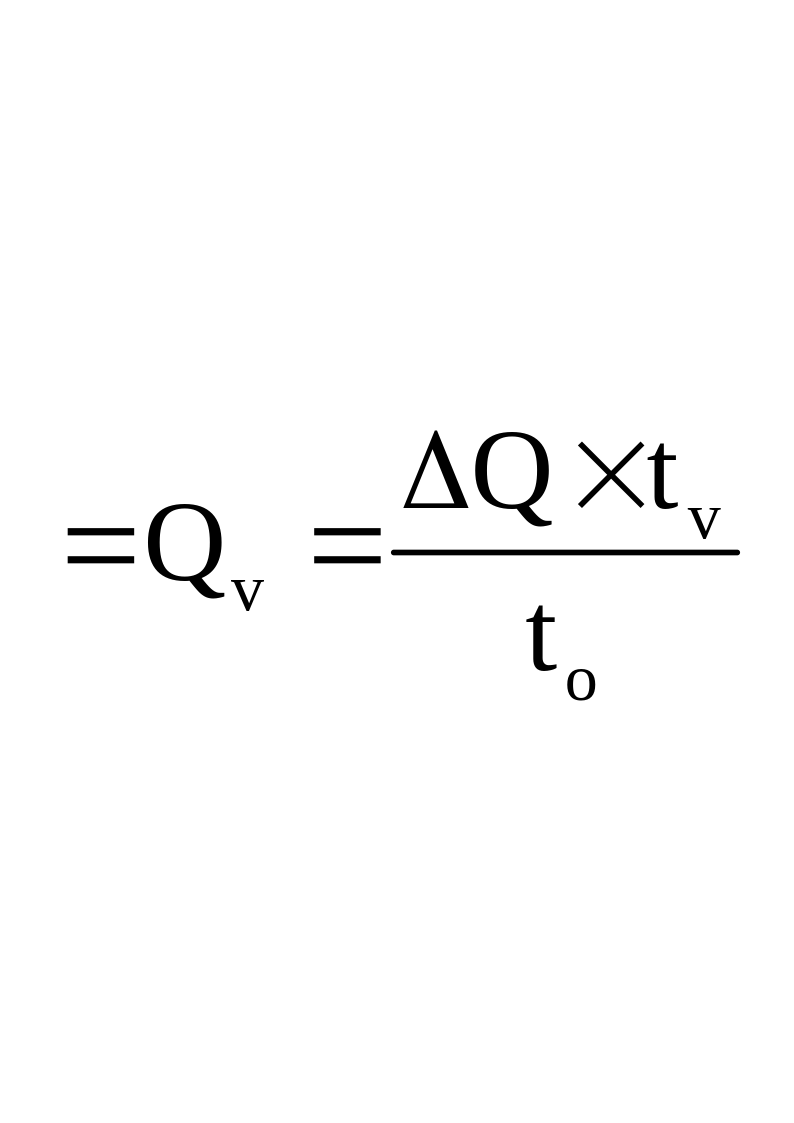
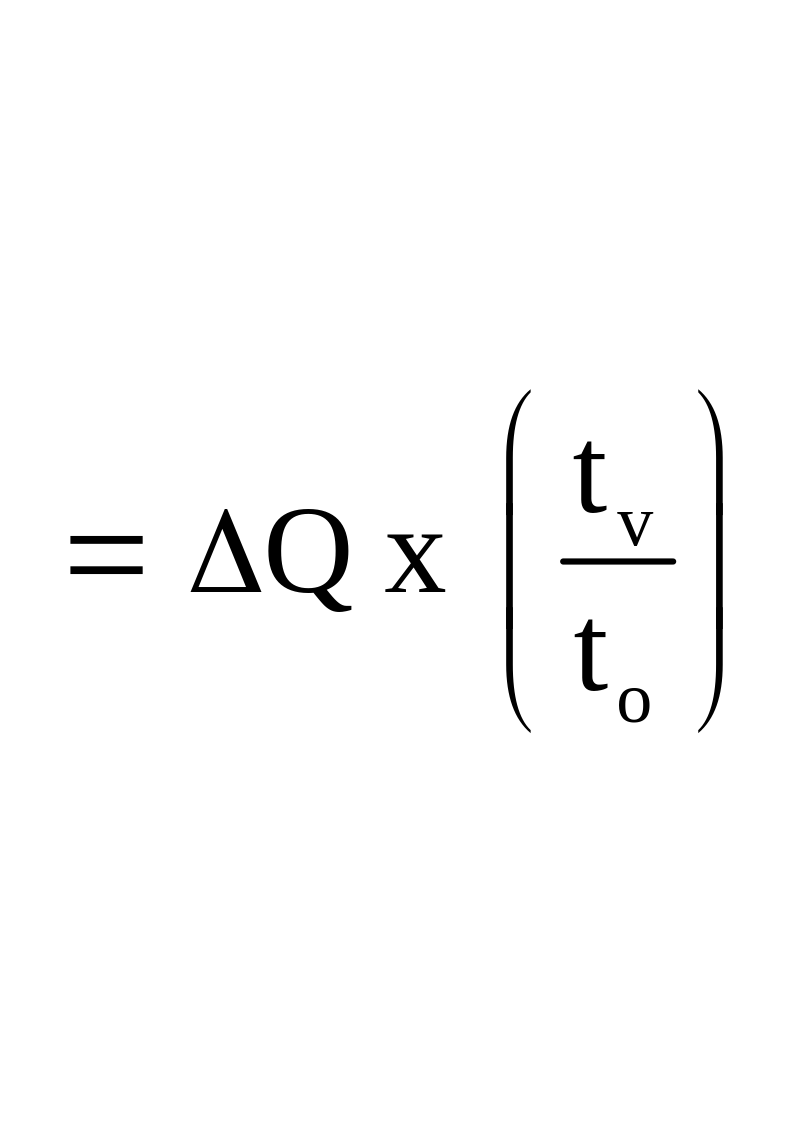
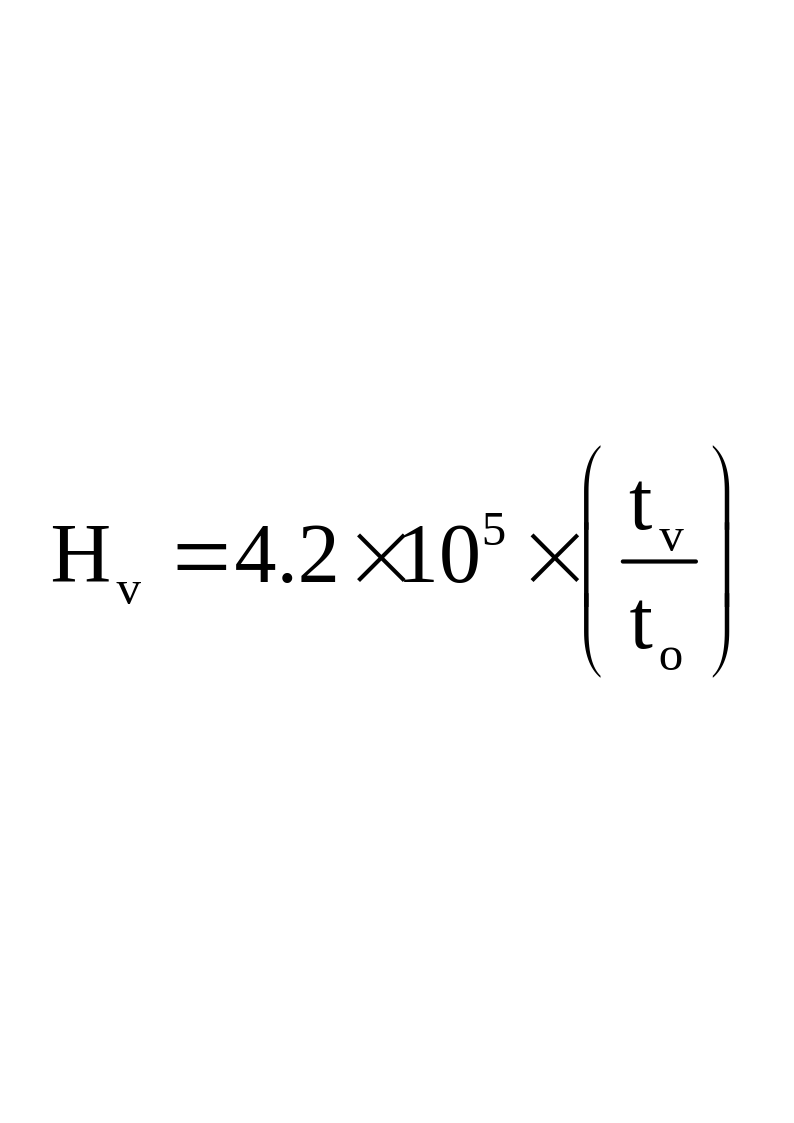
As we know that ∆Qv = m x Hv
Putting the values of tv and to which can be found though graph
Hv = 2.23 x 10⁶ Jkg-1
Results:
The latent heat of vaporization of boiled water (Hv) found for above experiment is 2.23 x 10⁶ JKg-1 however actual value is 2.26 x 10⁶ JKg-1.
Short Questions
Q1. Define latent heat of fusion. Write its formula and unit. (GRW 2013, 2015, LHR 2017)
LATENT HEAT OF FUSION
Definition:
“Heat energy required to change unit mass of a substance from solid to liquid state at its melting point without change in the temperature is called its latent heat of fusion”.
Mathematical Formula:
It is denoted by Hf.
Hf =
Or
∆Qf = m Hf
Unit:
SI unit of Latent Heat of Fusion is Jkg-1
Latent Heat of Fusion of Ice:
Ice changes at 0o C into water. Latent heat of fusion of ice is 3.36 x 10⁵ Jkg-1. That is; 3.36 x 10⁵ joules heat is required to melt 1 kg of ice into water 0o C.
Q2. Define latent heat of vaporization. Write its formula and unit? (GRW 2014)
LATENT HEAT OF VAPORIZATION
Definition:
“The quantity of heat that changes unit mass of a liquid completely into gas at its boiling point without any change in its temperature is called its latent heat of vaporization”.
Mathematical Form:
It is denoted by Hv.
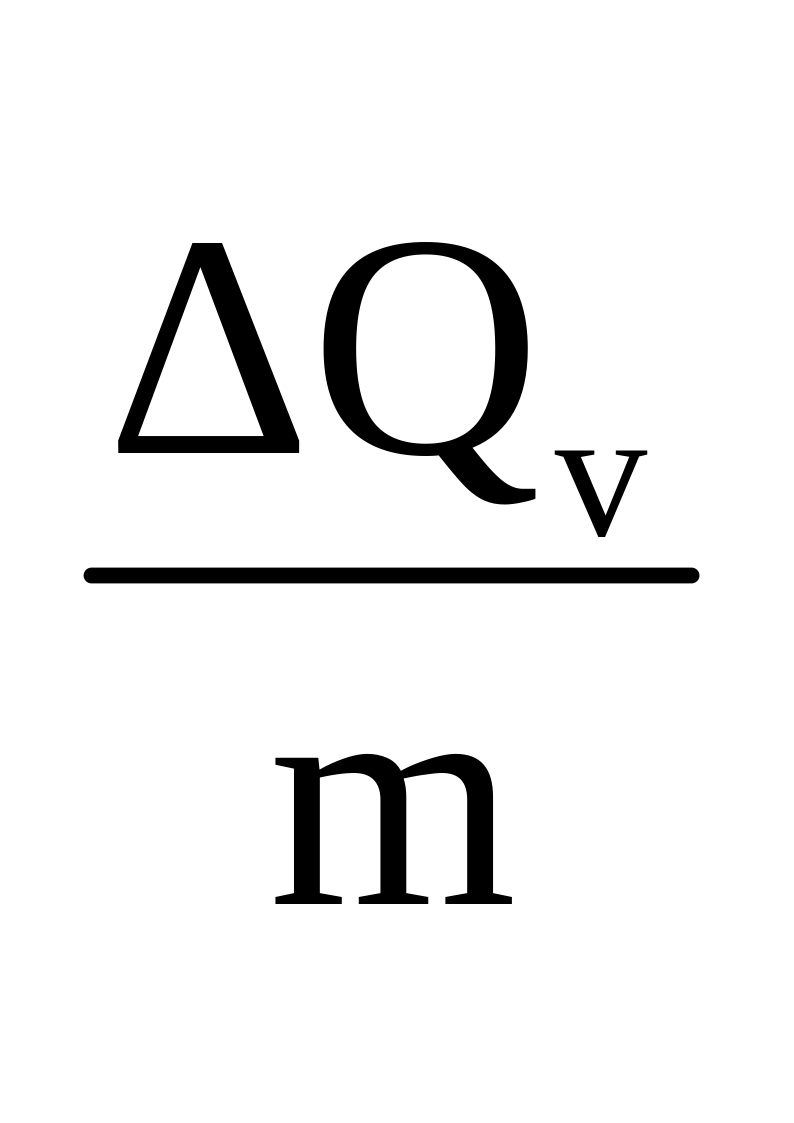
Hv =
Or
Δ Qv = m Hv
Unit:
SI unit of Latent Heat of vaporization is Jkg-1
Latent Heat of Vaporization of Water:
Q3. When water is heated, it boils at 100oC under standard pressure. Its temperature remains 100oC until it is changed into steam. Its latent heat of vaporization is 2.26×10⁶ Jkg-1. That is; one kilogram of water requires 2.26 x 10⁶ joule heat to change it completely into gas (steam) at its boiling point. Define fusion point or melting point.
FUSION POINT
“When a substance is changed from solid to liquid state by adding heat, the process is called melting or fusion. The temperature at which a solid starts melting is called its fusion point or melting point.”
Examples:
Melting point of ice is 0 oC
Melting point of Mercury is -39 oC
Q4. Define boiling point or melting point. (LHR 2017)
BOILING POINT
“When a substance is changed from liquid to gaseous state by adding heat, the process is called boiling. The temperature at which a liquid starts to convert into gas is called its boiling point.
Examples:
Boiling point of water is 100°C
Boiling point of Mercury is 357°C
Q5. Define freezing point. (LHR 2017)
FREEZING POINT
“When a liquid is cooled, it changes into solid state. The temperature at which a substance changes from liquid to solid state is called its freezing point. Different substances have different melting points. However, the freezing point of a substance is the same as its melting point.”
Examples:
Freezing point of water is 0oC
Freezing point of Mercury is -39oC
Q6. What is the difference between specific heat and latent heat of a material?
DIFFERENTIATION
Specific heat and latent heat of a material can be differentiated as:
| Specific Heat | Latent Heat |
| Definition | Definition |
| Specific heat is the amount of heat required to raise the temperature of unit mass of a substance through one Kelvin. | Latent heat is the amount of heat that is required to convert a unit mass from solid to liquid or liquid to gas at constant temperature. |
| Unit | Unit |
| Its unit is Jkg–1K–1. | It unit is Jkg–1. |
| Example | Example |
| Specific Heat of water is 4200 Jkg–1K–1. | Latent heat of vaporization of water is 2.26×10⁶ Jkg-1. |
Q7. Why temperature of a substance does not change while it is changing its state from solid to liquid?
TEMPERATURE AT CHANGING STATE
Q8. When a substance is changing from solid to liquid state, the temperature of the substance remains the same. It is because the heat supplied to the substance is used to overcome the attractive force among the atoms or molecules of the solid and not to increase the temperature. Tabulate melting point, boiling point, latent heat of fusion and latent heat of Vaporization of some common substances.
TABULATION
Table for above mentioned quantities of common substances is given below:
| Sr # | Substance | Melting Point (oC) | Boiling Point (oC) | Heat of Fusion KJkg -1 |
Heat of Vaporization KJkg -1 |
| 1 | Aluminium | 660 | 2450 | 39.7 | 10500 |
| 2 | Copper | 1083 | 2595 | 205.0 | 4810 |
| 3 | Gold | 1063 | 2660 | 64.0 | 1580 |
| 4 | Helium | -270 | -269 | 5.2 | 21 |
| 5 | Lead | 327 | 1750 | 23.0 | 858 |
| 6 | Murcury | -39 | 357 | 11.7 | 270 |
| 7 | Nitrogen | -21- | -196 | 25.5 | 200 |
| 8 | Oxygen | -219 | -183 | 13.8 | 210 |
| 9 | Water | 0 | 100 | 336.0 | 2260 |
8.7 Evaporation
Long Questions
Q1. Define evaporation. On what factor speed of evaporation depend? Explain.
EVAPORATION
Definition:
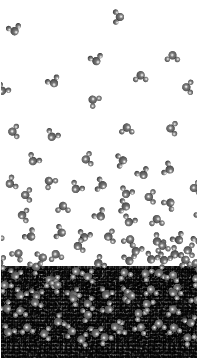
“Evaporation is the changing of a liquid into vapors (gaseous state) from the surface of the liquid without heating it”.
Activity:
Take some water in a dish. The water in the dish will disappear after some time. It is because the molecules of water are in constant motion and possesses kinetic energy. Fast moving molecules escape out from the surface of water and goes into atmosphere this process is called evaporation as shown in the figure:
Comparison of Boiling and Evaporation:
Unlike boiling, evaporation takes place at all temperatures but only from the surface of a liquid. The process of boiling takes place at a certain fixed temperature which is the boiling point of that liquid. At boiling point, a liquid is changing into vapors not only from the surface but also within the liquid. These vapors are comes out of the boiling liquid as bubbles which breakdown on reaching the surface.
Evaporation Cause Cooling:
During evaporation fast moving molecules escape out from the surface of the liquid. Molecules that have lower kinetic energies are left behind. This lowers the average kinetic energy of the liquid molecules and the temperature of the liquid. Since temperature of a substance depends on the average kinetic energy of its molecules. Evaporation of perspiration helps to cool our bodies.
In refrigerator evaporation of liquefied gas produces cooling.
Factors:
Evaporation takes place at all temperatures from the surface of a liquid. The rate of evaporation is affected by various factors.
Temperature:
Wet clothes dry up more quickly in summer than in winter because at higher temperature, more molecules of a liquid are moving with high velocities. Thus, more molecules escape from its surface. Thus, evaporation is faster at high temperature that at low temperature.
Surface Area:
Large is the surface area of a liquid, greater number of molecules has the chance to escape from its surface that is why we spread wet clothes to increase their surface area and to increase rate of evaporation.
Wind:
Wind blowing over the surface of a liquid sweeps the liquid molecules that have just escaped out. This increases the chance for more liquid molecules to escape out.
Nature of the Liquid:
Evaporation depends on the nature of the liquid. The molecules having weaker intermolecular forces evaporate more quickly as compared to others, if we take spirit and water on our palm. As evaporation rate of spirit is greater than water, so we feel cooling effect due to evaporation of spirit.
Short Questions
Q1. Differentiate evaporation and boiling
DIFFERENTIATION
Evaporation and Boiling can be differentiated as:
| Evaporation | Boiling |
| Definition | Definition |
| Evaporation is the changing of a liquid into vapors (gaseous state) from the surface of the liquid without heating it | When a substance is changed from liquid to gaseous state by adding heat, the process is called boiling. |
| Temperature | Temperature |
| Evaporation takes place at all temperatures. | Boiling takes place at specific temperature called boiling point. |
| Bubbles | Bubbles |
| There is no bubble formation during evaporation. | Bubbles form during process of boiling. |
| Area of Occurrence | Area of Occurrence |
| Evaporation takes place on the surface of the liquid only. | Boiling takes place throughout the liquid. |
| Effect | Effect |
| Evaporation cause cooling. | Boiling cause burning. |
| Example | Example |
| Take some water in a dish. The water in the dish will disappear after some time. It is because the molecules of water are in constant motion and possesses kinetic energy. Fast moving molecules escape out from the surface of water and goes into atmosphere this process is called evaporation. | The process in which liquid converts into gas at its boiling point is called vaporization or boiling. Boiling point of water is 100oC |
Q2. How evaporation differs from vaporization? (Mini exercise Pg. # 182)
DIFFERENTIATION
Evaporation and vaporization can be differentiated as:
| Evaporation | Vaporization |
| Definition | Definition |
| Evaporation is the changing of a liquid into vapors (gaseous state) from the surface of the liquid without heating it. | The process in which liquid converts into gas at its boiling point is called Vaporization. |
| Temperature | Temperature |
| Evaporation takes place at all temperatures. | Vaporization takes place at specific temperature called boiling point. |
| Bubbles | Bubbles |
| There is no bubble formation during evaporation. | Bubbles form during process of vaporization. |
| Example | Example |
| Take some water in a dish. The water in the dish will disappear after some time. It is because the molecules of water are in constant motion and possesses kinetic energy. Fast moving molecules escape out from the surface of water and goes into atmosphere this process is called evaporation. | Vaporization of water takes at 100oC |
Q3. How is cooling effect produced by evaporation?
COOLING EFFECT OF EVEPORATION
During evaporation fast moving molecules escape out from the surface of the liquid. Molecules that have lower kinetic energies are left behind. This lowers the average kinetic energy of the liquid molecules and the temperature of the liquid. Since temperature of a substance depends on the average kinetic energy of its molecules. Evaporation of perspiration helps to cool our bodies.
Q4. Why wet clothes dry up more quickly in summer than in winter?
WET CLOTH
Wet clothes dry up more quickly in summer than in winter because at higher temperature, more molecules of a liquid are moving with high velocities. Thus, more molecules escape from its surface. Thus, evaporation is faster at high temperature that at low temperature.
Q5. Why water evaporates faster when spread over large area?
LARGE AREA
Large is the surface area of a liquid, greater number of molecules has the chance to escape from its surface that is why we spread wet clothes to increase their surface area and to increase rate of evaporation.
Q6. Does spirit and water evaporates at the same rate?
RATE OF EVAPORATION
No, spirit and water does not evaporate at the same rate because evaporation depends on the nature of the liquid. The molecules having weaker intermolecular forces evaporate more quickly as compared to others, spirit has weaker intermolecular forces than water so spirit evaporates more quickly than water.
Q7. Spread a few drops of ether or spirit on your palm. You feel cold, why?
COOLING EFFECT
If we take ether or spirit on our palm. Ether or spirit having weaker intermolecular evaporates more quickly so we feel cooling effect due to evaporation of spirit or ether.
Q8. Give two uses of cooling effect by evaporation. (Mini exercise Pg. # 182)
Ans. USES OF COOLING EFFECT
Following are uses of cooling effect produced by evaporation
Evaporation of perspiration helps to cool our body.
In refrigerator evaporation of liquefied gas produces cooling.
8.8 Thermal Expansion
Long Questions
Q1. What is thermal expansion? Explain on the basis of kinetic molecular theory. (LHR 2014)
THERMAL EXPANSION
Definition:
“Increase in the length or volume of a substance due to heat is called thermal expansion.”
Most of the substances solids, liquids and gases expand on heating and contract on cooling.
Their thermal expansion and contractions are usually small and are not noticeable. However these expansions and contractions are important in our daily life.
Explanation on the Basis of Kinetic Molecular Theory:
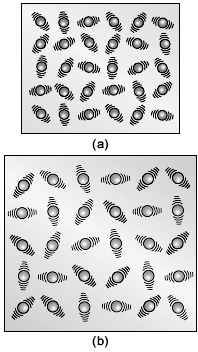
The kinetic energy of the molecules of an object depends on its temperature. The molecules of a solid vibrate with large amplitude at high temperature than at low temperature. Thus, on heating, the amplitude of vibration of the atoms or molecules of an object increases. They push one another farther away as the amplitude of vibration increases as shown in the figure:
Thermal expansion results an increase in length, breadth and thickness of a substance.
Q2. What is linear Expansion? On what factor it depends? Derive its mathematical formula.
LINEAR THERMAL EXPANSION
Definition:
“If a thin rod is heated, there is a prominent increase in its length as compared to its cross-sectional area. The expansion along length or in one dimension is called linear expansion”.
Dependence:
If we heat a metal rod the length of which is much larger than its thickness, then the increase in length depends on the following three factors:
Length of thin rod.
Change in temperature.
Nature of material of the rod.
Explanation:
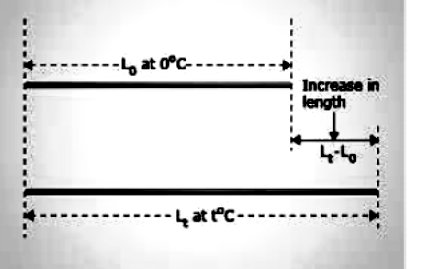
Solids expand on heating and their expansion is nearly uniform over a wide range of temperature. Consider a metal rod of length Lo at certain temperature To. Let its length on heating to a temperature T becomes L as shown in the figure:
Thus
Increase in length of the rod = ∆L = L – Lo
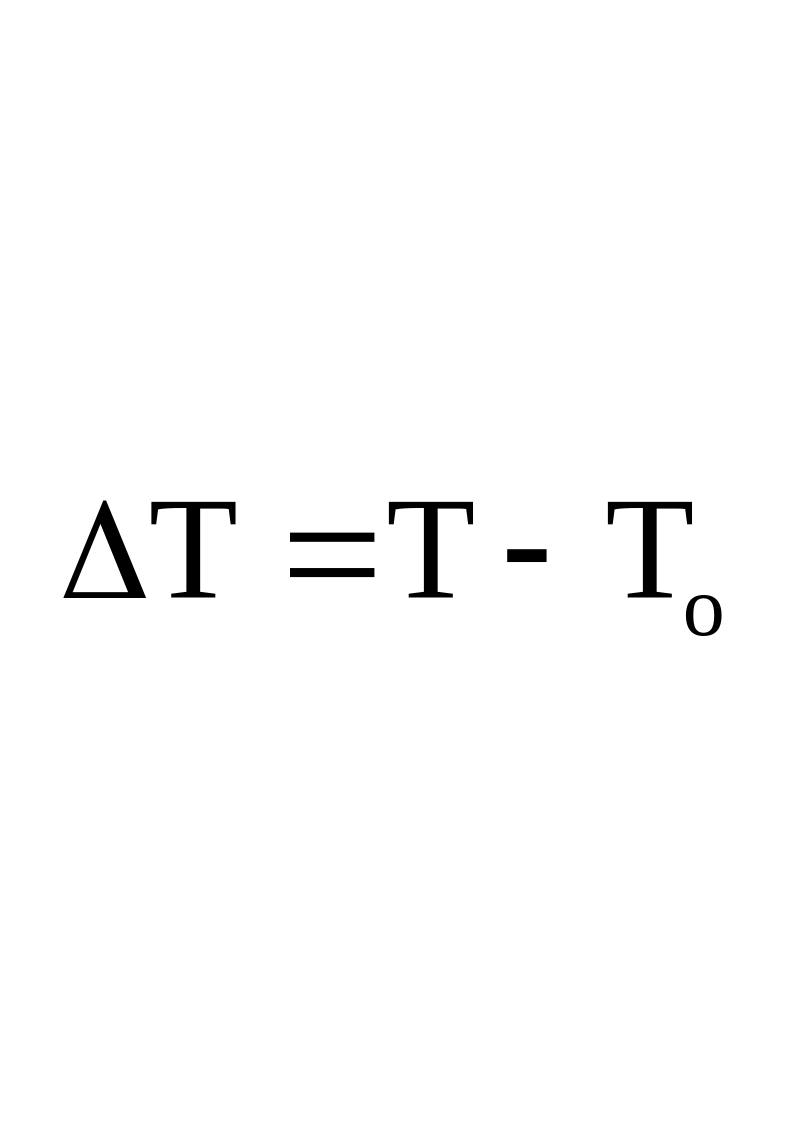
Increase in temperature = ∆T = T – To
It is found that change in length ∆L of a solid is directly proportional to its original length Lo and the change in temperature ∆T. that is;
∆L Lo ∆T
or ∆L = Lo ∆T
or L – Lo = Lo ∆T
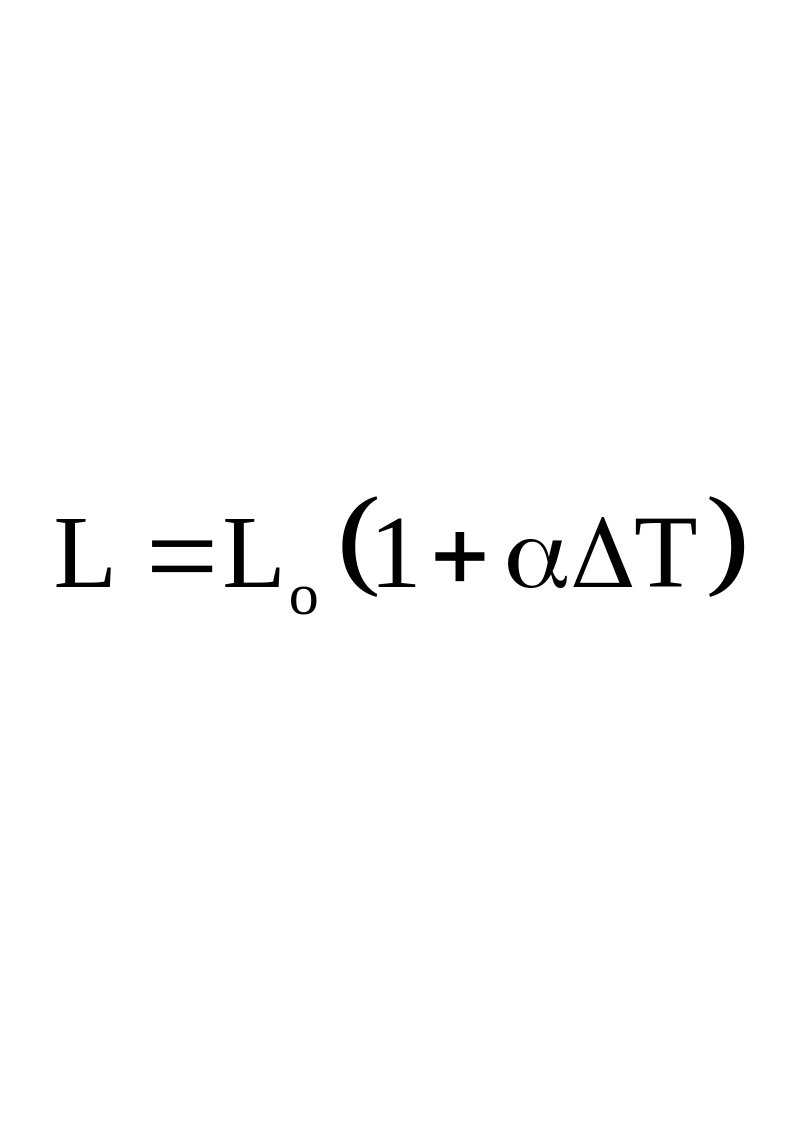
L = Lo (1 + α ∆T)
Coefficient of Linear Expansion:
We know
∆L = Lo ∆T
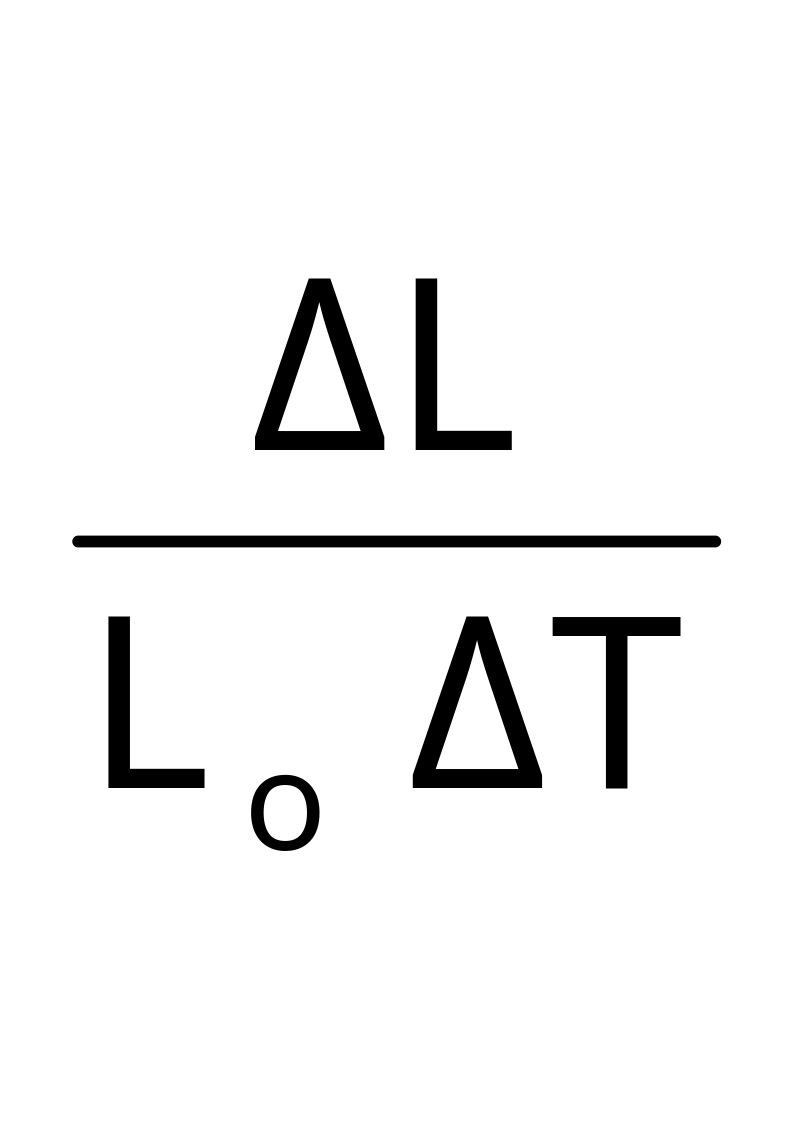
Where α is the proportionality constant and it is called co-efficient of linear expansion of the substance it can be defined as:
α =
Thus we can define coefficient of linear expansion α of a substance as “The fractional increase in its length per Kelvin rise in temperature.”
Unit:
Its unit is Per Kelvin (K-1)
Value:
Its value depends on the nature of the material of the rod and
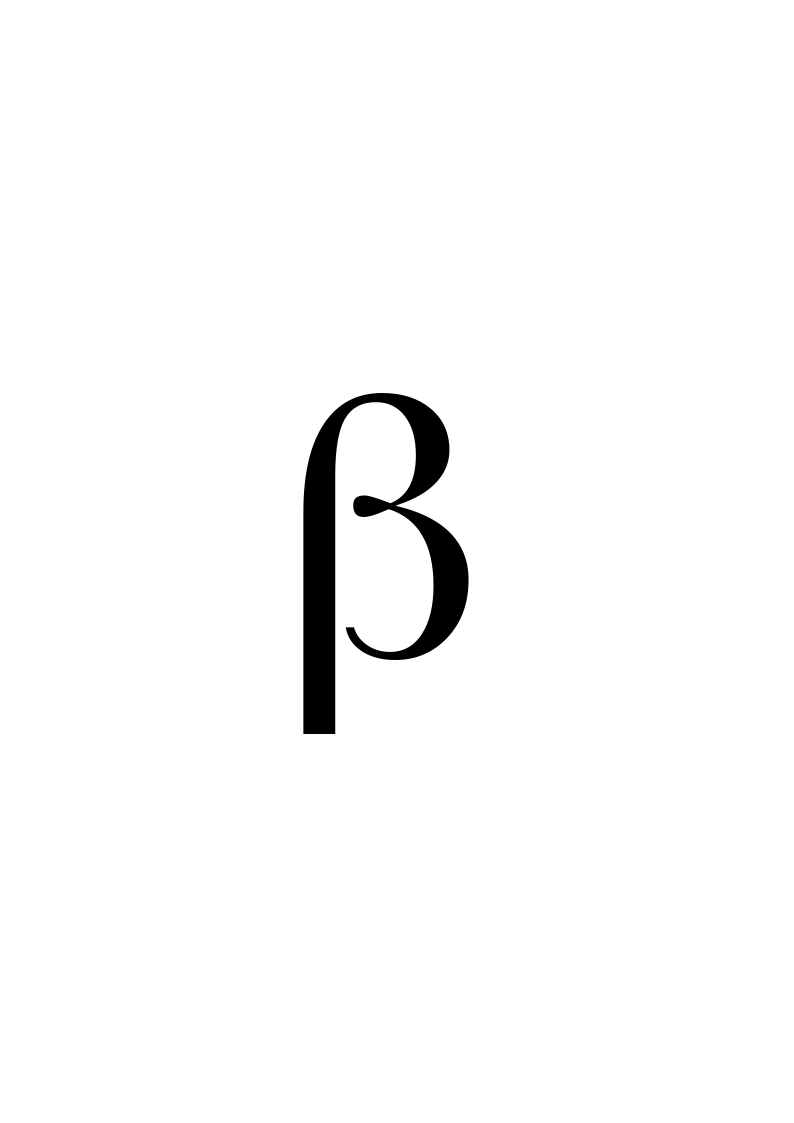
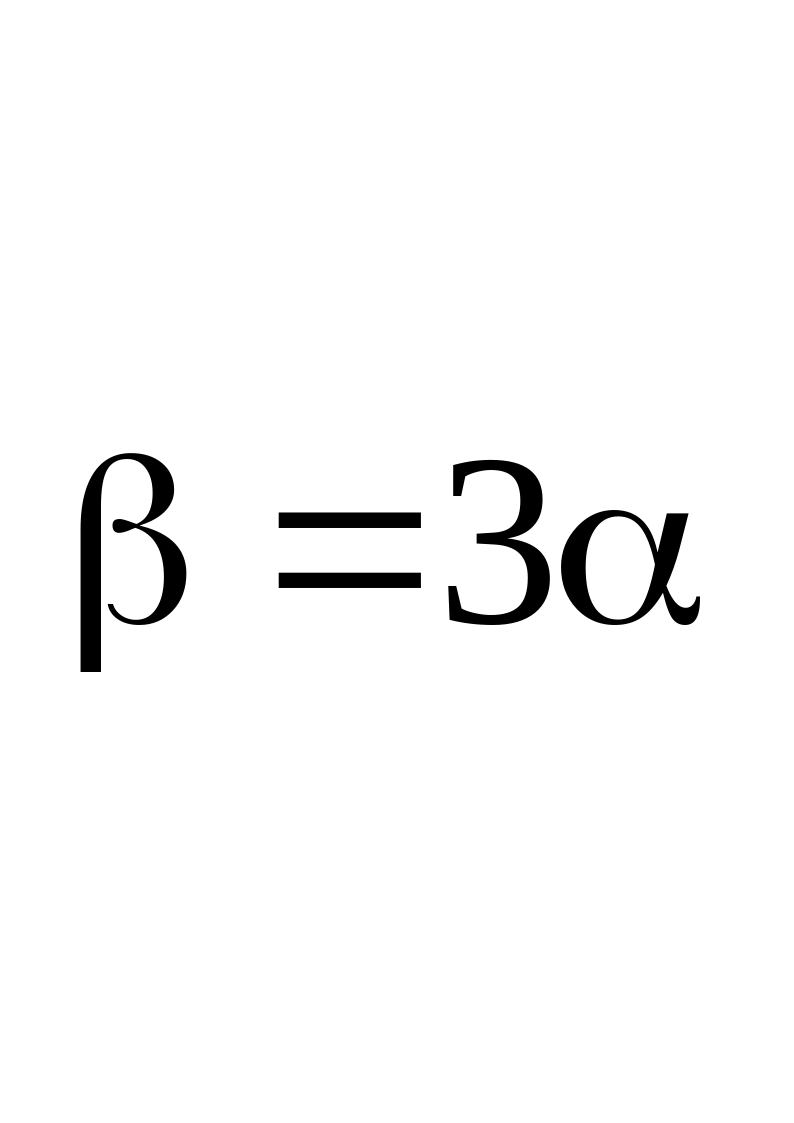
Relationship Between β and α:
Relationship Between β and α is given below:
β = 3α
Examples:
Some values for α and β are given:
| Sr. # | Substance | α (K -1) | β (K -1) |
| 1 | Aluminum | 2.4×10⁻⁵ | 7.2×510-5 |
| 2 | Brass | 1.9×10⁻⁵ | 6.0×10⁻⁵ |
| 3 | Copper | 1.7×10⁻⁵ | 5.1×10⁻⁵ |
Q3. What is volume expansion? On what factors it depends? Derive its mathematical formula.
VOLUME THERMAL EXPANSION
Definition:
“The volume of a solid also changes with the change in temperature and is called volume thermal expansion or cubical thermal expansion”.
Dependence:
If we heat a block then increase in volume of the block depends on the following three factors:
Original volume of block.
Change in temperature.
Nature of material of the block.
Explanation:
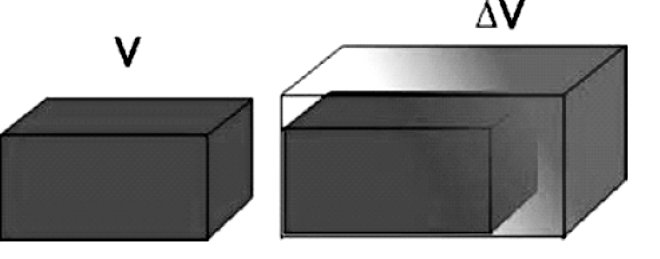
Consider a solid of initial volume Vo at certain temperature To. On heating the solid to a temperature T, let its volume becomes V as shown in the figure:
Then
Change in volume of a solid = ∆V = V – Vo
And Change in temperature = ∆T = T – To
Like linear expansion, the change in volume ∆V is found to be proportional to its original volume Vo and change in temperature ∆T. Thus
∆V Vo
And ∆V ∆T
∆V Vo ∆T
∆V = βVo ∆T
V – Vo = βVo ∆T
V = Vo + βVo ∆T
V = Vo (1 + β ∆T)
Coefficient of Volume Expansion:
We know
∆V = βVo ∆T
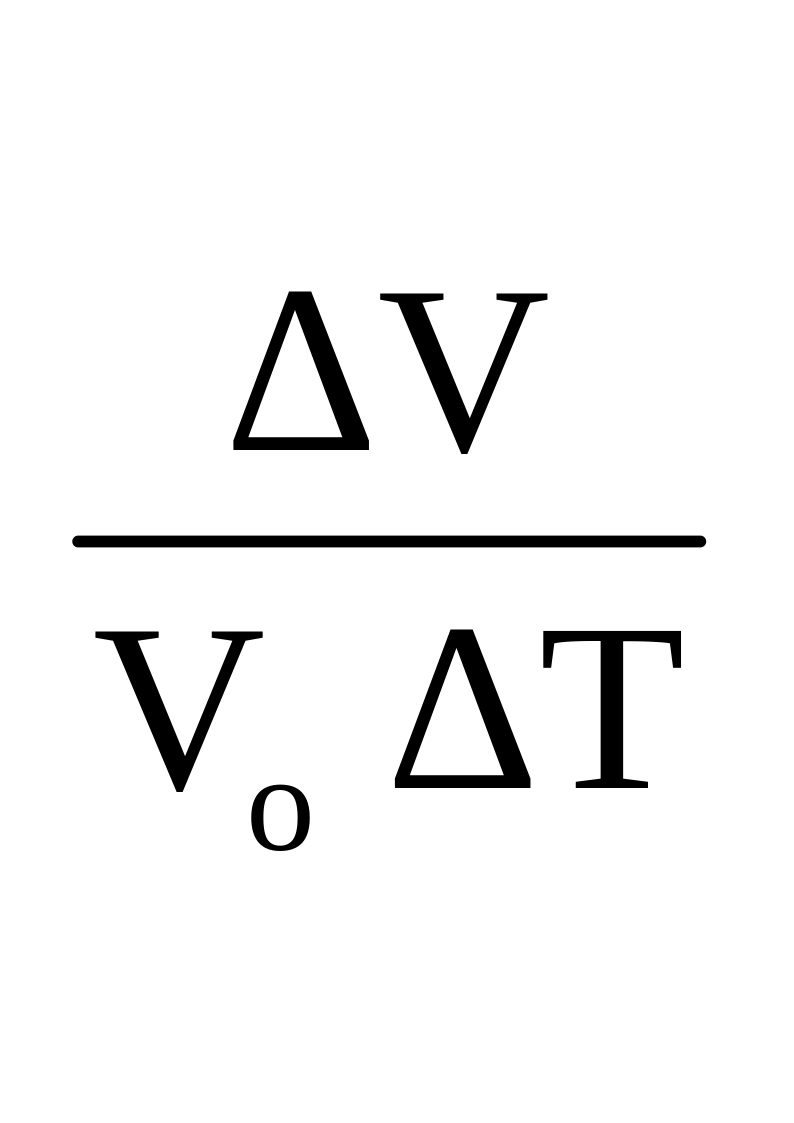
Where β is the proportionality constant and is called the co-efficient of volume expansion. And it can be defined as
β =
“The fractional change in its volume per Kelvin change in temperature”.
Unit:
Its unit is Per Kelvin (K-1)
Value:
Its value depends on the nature of the material of the rod and
Relationship Between β and α
The coefficients of linear and volume expansion are related by the following equation
β = 3α
Examples:
Some values for α and β are given:
| Sr. # | Substance | α (K -1) | β (K -1) |
| 1 | Aluminum | 2.4×10⁻⁵ | 7.2×10⁻⁵ |
| 2 | Brass | 1.9×10⁻⁵ | 6.0×10⁻⁵ |
| 3 | Copper | 1.7×10⁻⁵ | 5.1×10⁻⁵ |
Q4. Write down the consequences of thermal expansion.
CONSEQUENCES OF THERMAL EXPANSION
The expansions of solids many damage bridges, railway tracks and roads as they are constantly subjected to temperature changes.
Prevision is made during construction for expansion and contraction with temperature.
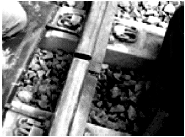
The expansion of solids may damage the bridges, railway tracks and roads as they are constantly subjected to temperature changes. So provision is made during construction for expansion and contraction with temperature. For example, railway tracks buckled on a hot summer day due to expansion if gaps are not left between sections as shown in the figure:
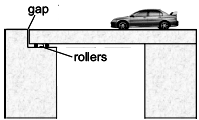
Bridges made of steel girders also expands during the day and contract during night. They will bend if their ends are fixed. To allow thermal expansion, one end is fixed while the other one of the girder rests on rollers in the gap left for expansion. Overhead transmission lines are also given a certain amount of sag so that they contract in winter without snapping as shown in the figure:
Q5. Write down the applications of thermal expansion.
APPLICATIONS OF THERMAL EXPANSION
Thermal expansion is used in our daily life. In thermometers, thermal expansion is used in temperature measurements.
To open the cap of a bottle that is tight enough, immerse it in hot water for a minute or so. Metal cap expands and becomes loose. It would now be easy to turn it to open.
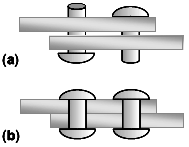
To join steel plates tightly together, red hot rivets are forced through holes in the plates as shown in figure. The end of hot rivet is then hammered. On cooling, the rivets contracts and bring the plates tightly griped.
Iron rims are fixed on wooden wheels of carts. Iron rims are heated. Thermal expansion allows them to slip over the wooden wheel. Water is poured on it to cool. The rim contracts and becomes tight over the wheel as shown in the figure:
Wires on electric poles are given some sag to prevent breaking in winter.
Thermal expansion concept is applied in Bimetal strip.
Q6. What is Bimetal strip? Write its construction and working.
BIMETAL STRIP
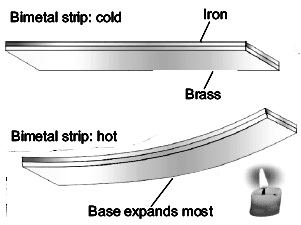
A bimetal strip consists of two thin strips of different metals such as brass and iron joined together as shown in figure.
On heating the strip, brass expands more than iron. This unequal expansion causes bending of the strip as shown in figure:
Usage:
Bimetal strips are used for various purposes.
Bimetal thermometers are used to measure temperature especially in furnaces and ovens.
Bimetal strips are also used in thermo states.
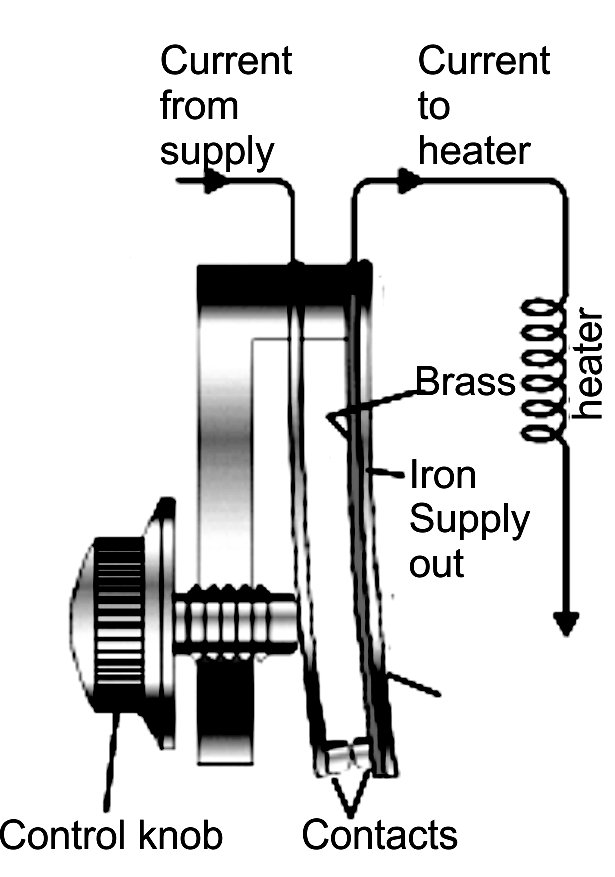
Bimetal thermo state switch is used to control the temperature of heater coil in an electric iron.
Q7. Explain the thermal expansion of liquid.
THERMAL EXPANSION IN LIQUIDS
The molecules of liquids are free to move in all directions within the liquid. On heating a liquid, the average amplitude of vibration of its molecules increases. The molecules push each other and need more space to occupy. This accounts for the expansion of the liquid when heated. The thermal expansion in liquids is greater than solids due to the weak forces between their molecules. Therefore, the coefficient of volume expansion of liquids is greater than solids.
No Definite Shape of Liquids:
Liquids have no definite shape of their own. A liquid always attains shape of the container in which it is poured. Therefore, when a liquid is heated, both liquid and the container undergo a change in their volume.
Types of Thermal Expansion For Liquids:
There are two types of thermal expansion for liquids:
Real volume expansion
Apparent volume expansion
Activity:
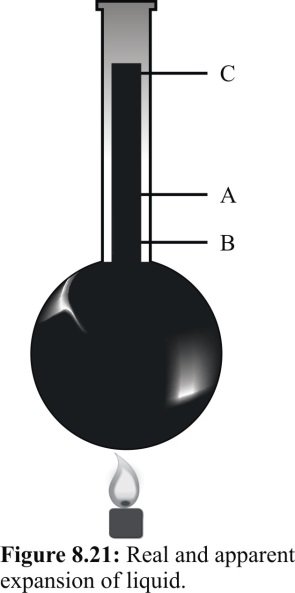
Take a long-necked flask. Fill it with some colored liquid up to mark A on its neck as shown in figure.
Now start heating the flask from bottom. The liquid level first falls to B and then rises to C.
Relation between expansions:
We observe that there are two types of expansions appear as a result of heating a liquid in any container.
Real volume expansion
Apparent volume expansion
The heat first reaches the flask which expands and its volume increases. As a result liquid descends in the flask and its level falls to B. After sometime, the liquid begins to rise above B on getting hot. At certain temperature it reaches at C. The rise in level from A to C is due to the apparent expansion in the volume of the liquid. Actual expansion of the liquid is greater than that due to the expansion because of the expansion of the glass flask. Thus real expansion of the liquid is equal to the volume difference between A and C in addition to the volume expansion of the flask. Hence
Real expansion of liquid = Apparent expansion of liquid + Expansion of the flask
BC = AC + AB
The expansion of the volume of a liquid taking into consideration the expansion of the container also, is called the real expansion of the liquid.
Coefficients of volume expansions:
The real rate of volume expansion βr of a liquid is defined as the actual change in unit volume of a liquid for 1K (or 1 oC) rise in its temperature. The real rate of volume expansion βr is always greater than the rate of volume expansion βa by an amount equal to the rate of volume expansion of the container βg.
Thus βr = βa + βg
It should be noted that different liquids have different coefficients of volume expansion.
Coefficients of liquid expansion:
In accordance with the apparent and real expansions of the liquids, their co-efficient of expansion are also measured in two ways:
Coefficient of apparent expansion
Coefficient of real expansion
It should be noted that different liquids have different coefficients of volume expansion
Short Questions
Q1. Define linear thermal expansion. On which factors does it depend?
LINEAR THERMAL EXPANSION
Definition:
“If a thin rod is heated, there is a prominent increase in its length as compared to its cross-sectional area. The expansion along length or in one dimension is called linear expansion”.
Dependence:
If we heat a metal rod the length of which is much larger than its thickness, then the increase in length depends on the following three factors:
Length of thin rod.
Change in temperature.
Nature of material of the rod.
Formula:
∆L = Lo ∆T
Q2. Define coefficient of linear thermal expansion. Write its formula and unit.
COEFFICIENT OF LINEAR THERMAL EXPANSION
Definition:
We know
∆L = Lo ∆T
Where α is the proportionality constant and it is called co-efficient of linear expansion of the substance it can be defined as:
α =
“The fractional increase in its length per Kelvin rise in temperature.”
Unit:
Its unit is Per Kelvin (K-1)
Value:
Its value depends on the nature of the material of the rod and
Relationship Between β and α
β = 3α
Q3. Define Volume thermal expansion. On which factors does it depend? (GRW 2013)
VOLUME THERMAL EXPANSION
Definition:
“Heating a block causes an increase in length, breadth and thickness, i.e., volume of the block increases that is known as volume expansion. It is also called cubic thermal expansion”.
Dependence:
If we heat a block then increase in volume of the block depends on the following three factors:
Original volume of block.
Change in temperature
Nature of material of the block.
Formula:
∆V = βVo ∆T
Q4. Define coefficient of linear thermal expansion. Write its formula and unit.
COEFFICIENT OF VOLUME THERMAL EXPANSION
Definition:
We know
∆V = βVo ∆T
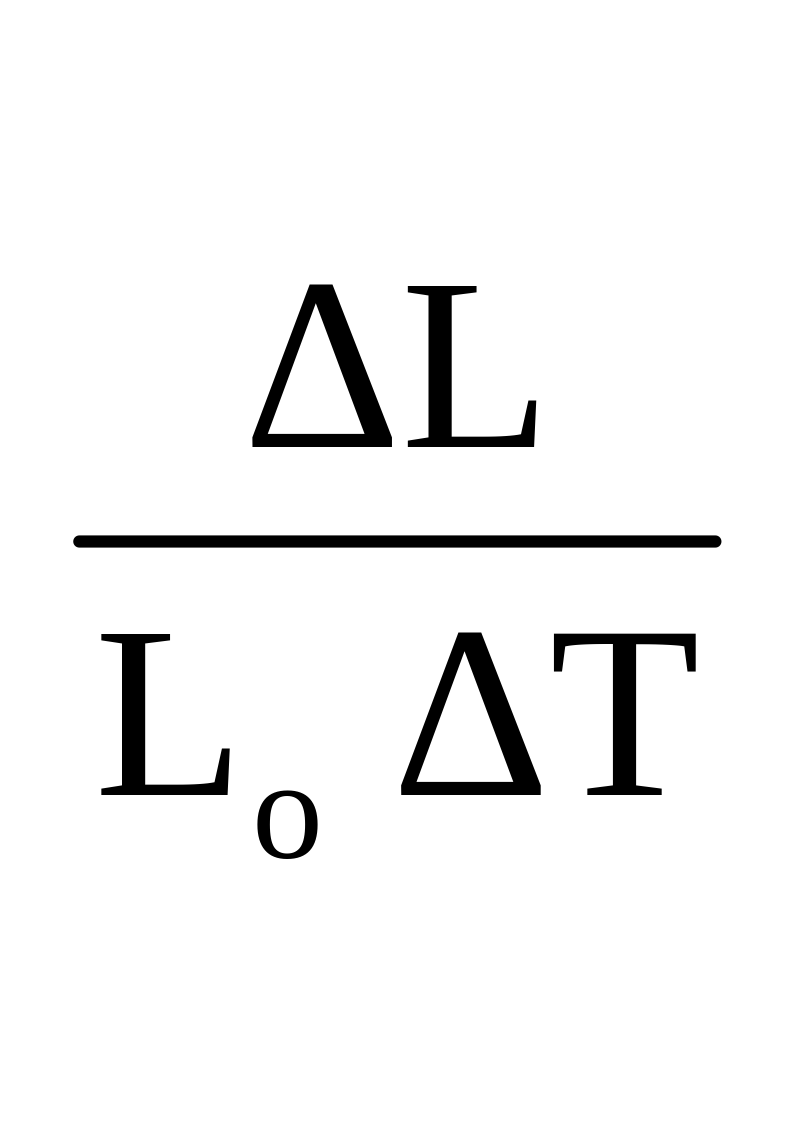
Where β is the proportionality constant and is called the co-efficient of volume expansion. And it can be defined as
β =
“The fractional change in its volume per Kelvin change in temperature”.
Unit:
Its unit is Per Kelvin (K-1)
Value:
Its value depends on the nature of the material of the rod and
Relationship Between β and α:
Relationship Between β and α is below:
β = 3α
Q5. Tabulate coefficient of Linear and volume expansion of some common substances.
VALUES OF COEFFICIENT OF THERMAL EXPANSION
Following vales have been tabulated by applying relation
| Sr. # | Substance | α (K -1) | β (K -1) |
| 1 | Aluminum | 2.4×10⁻⁵ | 7.2×10⁻⁵ |
| 2 | Brass | 1.9×10⁻⁵ | 6.0×10⁻⁵ |
| 3 | Copper | 1.7×10⁻⁵ | 5.1×10⁻⁵ |
| 4 | Steel | 1.2×10⁻⁵ | 3.6×10⁻⁵ |
| 5 | Silver | 1.93×10⁻⁵ | 5.79×10⁻⁵ |
| 6 | Gold | 1.3×10⁻⁵ | 3.9×10⁻⁵ |
| 7 | Platinum | 8.6×10⁻⁵ | 27.0×10⁻⁵ |
| 8 | Tungsten | 0.4×10⁻⁵ | 4.2×10⁻⁵ |
| 9 | Glass (Pyrex) | 0.4×10⁻⁵ | 1.2×10⁻⁵ |
| 10 | Glass (Ordinary) | 0.9×10⁻⁵ | 2.7×10⁻⁵ |
| 11 | Concrete | 1.2×10⁻⁵ | 3.6×10⁻⁵ |
| 12 | Glycerine | 17.7×10⁻⁵ | 53×10-5 |
| 13 | Mercury | 6×10⁻⁵ | 18×10-5 |
| 14 | Water | 7×10⁻⁵ | 21×10-5 |
| 15 | Air | 1.22×10⁻³ | 3.67×10⁻³ |
| 16 | Carbon dioxide | 1.24×10⁻³ | 3.72×10⁻³ |
| 17 | Hydrogen | 1.22×10⁻³ | 3.66×10⁻³ |
Q6. Why gaps are left in railway tracks? (LHR 2017)
GAPS IN RAILWAY TRACKS
Gaps are left in railway tracks to compensate thermal expansion during hot season. Railway tracks buckled on a hot summer day due to expansion if gaps are not left between sections
Q7. What is anomalous expansion of water?
ANOMALOUS EXPANSION
Water on cooling below 4oC begins to expand until 0oC. On further cooling its volume increases suddenly as it changes into ice at 0oC. When ice is cooled below 0oC, it contracts i.e. its volume decreases like solids. This unusual expansion of water is called the anomalous expansion of water.
EXAMPLE 8.6
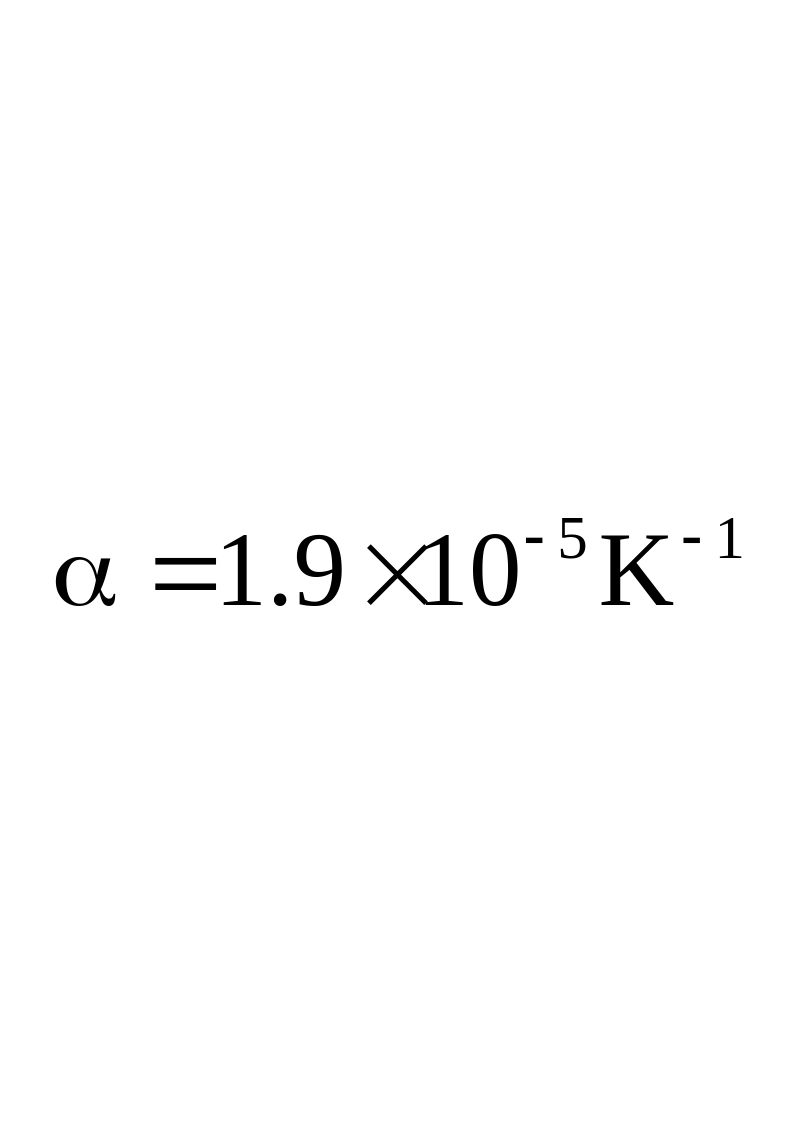
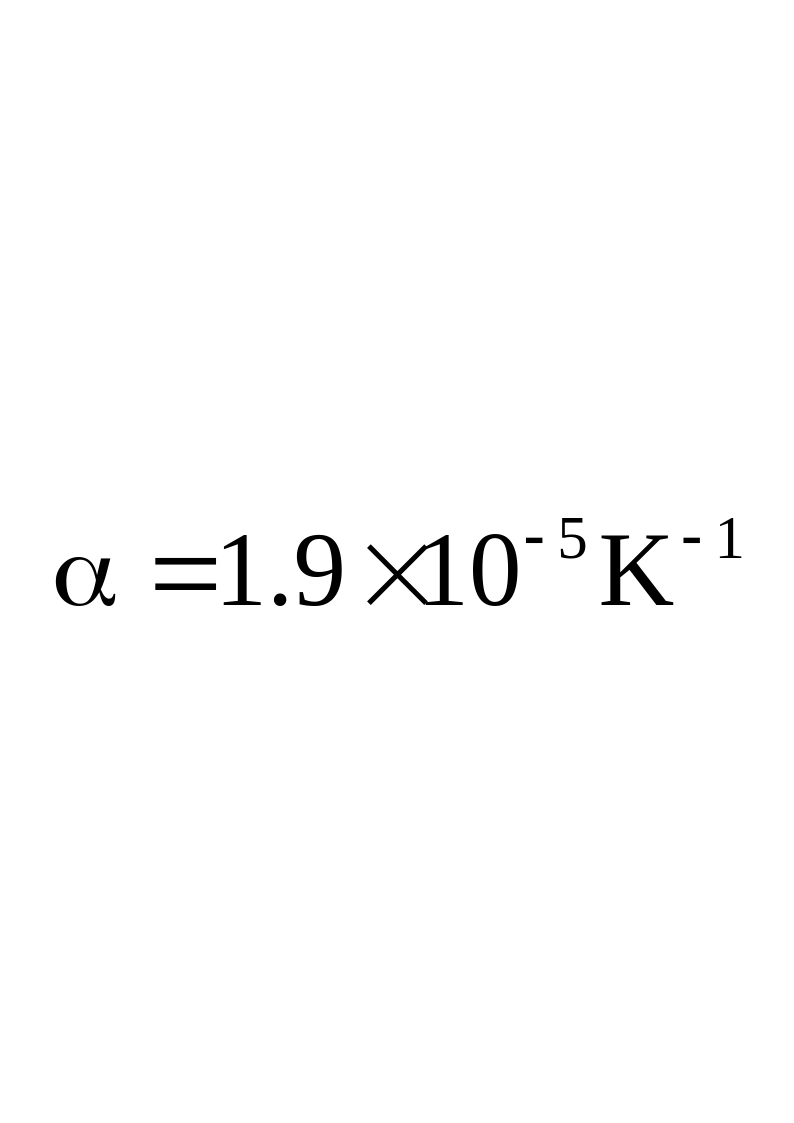
Q8. A brass rod is 1 m long at 0°C. Find its length at 30°C. (Coefficient of linear expansion of brass =1.9×10⁻⁵K-1) (LHR 2017)
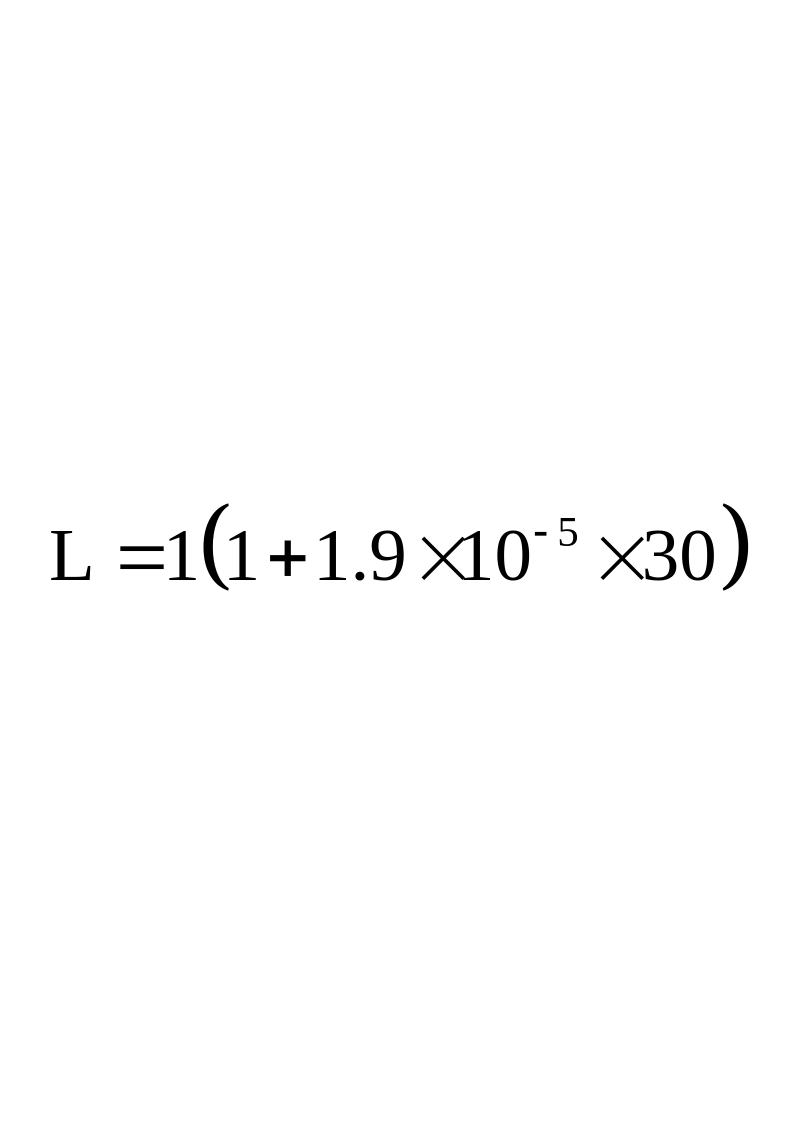
Given Data:
Initial length of the brass rod = Lo = 1m
Initial temperature of the brass rod = To = 0oC = 0+273 = 273 K
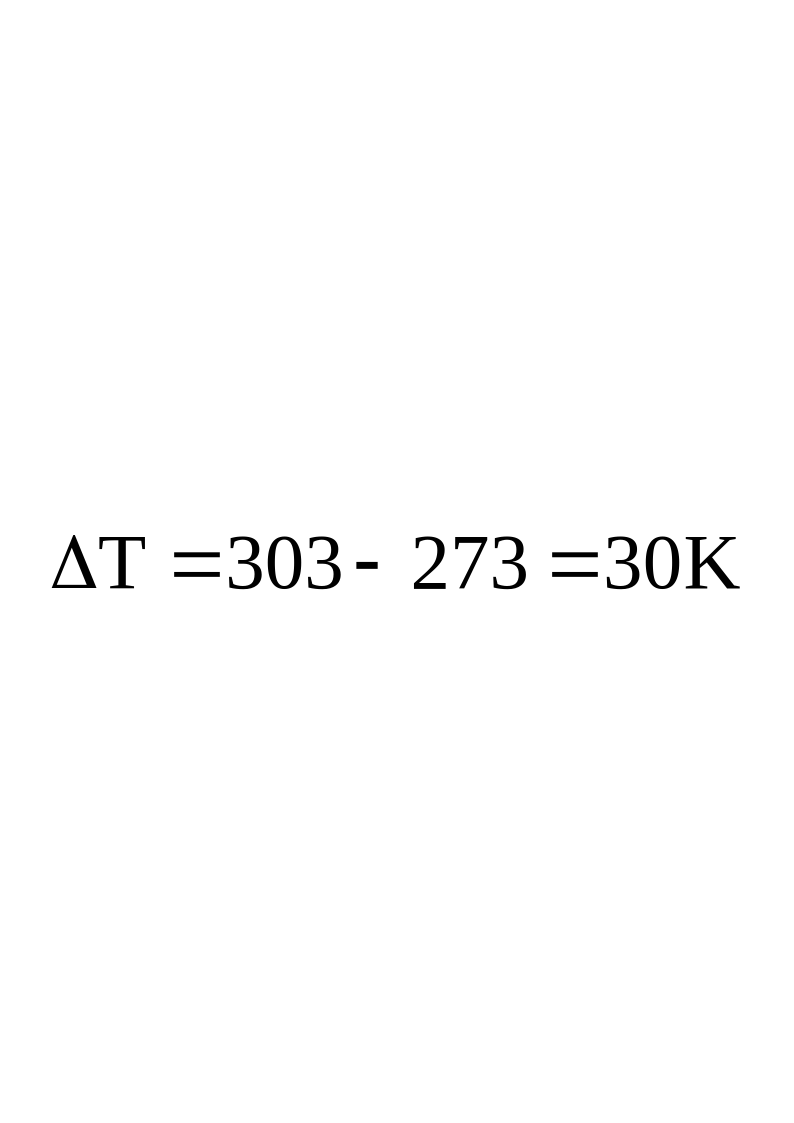
Final temperature of the brass rod = T = 30oC = 30 +273 = 303 K
Change in temperature
Change in temperature
Coefficient of linear expansion of brass =
To Find:
Final length of the brass rod = L =?
Calculations:
We know
Putting values
L = 1.00057 m
Result:
Hence, the length of the brass bar at 30°C will be 1.00057 m.
EXAMPLE 8.7
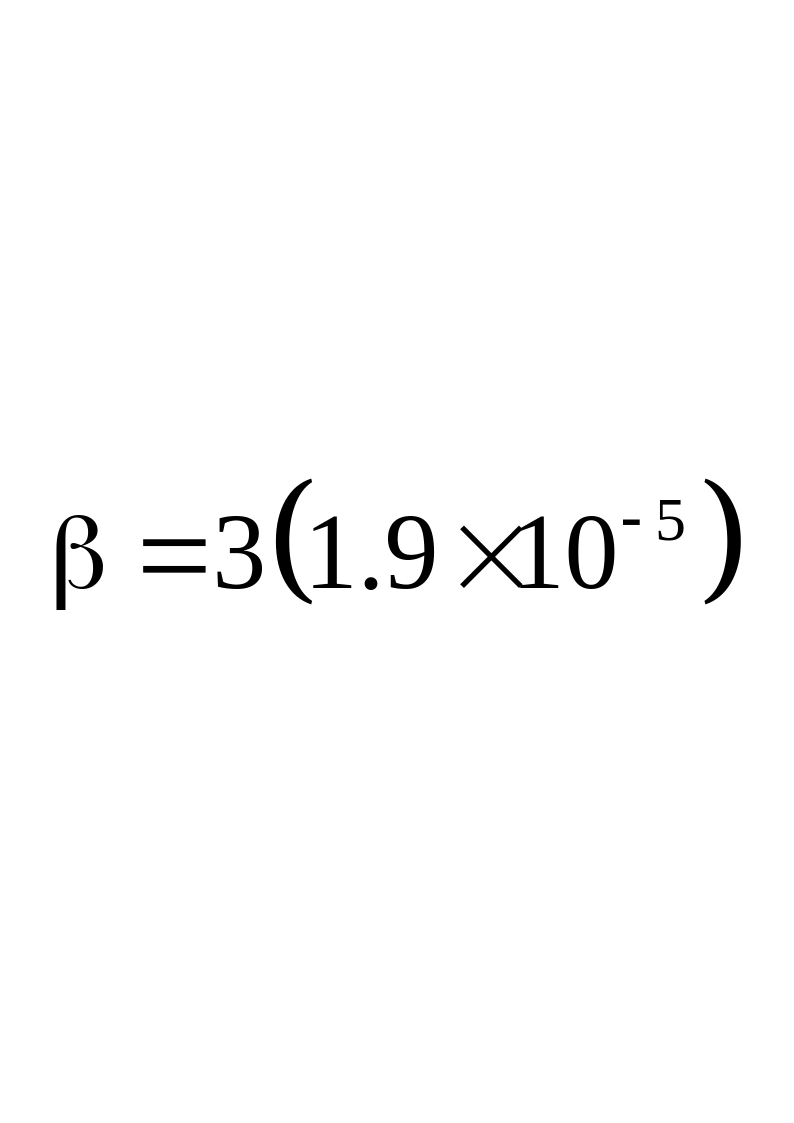
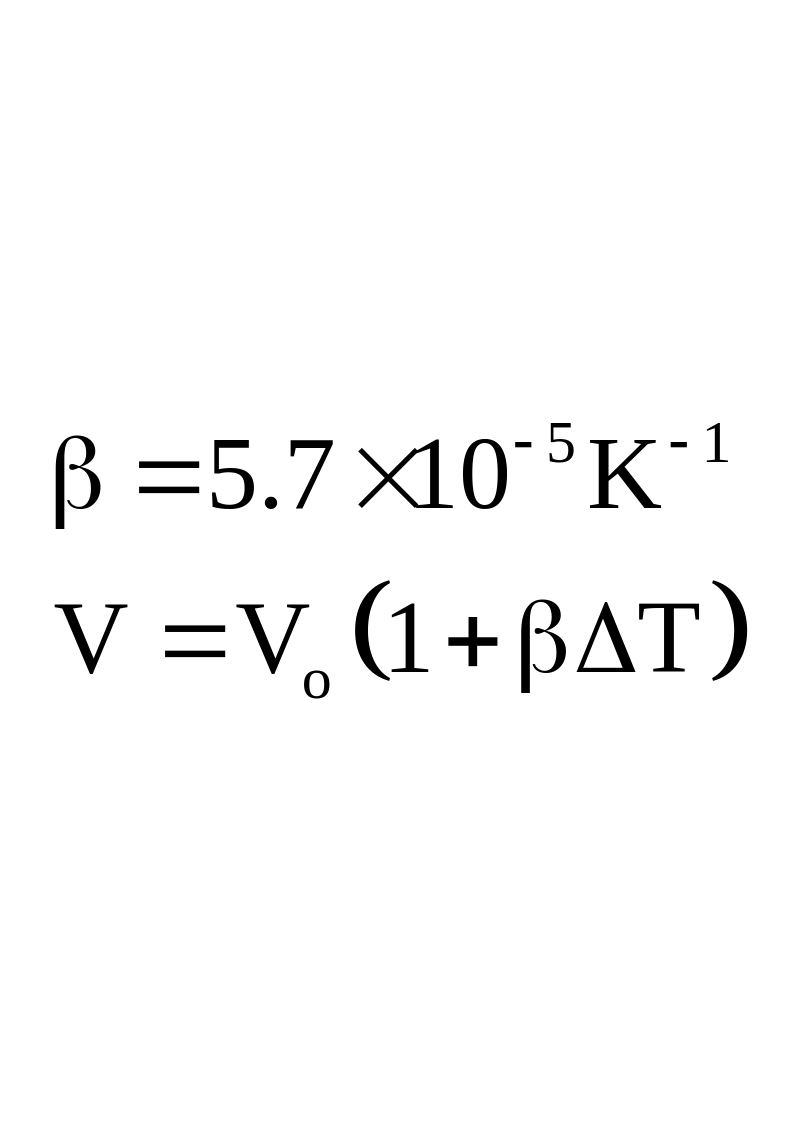
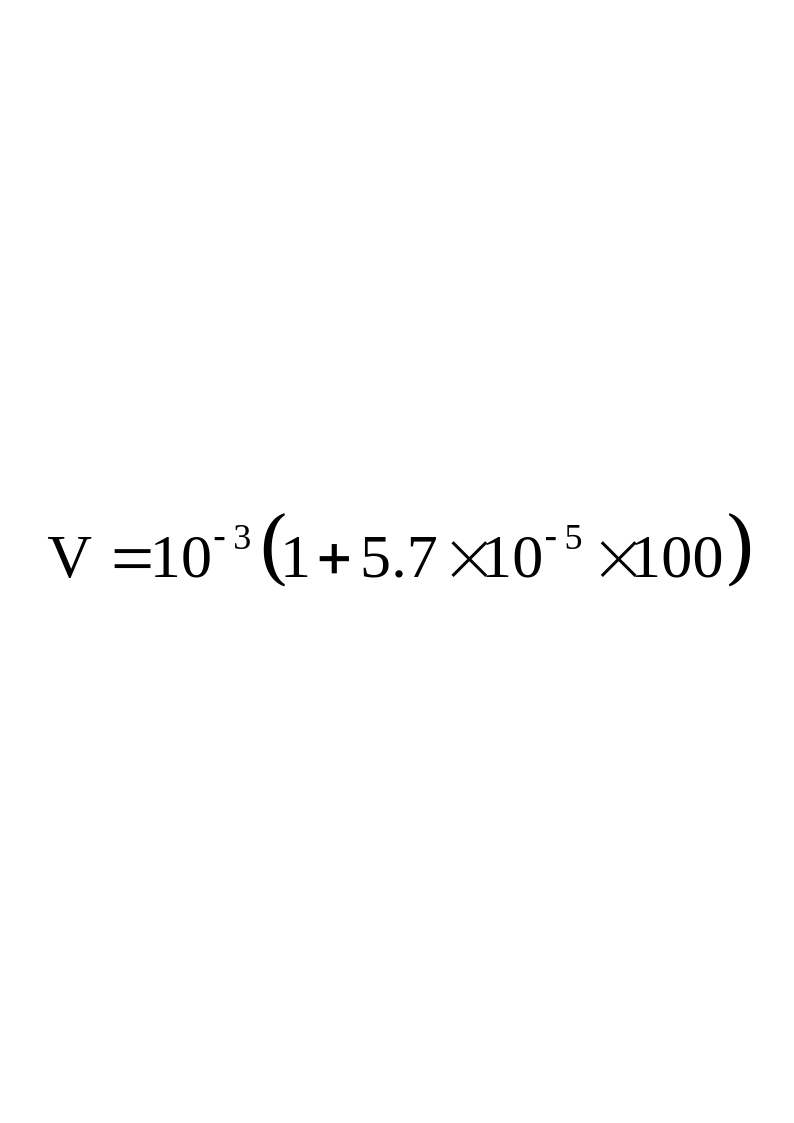
Q9. Find the volume of a brass cube at 100°C whose side is 10 cm at 0°C. (Coefficient of linear thermal expansion of brass = 1.9×10⁻⁵ K-1).
Given Data:
Initial length of the a side of brass = Lo = 0.1m
Initial volume of the brass cube = Vo = (Lo)3 = (0.1m)3 = 0.001m3 =10-3m3
Initial temperature of the brass cube= To = 0 oC = 0+273 = 273 K
Final temperature of the brass cube = T = 100 oC = 100 +273 = 373 K
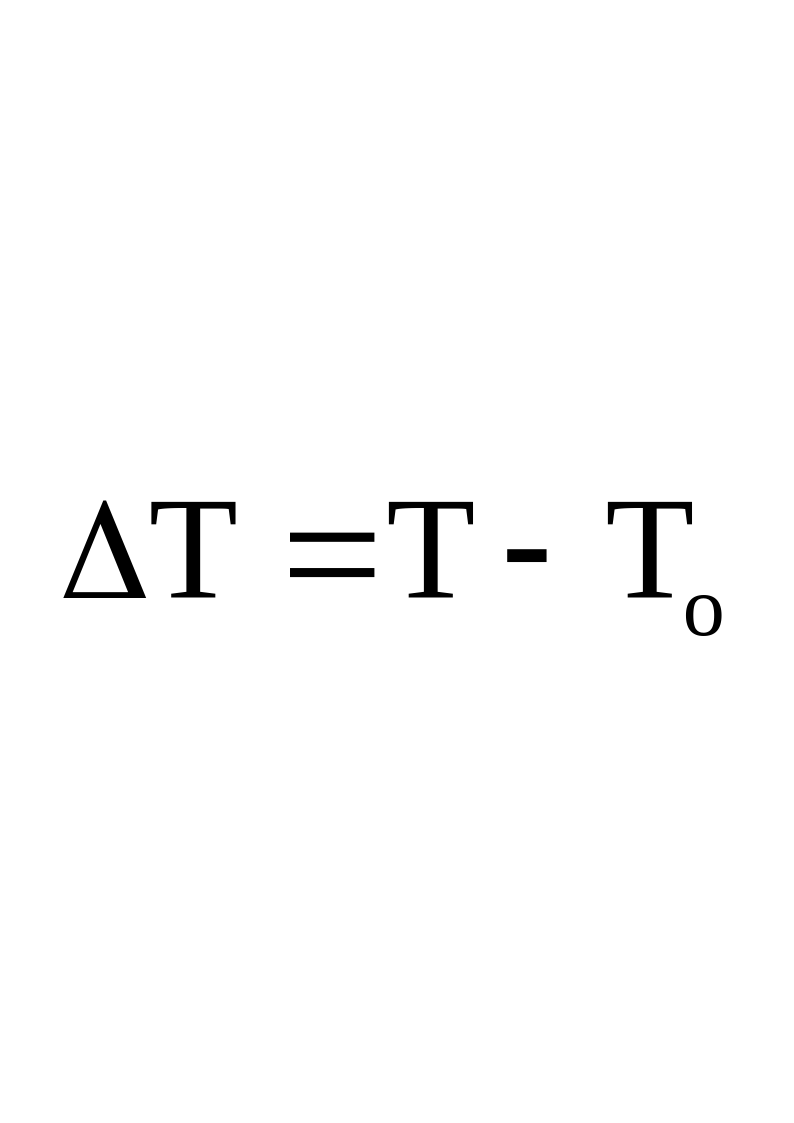
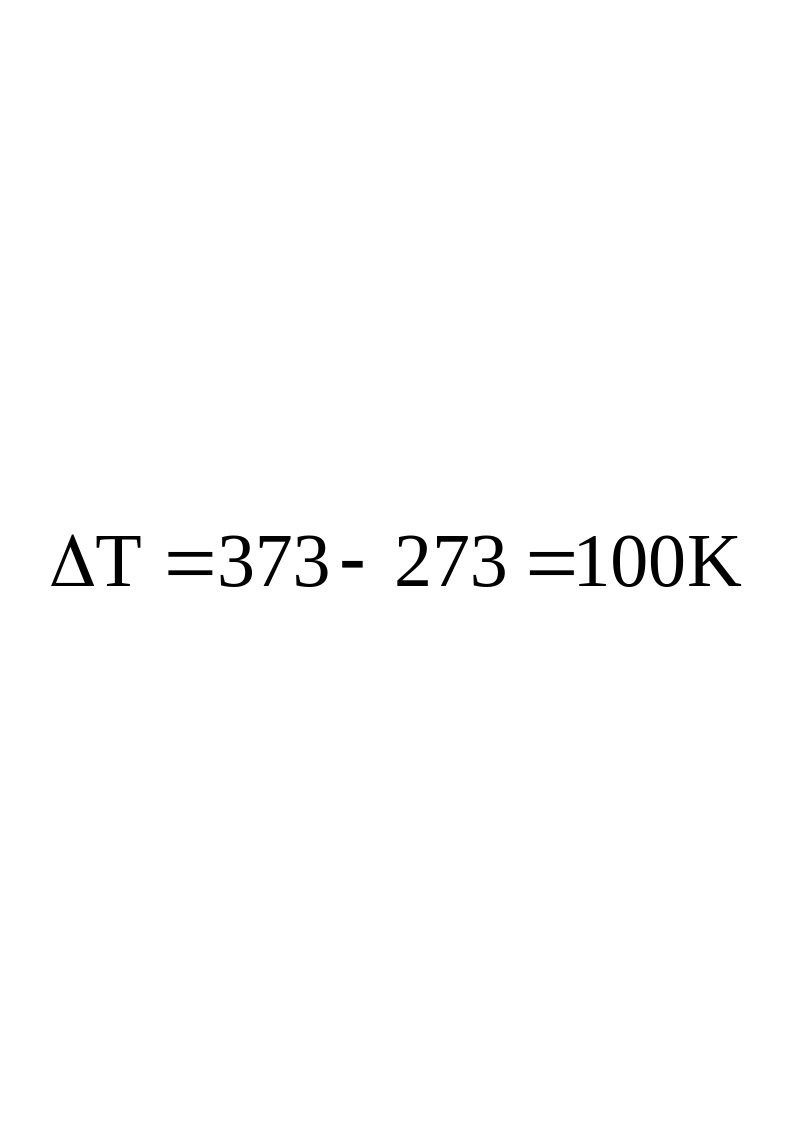
Change in temperature
Change in temperature
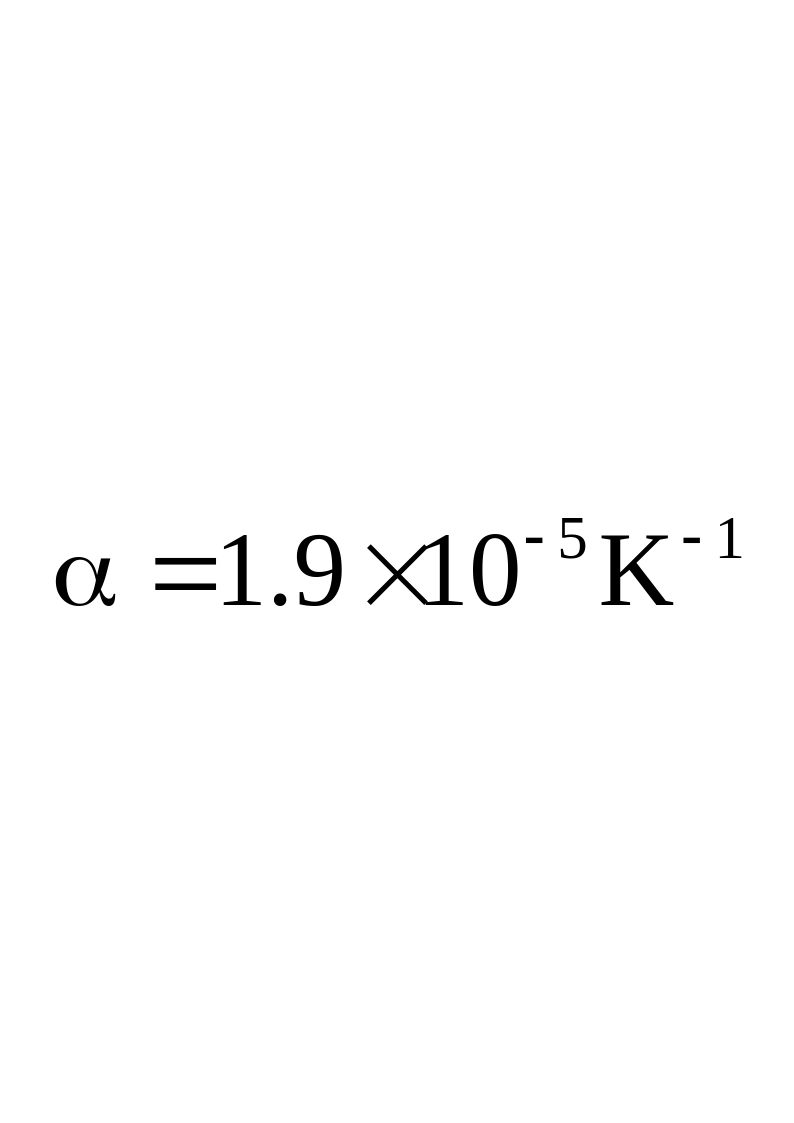
Coefficient of linear expansion of brass =
To Find:
Final volume of the brass cube = L =?
Calculations:
We know
Coefficient of linear expansion of brass =
We can find as
Putting values
Putting values
L = 1.0057 × 10⁻⁵ m3
Result:
Hence, the volume of brass cube at 100oC will be 1.0057×10⁻³m3.
TB Text Book Exercise
Long Questions
Q1. Define the term heat and temperature. (LHR 2013)
HEAT
Definition:
“Heat is the energy that is transferred from one body to the other in thermal contact with each other as a result of the difference of temperature”.
Quantity:
Heat is a derived and scalar quantity.
Unit:
SI unit of heat is Joule (J)
TEMPERATURE
Definition:
“Degree of coldness or hotness of the body is a measure of its temperature”
Quantity:
Temperature is a base and scalar quantity.
Unit:
SI unit of temperature is kelvin (K)
Q2. What is thermometer? Why mercury is preferred as thermometric substance?
THERMOMETER
Definition:
“The instrument which is used to measure the temperature is called a thermometer.”
Mercury The Best Thermometric Material:
Mercury is preferred as thermometric substance because
It has high boiling point i.e. 357°C
It has low melting point i.e. -39°C
It does not wet glass
It is good conductor
It is opaque
It has low heat capacity
Q3. Explain the volumetric thermal expansion.
See Q. 3 Long Question TOPIC 8.8
Q4. Define specific heat. How would you find the specific heat of a solid?
See Q. 1 ‘Long Question TOPIC 8.3
Q5. Define and explain latent heat of fusion.
See Q. 2 Long Question TOPIC 8.5
Q6. Define latent heat of vaporization.
See Q. 3 Long Question TOPIC 8.6
Q7. What is meant by evaporation? On what factors the evaporation of a liquid depends? Explain how cooling is produced by evaporation?
See Q. 1 Long Question TOPIC 8.7
Short Questions
Q1. Why does heat flow from hot body to cold body?
FLOW OF HEAT
Molecules of hot body have greater kinetic energy than the molecules of cold body. Therefore, fast moving molecules give their energy to cold body. So we can say that heat flows from hot body to the cold body. In other word we can say heat flows from hot body to cold body due to temperature difference between them.
Q2. What is meant by internal energy of a body?
INTERNAL ENERGY
Definition:
“The sum of kinetic energy and potential energy associated with the atoms, molecules and particles of a body is called its internal energy”.
Dependence:
Internal energy of a body depends on many factors such as the mass of the body, kinetic and potential energies of molecules etc. Kinetic energy of an atom or molecule is due to its motion which depends upon the temperature. Potential energy of atoms or molecules is the stored energy due to intermolecular forces.
Q3. How does heating affect the motion of molecules of a gas?
EFEECT OF HEAT ON GAS
The kinetic energy of gas molecules goes on increasing if a gas is heated continuously. This causes the gas molecules move faster and faster. The collisions between atoms and molecules of the gas become so strong that they tear off the atoms. Atoms lose their electrons and become positive ions. This ionic state of matter is called plasma.
In short on heating the gas, the motion of the molecules becomes faster. As a result average K.E and temperature of gas increases.
Numerical Problems
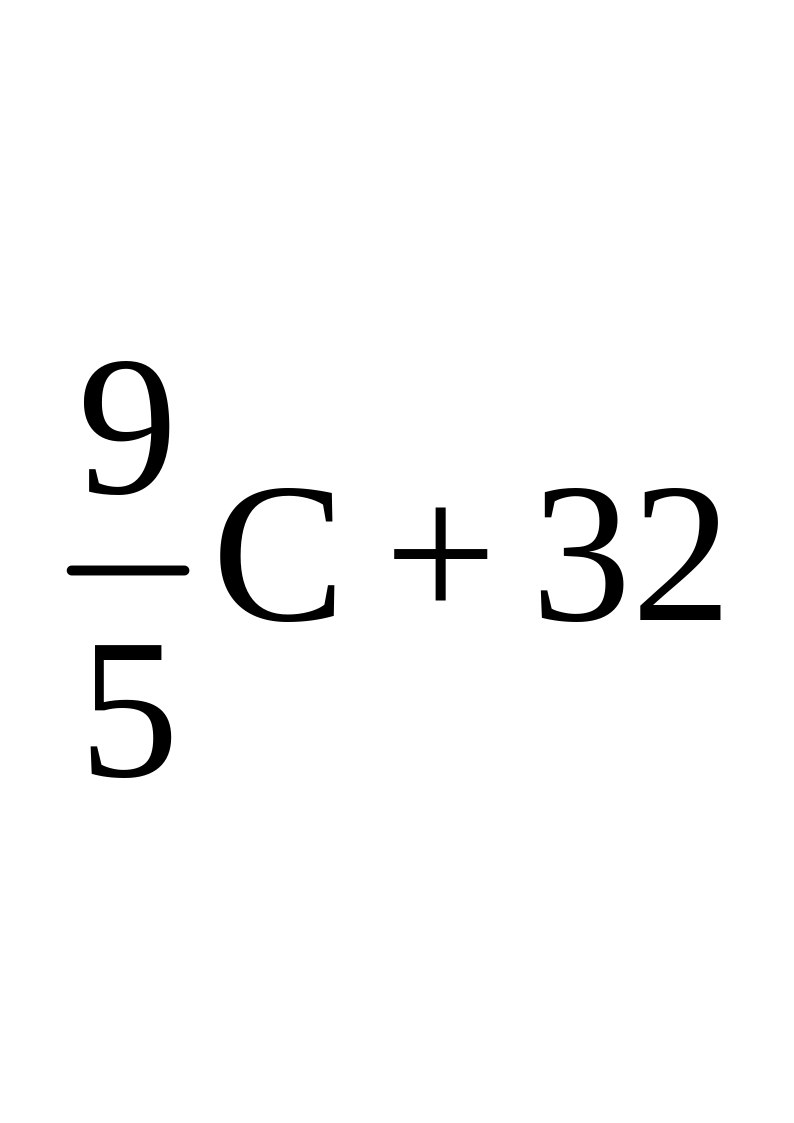
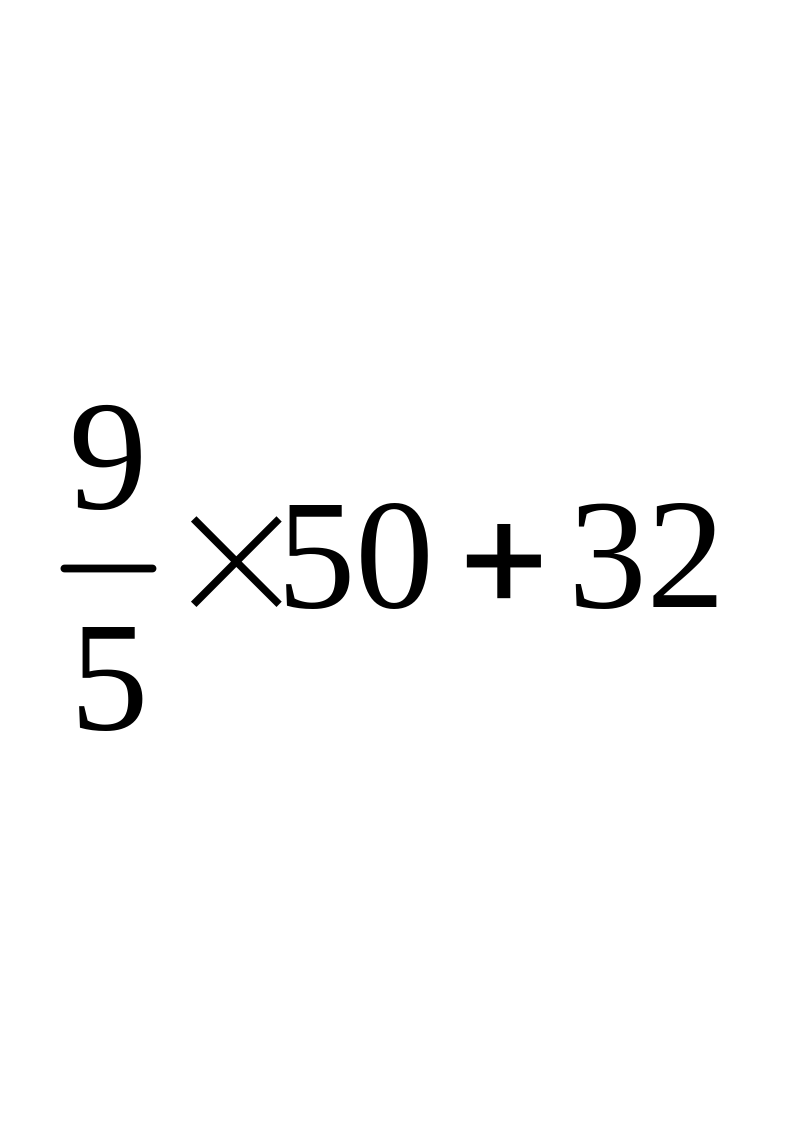
Numerical 1. Temperature of the water in beaker is 500C. What is its value in Fahrenheit scale?
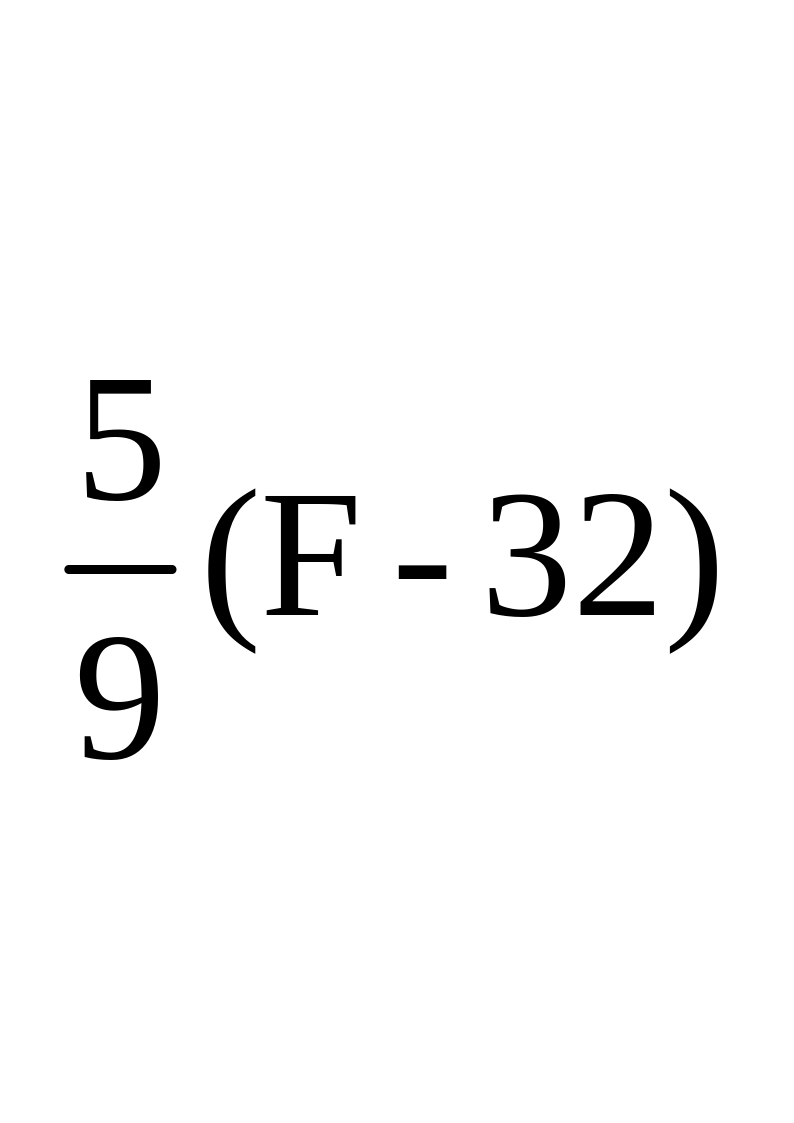
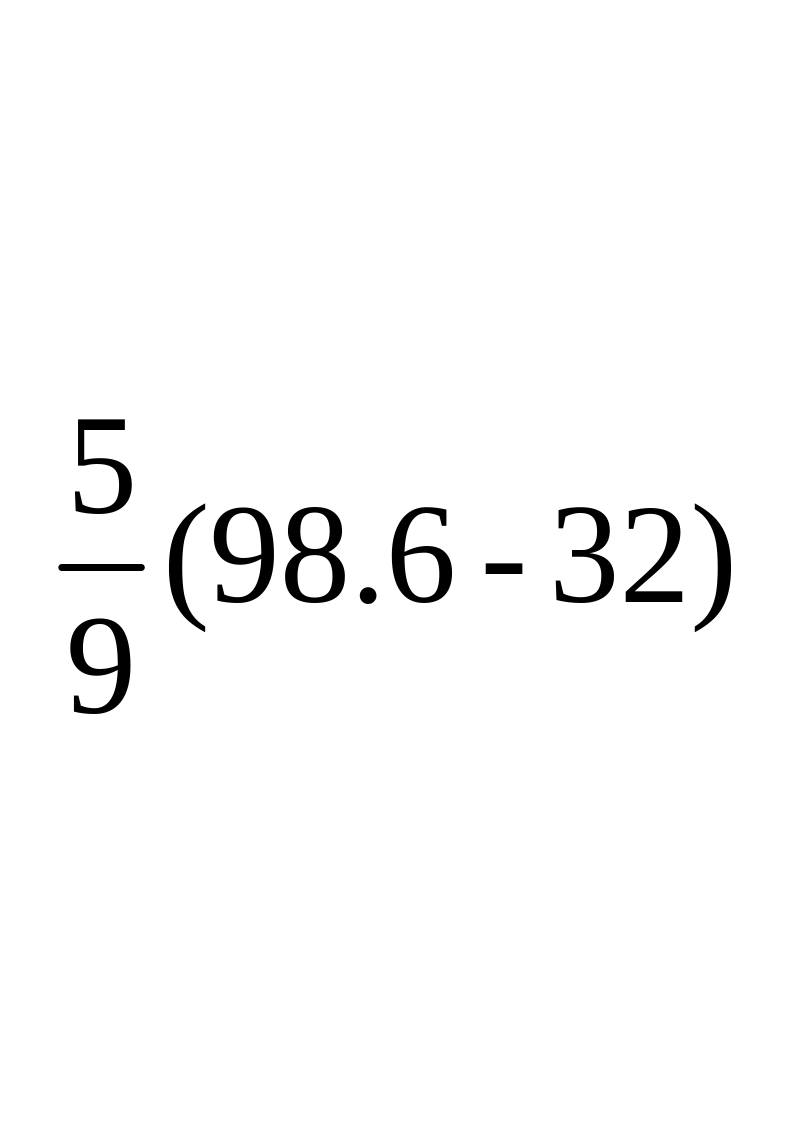
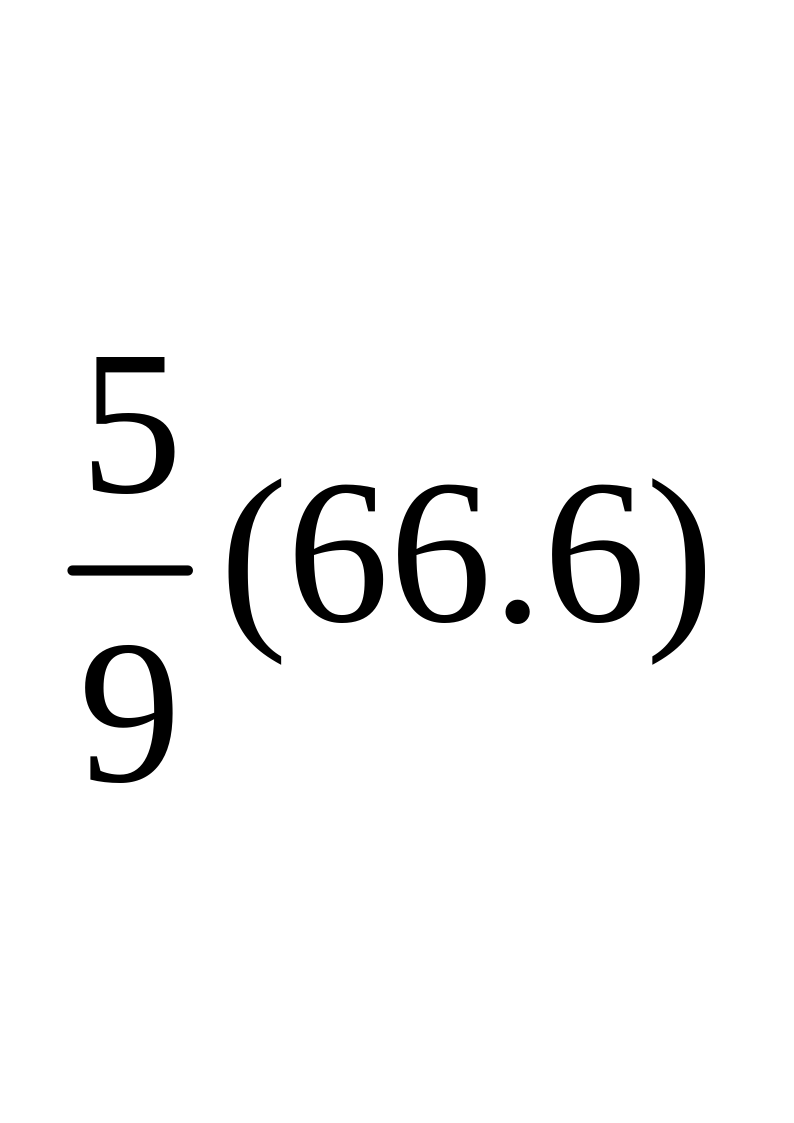
Given Data:
Temperature in Celsius = Tc = 500C
To Find:
Temperature in Fahrenheit = Tf = ?
Calculations:
Numerical 2. As we know that F = By putting the values, we have F = 90 + 32 F = 122 oF Result: Hence, the temperature in Fahrenheit will be 122°F. Normal human body temperature is 98.60 F. Convert it into Celsius and Kelvin scale. (GRW 2013, LHR 2013, 2015, 2017)
Given Data:
Normal human Temperature in Fahrenheit = Tf = 98.60 F
To Find:
Temperature in Celsius = Tc =?
Temperature in Kelvin = Tk =?
Calculations:
As we know that
C =
By putting the values, we have
C =
C =
C = 37 oC
As we know that
TK = C + 273
By putting the values, we have
TK = 37 + 273 = 310 K
TK = 310 K
Result:
Hence, the Temperature of normal human body in Celsius will be 37 oC and the temperature of normal human body in Kelvin will be 310 K.
Numerical 3. Calculate the increase in the length of an aluminium bar of 2m long when heated from 0°C to 20°C. If the thermal coefficient of linear expansion of aluminum is 2.5×10⁻⁵ K-1.
Given Data:
Length of aluminum bar = L1 = 2 m
Initial temperature = T1 = 0oC = (0 + 273) K = 273 K
Final temperature = T2 = 20oC = (20 + 273) K = 293 K
Coefficient of linear expansion of aluminum = α = 2.5 x 10⁻⁵ K-1
To Find:
Increase in length = L – Lo =?
Calculations:
As we know that
L – Lo = α Lo (T2 – T1)
By putting the values, we have
L – Lo = 2.5 x 10-5 x 2 x (293 – 273)
L – Lo = 5 x 10⁻⁵ (20)
L – Lo = 100 x 10-5
L – Lo = 1 x 10⁻³ m = 0.1 cm = 1 mm
Result:
Hence, the increase in length of Aluminum bar will be 1×10⁻³ m = 0.1 cm = 1 mm.
Numerical 4. A balloon contains 1.2 m3 of air at 15°C. Find its volume at 40°C. Thermal coefficient of volume expansion of air is 3.67×10⁻³ K-1.
Given Data:
Initial volume of air in balloon = V1 = 1.2 m3
Initial temperature = T1 = 150 C = (15 + 273) K = 288 K
Final temperature = T2 = 400 C = (40 + 273) K = 313 K
Coefficient of volume expansion = β = 3.67 x 10⁻³ K-1
To Find:
Final volume of gas = V2 = ?
Calculations:
As we know that
V = Vo (1 + β(T2 – T1))
By putting the values, we have
V = 1.2 (1 + 3.67 x 10-3 x (313 – 288))
V = 1.2 (1 + 3.67 x 10⁻³ (25))
V = 1.2 (1 + 91.75 x 10⁻³)
V = 1.2 (1 + 0.091)
V = 1.2 + 0.108 = 1.308 = 1.3 m3
Result:
Hence, the final volume of gas will be 1.3 m3.
Numerical 5. How much heat is required to increase the temperature of 0.5 kg of water from 10°C to 65°C. (LHR 2014 GRW 2015)
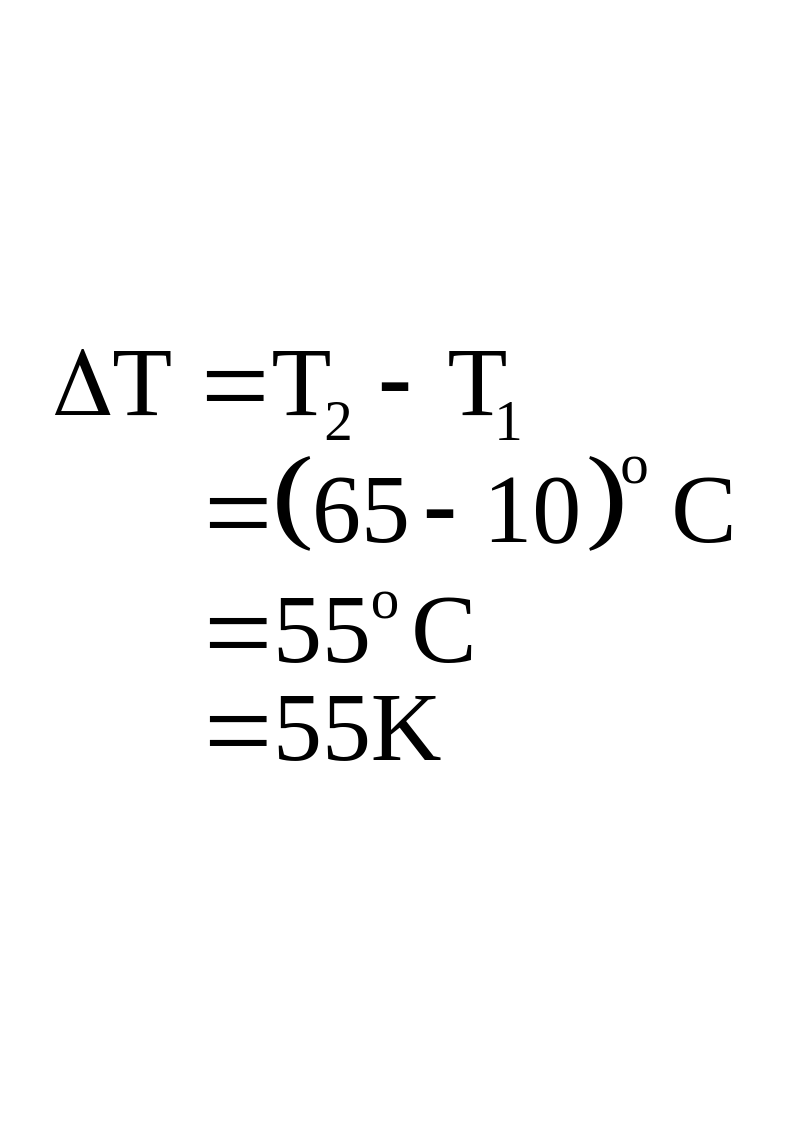
Given Data:
Mass of water = m = 0.5 kg
Initial temperature = T1 = 100 C
Final temperature = T2 = 650 C
Change in Temperature:
To Find:
Heat required = Q =?
Calculations:
As we know that
ΔQ = mcΔT
By putting the values, we have
ΔQ = 0.5 x 4200 x 55
ΔQ = 115500 J
Result:
Hence, the heat required will be 115500 J.
Numerical 6. An electric heater supplies heat at the rate of 1000 joule per second. How much time is required to raise the temperature of 200 g of water from 20°C to 90°C?
Given Data:
Rate of heat supplied by heat = P = 1000 Js-1
Mass of water = m = 200 g = 0.2 kg
Specific heat of water = c = 4200J
Initial temperature = T1 = 200 C
Final temperature = T2 = 900 C
Change in temperature = ΔT = 90 – 20 = 70o C = 70K
To Find:
Heat required = Q =?
Time = t =?
Calculations:
As we know that
Q = cm ΔT
Q = 0.2 x 4200 x 70
Q = 58800 J
As we also know that
P×t = Q
t = Q/P
t = 588000/1000
t = 58.8 s
Result:
Hence, the heat required will be 58800 J and the time taken will be 58.8 s.
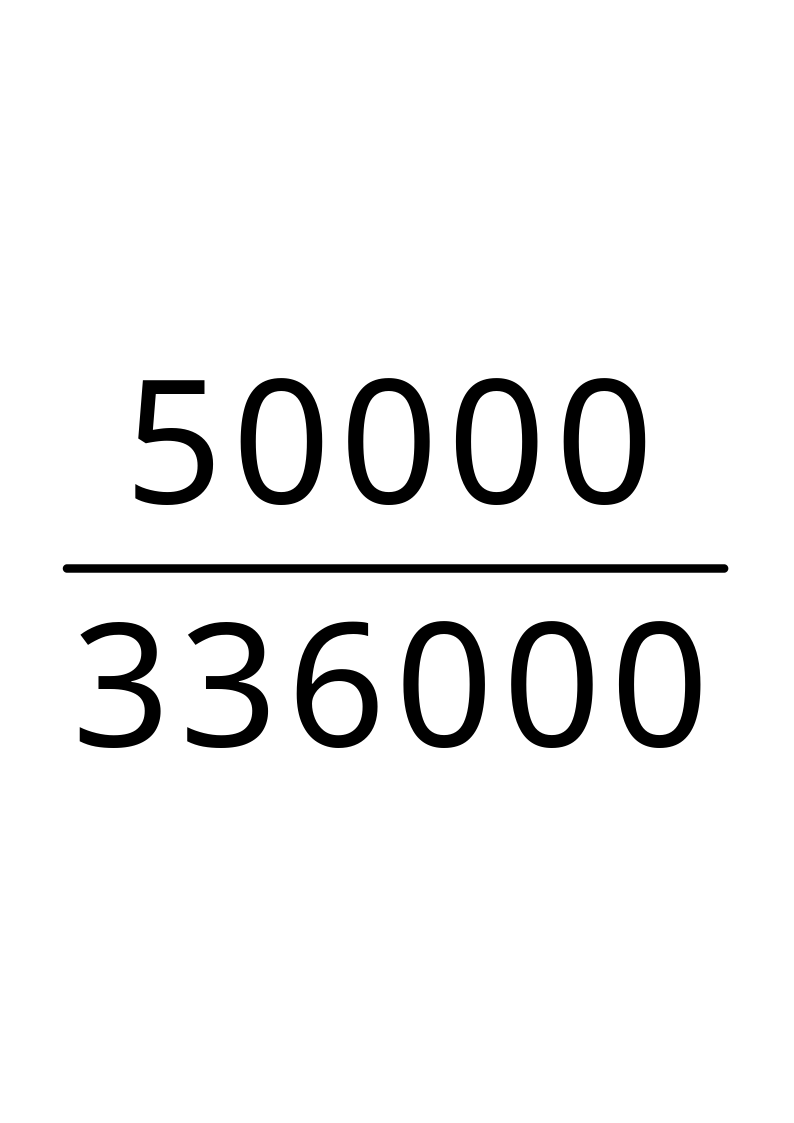
Numerical 7. How much ice will melt by 50000 J of heat? Latent heat of fusion of ice 336000 Jkg-1. (GRW 2013, 14)
Given Data:
Heat supplied to ice = ΔQf = 50000 J
Latent heat of fusion of ice = Hf = 336000 Jkg-1
To Find:
Mass of ice = m = ?
Calculations:
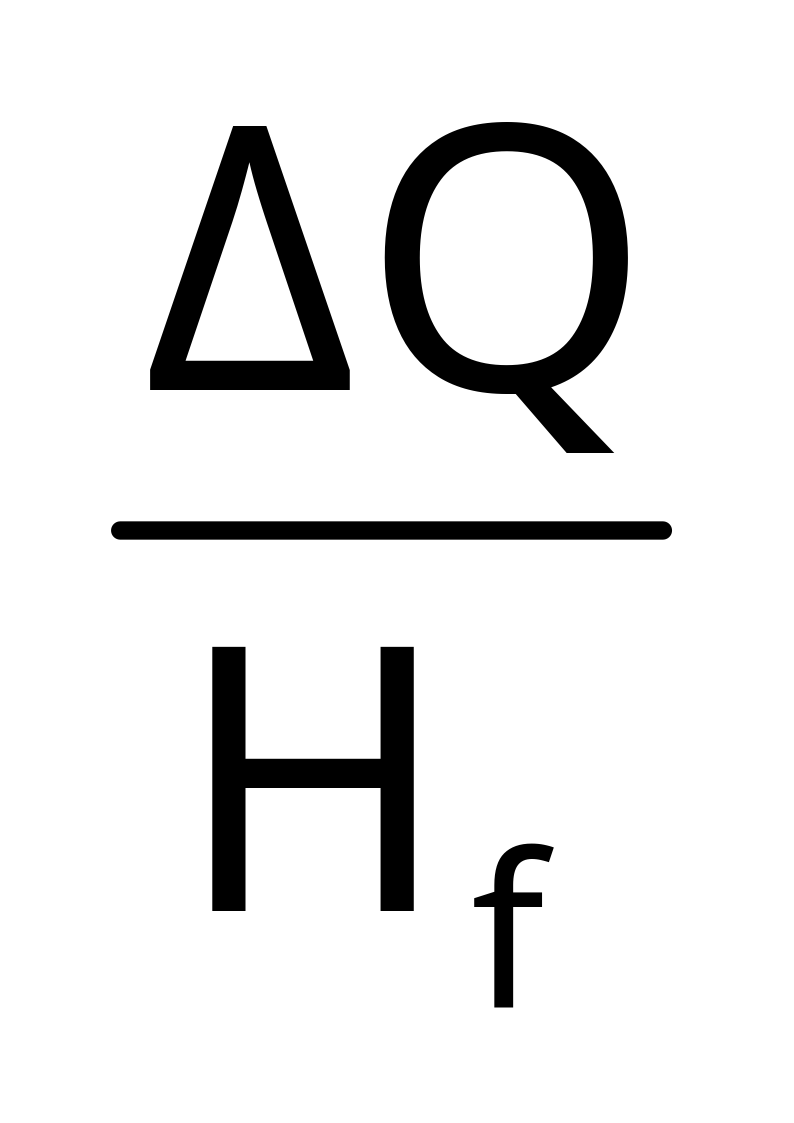
As we know that
ΔQ = m x Hf
So m =
By putting the values, we have
m =
m = 0.15 kg = 150 g
Result:
Hence, the mass of ice will be 150 g.
Numerical 8. Find the quantity of heat needed to melt 100 g of ice at -10°C to 10°C.
Given Data:
Mass of ice = m = 100 g = 0.1 kg
Specific heat of ice = 2100 JKg-1K-1
Specific heat of water = 4200 JKg-1K-1
Latent heat of fusion of ice = 336000 JKg-1K-1
Initial temperature of ice = T1 = -100 C
Final temperature = T2 = 100 C
To Find:
Heat required to raise the temperature of ice from –10°C to 10°C = Q = ?
Calculations:
Step-I:
Heat required to raise the temperature of ice from –10°C to 0°C = Q1 = ?
T1 = –10°C
T2 = 0°C
T = 0°C–(–10)°C = 10°C = 10 K
Q = cmT
Q1 = 2100 ×0.1×10
Q1 = 2100 J
Step-II:
Heat required to convert ice at 0°C into water at 0°C = Q2 =?
We know that
Q = mLf
Q2= 0.1 ×336000
Q2 = 33600 J
Step-III:
Heat required to raise temperature water from 0°C to 10°C = Q3 =?
T1 = 0°C
T2 = 10°C
T = 10°C –0°C = 10°C = 10K
We know that
Q = cmT
Q3 = 4200 ×0.1×10
Q3 = 4200 J
Total heat required = Q = Q1+Q2+Q3
Q = 2100+33600+4200
Q = 39900 J
Result:
Hence, the total heat required will be 39900 J.
Numerical 9. How much heat is required to change 100 g of water at 1000 C into steam? (LHR 2013, 2015)
Given Data:
Mass of water = m = 100 g = 0.1 kg
Temperature of water = T1 = 1000 C
Temperature of steam = T2 = 1000 C
Latent heat of vaporization of water = Hv = 2.26 x 10⁶ Jkg-1
To Find:
Heat required to change water into steam = Qv =?
Numerical 10. Find the temperature of water after passing 5 g of steam at 1000 C through 500 g of water at 10°C.
Given Data:
Mass of water = m1 = 500 g = 0.5 kg
Mass of steam = m2 = 5 g = 0.005 kg
Temperature of water = T1 = 100 C
Temperature of steam = T2 = 1000 C
Specific heat of water = c = 4200 Jkg-1K-1
Latent heat of vaporization of vaporization = Hv = 2.26×10⁶ Jkg-1
To Find:
Final temperature of water = T =?
Calculations:
According to law of heat exchange
Heat lost by steam = Heat gain by water
mHv + cmT = cmT
(0.005)(2.26×10⁶) + (4200)(0.005)(100–T) = (4200)(0.5) (T–10)
11300+21(100–T) = 2100(T–10)
11300+2100–21T = 2100T–21000
11300+2100+21000 = 2100T+21T
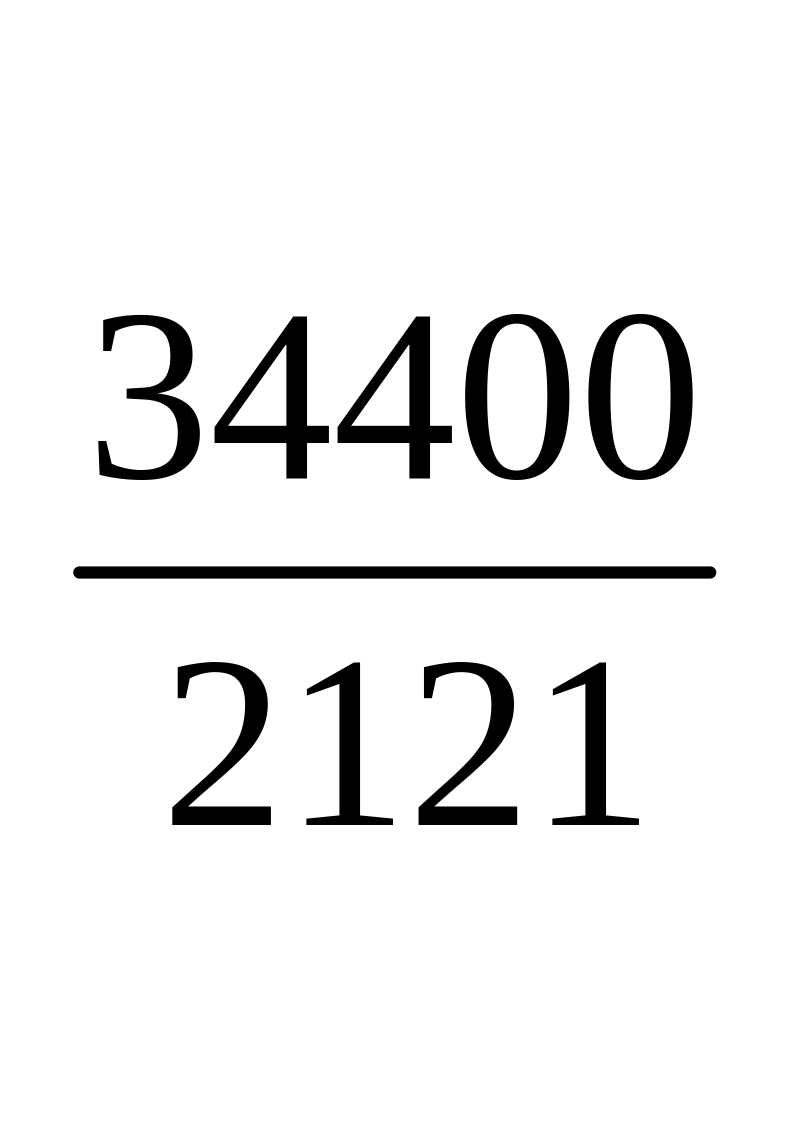
344400 = 2121T
T =
T = 16.2°C
Result:
Hence, the final temperature of water will be 16.2oC.
TB.ST Self Test
Long Questions
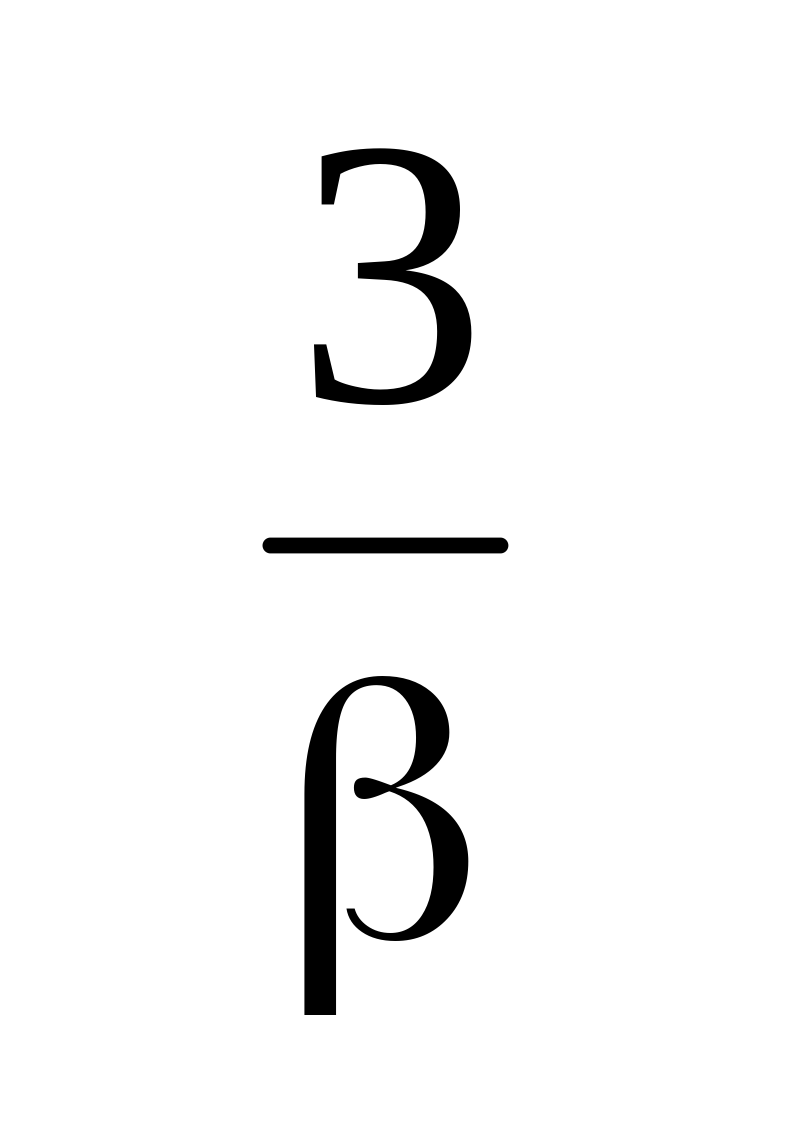
Q1. Explain volume thermal expansion in solids. Also derive the formula for volume expansion.
Q2. An electric heater supplies heat at the rate of 1000 joule per second. How much time is required to raise the temperature of 200g of water from 20 °C to 90 °C?
Q3. Note:
Q4. Parents or guardians can conduct this test in their supervision in order to check the skill of students.
Short Questions
Q1. What is thermostate? Write its uses.
Q2. How much ice will melt by 50,000 J of heat? Latent heat of fusion of ice is 336000 Jkg–1.
Q3. Why does ether evaporate quickly than water?
Q4. Why the temperature of ice does not change at 0°C for some time?
Q5. What happens when we touch a hot body?