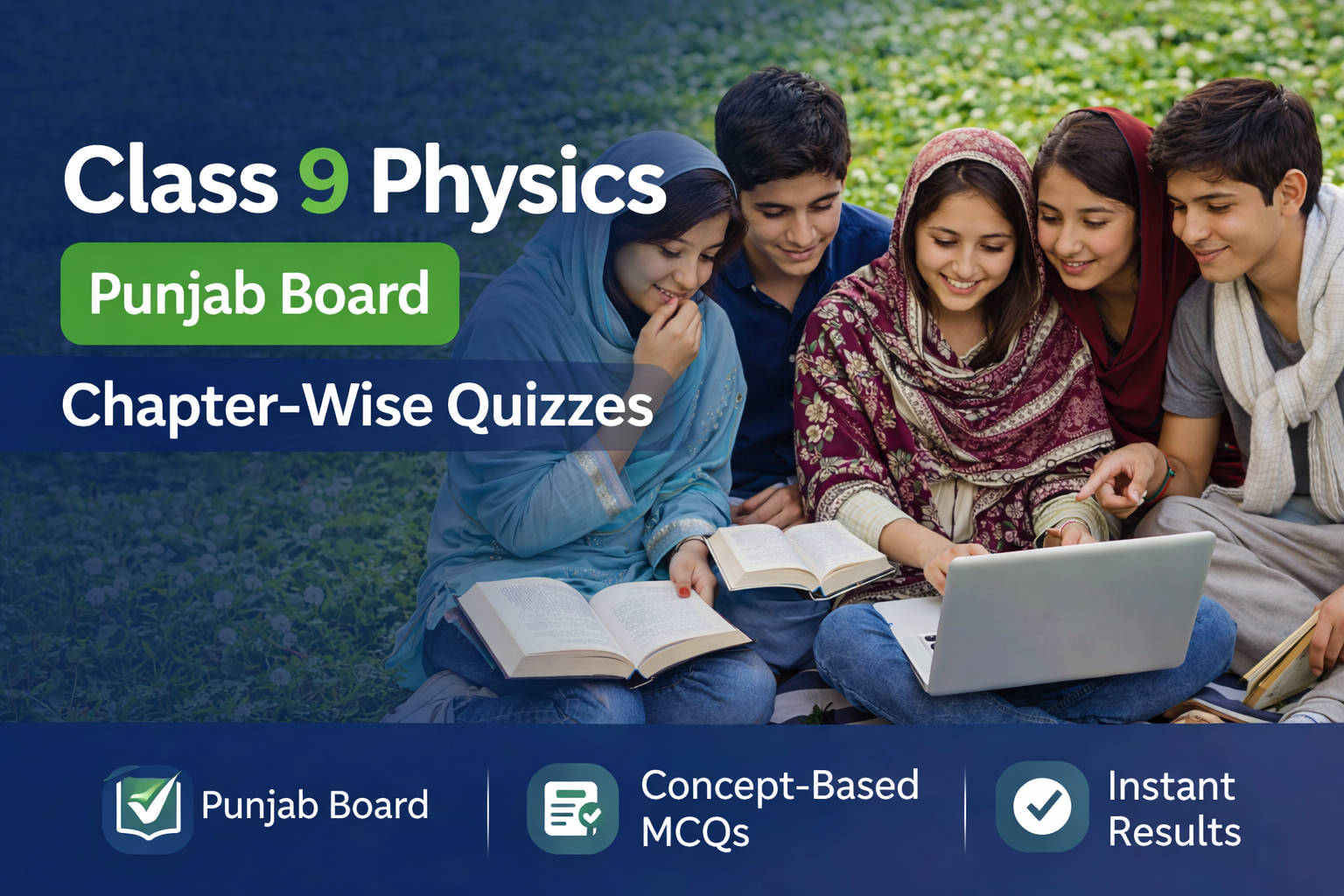
Class 9 Physics – Punjab Board (Chapter-wise Quizzes)
Wishlist Share
Share Course
Page Link
Share On Social Media

About Course

This course is designed to help Class 9 students of the Punjab Textbook Board strengthen their Physics concepts through chapter-wise practice quizzes based strictly on the latest syllabus.

All quizzes are prepared from the official Punjab Board Physics textbook, covering every chapter with concept-based MCQs, numerical understanding, and exam-oriented questions.

Students can attempt practice quizzes to test their understanding and chapter tests to evaluate exam readiness. Each quiz provides instant results, correct answers, and explanations to help students learn from their mistakes.

This course is ideal for:

  • Class 9 students preparing for school exams

  • Students who want regular Physics practice

  • Learners aiming to improve problem-solving skills and confidence

No videos or lectures are included — this course is purely focused on practice, assessment, and improvement through quizzes.

Show More

What Will You Learn?

  • Understand core concepts of Class 9 Physics through MCQ practice
  • Improve accuracy in physical quantities and measurement problems
  • Learn correct use of SI units, prefixes, and significant figures
  • Develop numerical problem-solving skills for board exams
  • Identify weak areas using instant quiz results
  • Build exam confidence through repeated practice

Course Content

Chapter 1: Physical Quantities and Measurement
The chapter covers fundamental physics concepts, measurement techniques, SI units, instruments, errors, significant figures, and scientific notation. Physical Quantities and Measurement Differentiates physical and non-physical quantities. Physical quantities have magnitude and units; non-physical do not. Examples include length, mass, time, temperature. Measurement compares unknown quantities with standards. Standard units are essential for consistency across countries and sciences. ​ International System of Units (SI) Consists of seven base units: meter, kilogram, second, kelvin, ampere, candela, mole. Derived units are formed from base units, e.g., speed (m/s), force (N). Prefixes (milli, centi, kilo, mega, giga) simplify large/small numbers. ​ Scientific notation expresses large/small numbers efficiently. ​ Measurement Instruments Instruments include metre rule, vernier callipers, screw gauge, measuring tape, balance, stopwatch, and volume cylinders. Least count indicates the smallest measurement an instrument can accurately record. ​ Zero error affects readings; correction is necessary. ​ Parallax error occurs if scales are read at an angle. ​ Errors and Uncertainty Types: human, systematic, random. Errors affect accuracy and precision. ​ Multiple readings improve reliability. Uncertainty is estimated based on instrument least count and measurement conditions. ​ Significant Figures and Rounding Significant figures indicate reliably known digits. ​ Zeros may or may not be significant based on position. ​ Rounding rules depend on the last digit and context. ​ Proper recording reflects measurement uncertainty. ​ Precision and Accuracy Precision: closeness of repeated measurements. ​ Accuracy: closeness to true value. ​ Both are essential for reliable scientific data. Time and Volume Measurement Instruments include clocks, stopwatches, sand clocks, measuring cylinders, displacement cans. ​ Digital and analog devices vary in precision. ​ Displacement method measures volume of irregular objects. ​ Additional Topics Errors in measurements and their correction. ​ Use of scientific notation and prefixes. ​ Repetitive natural phenomena as time standards. ​ Practical activities for measurement skills development.

Chapter 2: Kinematics
Chapter-wise MCQs covering distance, displacement, speed, velocity, acceleration, equations of motion, and graphical analysis for Class 9 Punjab Board Physics.

Chapter 3: Dynamics
Practice quizzes based on Newton’s laws of motion, inertia, momentum, force, friction, and applications as per the Punjab Board syllabus.

Chapter 4: Turning Effect of Forces
MCQs focusing on torque, moment of force, equilibrium, couple, and stability concepts from the Class 9 Physics Punjab Board textbook.

Chapter 5: Work, Energy and Power
Chapter-wise quizzes covering work, energy, power, kinetic and potential energy, and law of conservation of energy.

Chapter 6: Mechanical Properties of Matter
MCQs based on elasticity, density, pressure in solids, liquids, and gases according to the Punjab Board curriculum.

Chapter 7: Thermal Properties of Matter
Practice MCQs on temperature, heat, thermal expansion, and states of matter for Class 9 Physics students.

Chapter 8: Magnetism

Chapter 9: Nature of Science
Chapter-wise quizzes focusing on conduction, convection, radiation, and practical applications of heat transfer.

Earn a certificate

Add this certificate to your resume to demonstrate your skills & increase your chances of getting noticed.

selected template

Student Ratings & Reviews

No Review Yet
No Review Yet
Scroll to Top